Lesson 03 — Belonging, Solidarity, and Collective Responsibility: Local to Global
Learners close the unit — and the year — by weighing belonging, solidarity, and collective responsibility, and acting on them for people and the Earth. They weigh the three against one another to decide how to act for the common good, trace one real act from local to global, and gather the integrated self, the goal handoff, and this act of belonging into a single carried whole. The lesson ends in a celebration of each whole person, the solidary community, and the living Earth.
Objectives
Objectives
- D02.S3.12.02 Weigh belonging, solidarity, and collective responsibility in deciding how to act for the common good.
- D02.S4.12.02 Act on collective responsibility for people and the Earth, connecting local action to global solidarity.
Essential question
How do I weigh belonging, solidarity, and collective responsibility — and act on them for people and the Earth, from local action to global solidarity?
Key vocabulary
Materials
Standard materials
- Belonging-solidarity-responsibility weighing sheet · 1 per learner A three-pan balance — belonging (what holds me), solidarity (what holds us), collective responsibility (what we owe each other and the Earth) — with a line for the decision: 'so I will act by ___'
- Local-to-global chain sheet · 1 per learner A chain of four links — my local act, its immediate effect, its connection to distant people and ecosystems, its contribution to a global movement — plus a link to the living Earth
- Capstone portfolio cover · 1 per learner A one-page cover gathering the closing week's artifacts — the integrated self, the goal handoff, and this act of belonging — into one carried whole
Low-tech / no-cost
- Paper and pencil To draw the balance, trace the chain, and write the closing statement by hand
- Voice and body (or pen, screen, or hands) To share the closing line aloud, in writing, or in sign — no printed sheet needed
Enriched / lab & device
- One plain-language page on mutual aid and solidarity · 1 per pair A short page distinguishing charity from solidarity, where people meet one another's needs together as equals (Spade), to ground the weighing step
Works in different contexts
- large-group Weigh and trace individually, then a closing celebration circle where each learner shares one line of the whole they will carry — spoken, written, or signed
- multi-age Younger learners do "belonging" and one local act; older learners complete the full balance, the chain, and the closing statement
- self-directed A learner completes the balance, the chain, and the closing statement alone, then reads it aloud or silently (or signs/types it) to themselves as the year's final promise
- level-grouped A ready group also names the difference between charity and solidarity in their own act, and who shares the deciding
- outdoor-only Mark the nested rings on the ground and walk from self to community to world to living Earth, naming one act at each step; end gathered in a circle
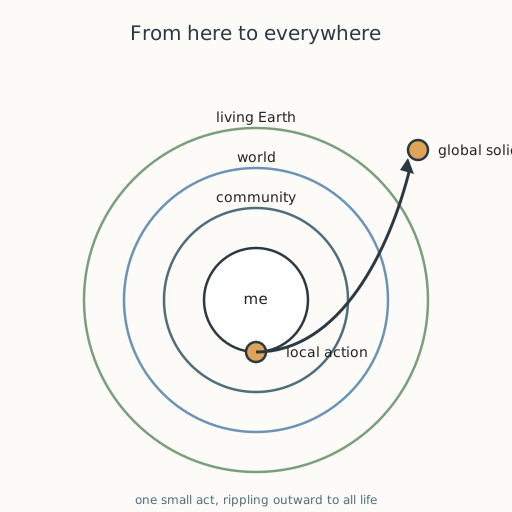
Lesson 3 — Belonging, Solidarity, and Collective Responsibility: Local to Global
Summary
Learners close the unit — and the year — by weighing belonging, solidarity, and collective responsibility, and acting on them for people and the Earth. They weigh the three against one another to decide how to act for the common good, trace one real act from local to global, and gather the integrated self, the goal handoff, and this act of belonging into a single carried whole. The lesson ends in a celebration of each whole person, the solidary community, and the living Earth.
Objectives
- Weigh belonging, solidarity, and collective responsibility in deciding how to act for the common good. (D02.S3.12.02)
- Act on collective responsibility for people and the Earth, connecting local action to global solidarity. (D02.S4.12.02)
Connection
A single seed, planted on one street, is a local act; the shade, the soil, the bees, and the trees people plant because they saw yours are the global one. Belonging is what holds you close; solidarity is what holds you together with others; collective responsibility is what you owe to people you will never meet and to the Earth itself. Today you weigh the three, act on them, and — because this is the last lesson of the year — you gather everything you have become into one whole and hand it to the world.
Materials
- Belonging-solidarity-responsibility weighing sheet
- Local-to-global chain sheet
- Capstone portfolio cover
- Paper and pencil (low-tech); voice, body, pen, screen, or hands (low-tech)
- Mutual-aid page (enriched)
Preparation
- Copy or draw the weighing sheet (three-pan balance + decision line) and the chain sheet (four links + a link to the living Earth).
- Retrieval: from the community-and-care arc, the nested rings, the weighing of solidarity, the ethic of care, mutual aid, and the local-to-global chain (D02.S3.12.02, D02.S4.12.02). Today they are gathered, weighed, and acted on once more, as the year’s close.
- Prepare a model weighing and chain (worked example first: Kirschner, Sweller & Clark, S-011), and hold the whole as a celebration, not a test — the closing gathers every learner’s path with joy and dignity, never a ranking.
Facilitator note
This lesson is written to the learner (“you”). The idea to land: belonging, solidarity, and collective responsibility are three different pulls, and acting for the common good means weighing them — then turning the decision into one real act that connects here to everywhere, and to the Earth. This is the year’s final lesson: a celebration and a handoff, not new content. Model once, then let each learner weigh and trace their own (S-011); the gathering is retrieval across the whole year, the spacing payoff in full (Dunlosky et al., S-039).
The ethics lens: weighing what holds me, what holds us, and what we owe is the year’s moral core, now completed. The egalitarianism lens: solidarity is shared deciding, not a one-way gift — the lesson distinguishes mutual aid from charity, where people meet one another’s needs as equals (Spade, S-345), and names mutual aid as a documented, widespread human practice (Kropotkin, S-163), held here as description, not as a claim that helping is good. The global lens: the lesson honors the world’s named traditions of pulling together — harambee, gotong royong, mink’a/minga, barn-raising (S-164) — as living ways communities already connect local action to a shared life, never as specimens. The technology lens: tools can carry solidarity across distance or narrow it into an echo; the chain’s “global” link can travel by hand, by letter, by screen — the learner chooses the carrier and names its limit. The environment lens: the outermost ring is the living Earth, not a backdrop — the ethic of reciprocity with the more-than-human world (Kimmerer, S-427) and the idea that a life’s work can return to the land rather than only take from it (circular economy, S-452) close the year where flourishing is mutual.
Safeguarding: this is a celebration, not a competition. Every learner’s act — grand, modest, or still being found — is honored; no one is required to name a family, a cause, or a trauma, and a learner may share only the part they choose. The closing circle holds each whole person with joy and dignity.
Procedure
- Retrieve the year (8 min). Without opening your journal, write the tools of the community-and-care arc from memory: the nested rings, the weighing of solidarity, the ethic of care, mutual aid, the local-to-global chain. Then check against your journal (retrieval: S-039).
- Meet the three pulls (6 min). Read the model weighing (S-011). Belonging — what holds me close. Solidarity — what holds us together. Collective responsibility — what we owe people we will never meet and the Earth itself. Acting for the common good weighs all three; none cancels the others.
- Weigh and decide (12 min). On the three-pan balance, name one real pull for each, and write one decision: so I will act by ___. Say whether your act shares the deciding with others or only gives — and lean it toward solidarity (S-345).
- Trace local to global (12 min). On the chain, write your local act, its immediate effect, its connection to distant people and ecosystems, and its contribution to a global movement — then one link to the living Earth. One act from a tradition you know or learn (S-164) may stand beside your own.
- Gather the whole (10 min). On the portfolio cover, bring together this week’s three artifacts — the integrated self, the goal handoff, this act of belonging — and write one closing line: the person and citizen of the living world you are handing to adult life.
- Celebrate (7 min). In a closing circle, each person who wishes shares one line of the whole they will carry — spoken, written, or signed. Receive every path with the same joy; end in the shared silence or sound of having arrived together.
Differentiation
- Support: Name “belonging” and one local act, trace the chain in two links, and write a one-line closing; share one line — spoken, written, or signed.
- Extension: Write a one-page “solidarity plan” — one act you will begin this month, with who shares the deciding and one way you will check the effect on people and the Earth.
- Communication access: Every step — weighing, tracing, gathering, sharing, or celebrating — can be done in writing, sign, gesture, typing, or AAC instead of speech. Learners who are non-speaking, d/Deaf, hard-of-hearing, or who use AAC complete every task in their preferred mode; no step requires hearing or producing sound. A learner who is blind or has low vision completes the balance and chain through spoken description, dictation, or a tactile organizer.
- Number access (dyscalculia): No arithmetic is required. “Three pulls” and “four links” are simple counts the sheets already structure with labeled boxes, so no learner needs to hold numbers in mind to complete the weighing or the chain.
Assessment
- Summative + portfolio (unit): The completed weighing sheet, the local-to-global chain, and the capstone portfolio cover with the closing line — assessed for a real weighing (does the decision weigh all three pulls?), a real connection (does the act actually reach beyond the local?), and honesty, never for the size of the act or agreement with any view.
- Self + peer + performance: The shared closing line and the celebration circle, received without ranking.
Home connection
Share your closing line with someone who matters to you — read it aloud, or show them the written or signed version — and ask them to remind you of it in a year. Write one sentence on what they said, and one act you will begin this month.
Resources
- On mutual aid as a documented, widespread human practice: Kropotkin, Mutual Aid (S-163); on named traditions of pulling together — harambee, gotong royong, mink’a/minga, barn- raising: communal-work traditions (S-164).
- On the difference between charity and solidarity, where people share the deciding: Spade, Mutual Aid (S-345).
- On reciprocity with the living world: Kimmerer, Braiding Sweetgrass (S-427); on a life’s work returning to the land: Ellen MacArthur Foundation, the circular economy (S-452).
- On worked examples and guided practice: Kirschner, Sweller & Clark (2006) (S-011); on spaced retrieval across the year: Dunlosky et al. (2013) (S-039).