Lesson 02 — My Meaningful Life Goal: Handing Myself to Adult Life
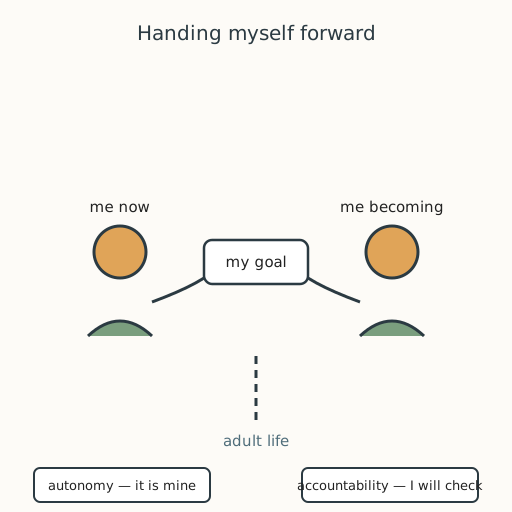
Learners close the self-and-agency arc by handing their meaningful life goal to the adult they are becoming. They retrieve the goal and plan they set earlier in the year, renew them with one honest update, and name the two handles that make the handoff real: autonomy (it is mine, not borrowed) and accountability (a named check and a date). They sign the goal over in a short promise and celebrate it — with no pressure to have a perfect goal.
Objectives
Objectives
- D01.S3.12.01 Exercise self-directed agency by setting, planning, and acting on a meaningful life goal with autonomy and accountability.
Essential question
How do I hand my meaningful life goal — set, planned, and acted on with autonomy and accountability — to the adult I am becoming?
Key vocabulary
Materials
Standard materials
- Goal-handoff sheet · 1 per learner A one-page frame with four lines — my goal, why it matters, my next step (with a date), and who or what will hold me accountable — and a space to sign it over
- Capstone journal · 1 per learner The year-long notebook holding the chosen goal and plan, now renewed and handed forward
Low-tech / no-cost
- Paper and pencil To write the handoff and sign it over by hand
- Voice and body (or pen, screen, or hands) To speak, write, or sign the handoff to a partner — no printed sheet needed
Enriched / lab & device
- One plain-language page on goal setting and feedback · 1 per pair A short page explaining that specific goals with a way to check progress work better than vague wishes (Locke & Latham), to ground the renew-and-check step
Works in different contexts
- large-group Renew the plan individually, then a handoff circle where each learner states their goal and one next step to a partner who will listen — spoken, written, or signed
- multi-age Younger learners name a goal and one next step; older learners complete the full handoff sheet, the autonomy/accountability pair, and the promise
- self-directed A learner renews the plan, writes the handoff, and reads it aloud or silently (or signs/types it) to themselves as a promise they make to themselves
- level-grouped A ready group also writes one honest answer to "what would make me abandon this goal, and how will I not?" — the stress-test of the promise
- outdoor-only A threshold (a doorway, a gate, a line in the earth) marks the crossing; step across it while stating the goal and the next step — spoken, written, or signed
Lesson 2 — My Meaningful Life Goal: Handing Myself to Adult Life
Summary
Learners close the self-and-agency arc by handing their meaningful life goal to the adult they are becoming. They retrieve the goal and plan they set earlier in the year, renew them with one honest update, and name the two handles that make the handoff real: autonomy (it is mine, not borrowed) and accountability (a named check and a date). They sign the goal over in a short promise and celebrate it — with no pressure to have a perfect goal.
Objectives
- Exercise self-directed agency by setting, planning, and acting on a meaningful life goal with autonomy and accountability. (D01.S3.12.01)
Connection
When you hand something you have made — a key, a letter, a tool — to the person who will carry it next, you trust them with it, and you also promise them something about how it will be kept. Today you are both people at once: the one who made the goal and the adult who will carry it. The handoff is small but it is what turns a wish into a life: it is mine, and there is a check on it.
Materials
- Goal-handoff sheet
- Capstone journal
- Paper and pencil (low-tech); voice, body, pen, screen, or hands (low-tech)
- Goal-setting page (enriched)
Preparation
- Copy or draw the goal-handoff sheet (my goal / why it matters / next step + date / who or what will hold me accountable / signature line).
- Retrieval: from earlier in the year, the chosen meaningful goal and the plan (milestones, an if-then for the hard moment, a first step, an accountability check) built in the self-and-agency arc (D01.S3.12.01). Today they are renewed and handed forward.
- Prepare a model handoff (worked example first: Kirschner, Sweller & Clark, S-011), and hold the goal explicitly as the learner’s own, never prescribed — a goal may be modest, unfolding, or still being found, and “I am still finding mine” is a complete and honored handoff.
Facilitator note
This lesson is written to the learner (“you”). The idea to land: a meaningful life goal is handed to adult life with two handles — autonomy (it is genuinely mine, not borrowed from a parent, a feed, or a fear) and accountability (a named check and a date) — and the handoff is a promise, not a grade. There is no new heavy content; this is consolidation and a closing ceremony. Model once, then let each learner renew their own (S-011); the renewal is retrieval across months, the spacing payoff in action (Dunlosky et al., S-039). Specific, checkable goals with feedback outperform vague wishes (Locke & Latham, S-223) — that is the evidence behind the “next step + date + named check.”
The ethics lens: choosing a goal worth the cost of pursuing it is a moral act, not just a practical one — the learner names what they will give their life toward. The egalitarianism lens: every path is honored — no goal outranks another, and a learner with a modest, uncertain, or still-forming goal is celebrated exactly as fully as one with a grand plan; the pressure to have a “perfect” life goal is refused, not required. The global lens: what a meaningful life looks like differs across cultures and lives — a goal of care for family, land, craft, or community is as valid as any ambition, and the lesson does not import one region’s template of “success.” Some traditions name the good life as living well rather than endlessly accumulating: Andean buen vivir (sumak kawsay, “living well”) holds a meaningful life as one lived in harmony with community and the living Earth (S-509) — a different shape of “meaningful” from a self-made ambition, and equally honored. The technology lens: name one tool that will serve the goal and one that will tempt it — the handoff includes a decision about technology, as the earlier carried-ethic lessons did. The environment lens: a meaningful goal may serve the living world, and the lesson leaves room for it — the full return to people and the Earth arrives in Lesson 3.
Safeguarding: the goal is the learner’s own and may be private; no one is required to name a goal tied to family, money, or a marginalized identity, and “still finding it” is a complete answer. The promise is shared only in the part the learner chooses.
Procedure
- Retrieve the goal and plan (8 min). Without opening your journal, write your meaningful goal, its next step, and your accountability check from memory. Then open your journal and see what you recalled and what drifted (retrieval: S-039).
- Meet the handoff (6 min). Read the model handoff (S-011). It has four lines — my goal, why it matters, my next step (with a date), who or what will hold me accountable — and a signature. The two handles are named: autonomy (it is mine) and accountability (it is checked).
- Renew the plan (12 min). Update one thing honestly: a milestone, a date, an if-then for the hard moment, or the next step. A living goal is revised, not frozen — and “still finding it” can be the whole entry.
- Write the handoff (12 min). Fill the sheet in your own words, and sign it over from “me now” to “me becoming.” Keep it specific and checkable (S-223).
- Make the promise (10 min). With a partner, speak, write, or sign your goal and your next step. Your partner listens and asks one question: what will you do first, and when? Then trade places.
- Celebrate (7 min). In a circle, each person who wishes shares one line of their handoff. Receive every path with the same joy — the grand, the modest, and the still being found.
Differentiation
- Support: Name a goal and one next step with a date; write a two-line handoff; share one line — spoken, written, or signed.
- Extension: Write a one-page letter to your future self, sealed to reopen in a year, naming where this goal will be tested and what you will do then.
- Communication access: Every step — recalling, renewing, writing, signing, promising, or celebrating — can be done in writing, sign, gesture, typing, or AAC instead of speech. Learners who are non-speaking, d/Deaf, hard-of-hearing, or who use AAC complete every task in their preferred mode; no step requires hearing or producing sound. A learner who is blind or has low vision completes the handoff through dictation or a spoken promise rather than a printed sheet.
- Number access (dyscalculia): No arithmetic is required. A date can be named in words (“before the next harvest,” “this week”) rather than numbers, and the sheet already structures the four lines, so no learner needs to hold numbers in mind to complete the handoff.
Assessment
- Summative + portfolio (unit): The signed goal-handoff sheet, filed as a closing capstone artifact — assessed for autonomy (is it genuinely theirs?) and accountability (is there a named check and a date?), never for the size or impressiveness of the goal.
- Self + peer: Did the learner renew one element, state a specific next step, and name an accountability check? Shared without ranking.
Home connection
Share your handoff with someone at home — read it aloud, or show them the written or signed version — and ask them to check in with you at the date you named. Write one sentence on what they said.
Resources
- On specific, checkable goals with feedback: Locke & Latham (1990) (S-223).
- On worked examples and guided practice: Kirschner, Sweller & Clark (2006) (S-011); on spaced retrieval across the year: Dunlosky et al. (2013) (S-039).
- On self-kindness when a goal is still being found: Neff, Self-Compassion (S-222).
- On a non-Western shape of the good life — living well in harmony with community and the Earth: buen vivir / sumak kawsay (S-509).