Lesson 03 — Feelings Come and Go
Learners discover that feelings change: they arrive, stay a while, and pass — and that this is okay. They retell a feeling that came and went.
Objectives
Objectives
- D01.S1.K.01 Name and identify basic feelings (happy, sad, angry, scared, calm) in self and others.
- D01.S1.K.02 Describe a feeling using words, a drawing, or a movement.
Essential question
What happens to a feeling over time?
Key vocabulary
Materials
Standard materials
- Feeling face cards (from Lesson 1) · 1 set Reuse the five feeling faces
- Paper and crayons · per learner
- A soft ball or rolled cloth · 1 To pass around while taking turns talking
Low-tech / no-cost
- Voice and body Act out a feeling "arriving," "growing," and "leaving" with the whole body; no cards needed
- A small stone or seed Hold it while you tell about a feeling that came and went
Enriched / lab & device
- A picture book about changing feelings · 1 Any gentle story where a character's feeling changes from start to end
- A tablet with a drawing app · 1 per pair Learners draw a feeling "then" and "now" side by side
Works in different contexts
- large-group Pass the soft ball around the circle; each learner finishes the sentence "I felt ___, and then it ___."
- self-directed A learner thinks of a feeling from earlier today, draws it, then draws how it changed by now
- outdoor-only Watch clouds or shadows change shape and pass; connect it to how a feeling can move on too
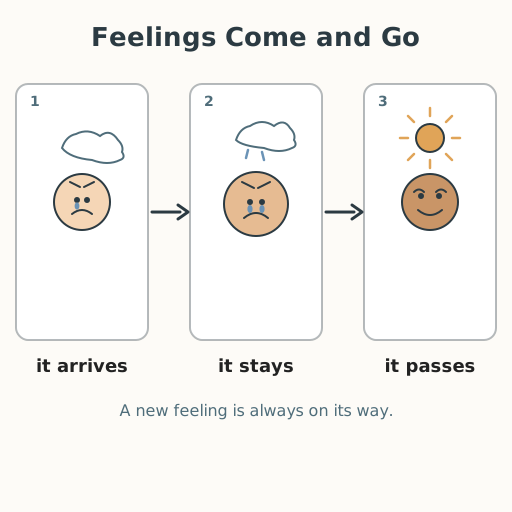
Lesson 3 — Feelings Come and Go
Summary
Learners explore how feelings move and change over time. A feeling arrives, stays for a while, and then passes — and another one comes. They practice retelling a feeling that came and went, and learn that change is okay.
Objectives
- Name and identify basic feelings (happy, sad, angry, scared, calm) in self and others. (D01.S1.K.01)
- Describe a feeling using words, a drawing, or a movement. (D01.S1.K.02)
Connection
Think of a time you were sad, and then later you felt better. Or angry, and then a hug or a game made it soften. Feelings are like weather: rain comes, and then the sun comes out again. No feeling lasts forever.
Materials
- Feeling face cards (happy, sad, angry, scared, calm)
- Paper and crayons
- A soft ball or rolled cloth to pass around
Preparation
- Reuse or redraw the feeling face cards.
- Arrange a circle so the ball can pass from learner to learner.
- Prepare a gentle sentence frame to share aloud.
Facilitator note
This lesson is written to the learner (“you”) so it works in a classroom and for a self-directed learner. As facilitator, model first: tell your own “I felt ___, and then it ___” story. Keep it light — this lesson is about the natural passing of feelings, not about fixing or judging them. If a learner shares something heavy, honor it calmly and help them notice it softened or passed.
Procedure
- Gather (5 min). Sit in a circle. Think of a feeling you had today. Does it still feel the same now?
- Watch feelings move (10 min). Look at the feeling cards. A feeling is like a guest: it knocks, it stays a while, and then it goes. Act it out — happy arrives (big smile), happy grows (jump), happy leaves (soft and still).
- A feeling story (15 min). Pass the ball. When it comes to you, finish this sentence: “I felt ___, and then it ___.” (Example: “I felt angry when my turn was skipped, and then it went away when I played.”)
- Draw then and now (10 min). On paper, draw a feeling you had earlier, and beside it, draw how you feel now. They can be different.
- Close (5 min). Remember: feelings come and go. That is okay. A new feeling is always on its way.
Differentiation
- Support: Offer two feeling cards to choose from and a partner to help finish the sentence.
- Extension: Invite learners to tell a “before, during, after” story of one feeling with three quick drawings.
Assessment
- Formative (observation): Can the learner retell a feeling that changed using “and then”?
- Artifact (portfolio): The “then and now” drawing.
Resources
- CASEL SEL Framework (foundational competencies): https://casel.org/fundamentals-of-sel/
Home connection
At home, ask a grown-up to tell you about a feeling they had today that changed. Take turns telling your “I felt ___, and then it ___” stories.