Lesson 04 — Finding Feelings in Others
Learners practice reading feelings in other people by noticing faces, voices, and bodies — and learn to check their guess by asking kindly.
Objectives
Objectives
- D01.S1.K.01 Name and identify basic feelings (happy, sad, angry, scared, calm) in self and others.
Essential question
How can I tell how someone else is feeling?
Key vocabulary
Materials
Standard materials
- Feeling face cards (from Lesson 1) · 1 set Reuse the five feeling faces
- A mirror (optional) · 1
- Paper and crayons · per learner
Low-tech / no-cost
- Real faces and voices Use a friend's face, voice, and body as the "card"; no materials needed
- A partner game One learner makes a feeling, the other names it — then swap
Enriched / lab & device
- A short silent video or picture set of faces · 1 Learners watch faces without sound and guess the feeling
- A set of face photos from the class · 1 set Real photos of learners showing each feeling, to sort and match
Works in different contexts
- large-group One volunteer stands in the middle and shows a feeling with face, voice, and body; the group guesses and then checks by asking
- self-directed A learner looks at a picture or thinks of a person, guesses the feeling from face and body, and writes or draws the clue
- outdoor-only In pairs, one learner stands far away and shows a feeling using only their body (no face or words); the other guesses from the body shape
Lesson 4 — Finding Feelings in Others
Summary
Learners practice noticing how other people show feelings through their face, voice, and body. They learn that a guess is not always certain — so we check kindly by asking.
Objectives
- Name and identify basic feelings (happy, sad, angry, scared, calm) in self and others. (D01.S1.K.01)
Connection
You can often tell how a friend is feeling before they say a word. A smiling mouth, a quiet voice, shoulders that drop — these are clues. People show feelings in many ways, so we look, listen, and then ask to be sure.
Materials
- Feeling face cards (happy, sad, angry, scared, calm)
- A mirror (optional)
- Paper and crayons
Preparation
- Reuse the feeling face cards.
- Clear space for partners to face each other.
- Prepare the checking question: “Are you feeling ___?”
Facilitator note
This lesson is written to the learner (“you”) so it works in a classroom and for a self-directed learner. As facilitator, emphasize three clue-spots: face, voice, body. Model guessing gently and checking by asking. Remind learners that faces and voices show feelings differently in different families and cultures — a guess is a guess, and asking is how we learn.
Procedure
- Gather (5 min). Sit with a partner. Look at each other’s faces. What might your partner be feeling? Do not say it yet.
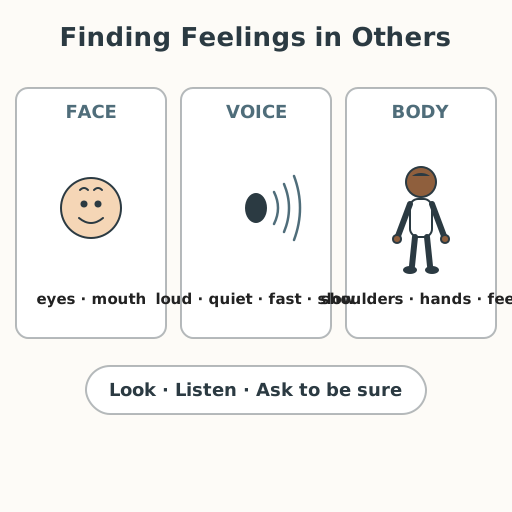
- Three clue-spots (10 min). Feelings show in three places: the face (eyes, mouth), the voice (loud, quiet, fast, slow), and the body (shoulders, hands, feet). Look at the feeling cards and find the clues on each face.
- Guess and check (15 min). One partner secretly chooses a feeling and shows it with face, voice, and body. The other guesses: “Are you feeling sad?” Then check: “Yes!” or “No, I’m feeling tired.”
- Draw the clues (10 min). Choose one feeling. Draw a face with that feeling, and add a voice word (like “quiet” or “loud”) and a body clue (like “shoulders down”).
- Close (5 min). Remember: look, listen, and ask. Asking kindly helps us know for sure.
Differentiation
- Support: Offer two feeling cards to choose between when guessing.
- Extension: Invite learners to show the same feeling two different ways and ask a partner which was easier to read.
Assessment
- Formative (observation): Can the learner name a feeling from a face, voice, or body clue and check their guess?
- Artifact (portfolio): The feeling-clue drawing.
Resources
- CASEL SEL Framework (foundational competencies): https://casel.org/fundamentals-of-sel/
Home connection
At home, play the guessing game with a family member: show a feeling with your face and body, let them guess, then check by asking. Swap turns.