Lesson 05 — Many Ways to Say a Feeling
Learners discover that one feeling can be shown many ways — with words, a drawing, a movement, or a sound — and choose the way that fits them best.
Objectives
Objectives
- D01.S1.K.02 Describe a feeling using words, a drawing, or a movement.
Essential question
How many ways can I show one feeling?
Key vocabulary
Materials
Standard materials
- Feeling face cards (from Lesson 1) · 1 set Reuse the five feeling faces
- Paper and crayons · per learner
- A simple drum, shaker, or clapped hands · as available For making a feeling into sound
Low-tech / no-cost
- Voice and body Words, faces, and movements need no tools at all
- Found objects to tap or shake A cup, a seed pod, or two sticks can make a feeling sound
Enriched / lab & device
- A tablet with a drawing app and a sound recorder · 1 per group Learners record a feeling as a drawing, a sound, and a short spoken word
Works in different contexts
- large-group Call out a feeling; half the group shows it with movement while the other half shows it with sound, then swap
- self-directed A learner picks one feeling and shows it three ways — a word, a drawing, a movement — then explains each to a grown-up or in a journal
- outdoor-only Find something in nature that says a feeling — a rustling leaf for calm, a sharp stick-shape for angry — and share what you found
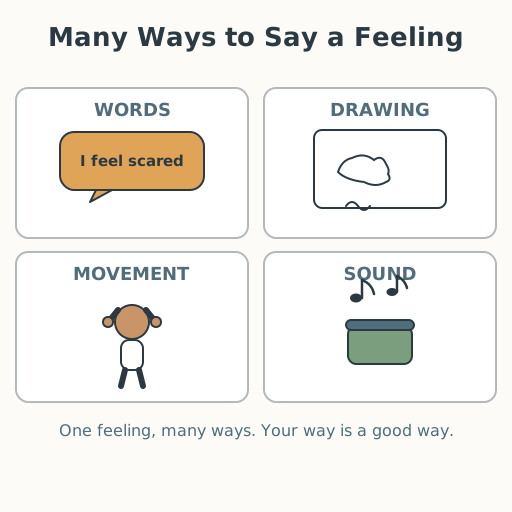
Lesson 5 — Many Ways to Say a Feeling
Summary
Learners explore the many “languages” of feeling: words, drawings, movement, and sound. They practice showing one feeling in several different ways and discover that every person has ways that fit them best.
Objectives
- Describe a feeling using words, a drawing, or a movement. (D01.S1.K.02)
Connection
People everywhere show feelings in different ways. Some sing when they are happy, some dance, some draw, some tell a friend. There is no single right way — your way is the one that helps you be understood.
Materials
- Feeling face cards (happy, sad, angry, scared, calm)
- Paper and crayons
- A simple drum, shaker, or clapped hands (optional)
Preparation
- Reuse the feeling face cards.
- Clear space for movement and sound.
- Gather any simple sound-makers, or plan to use voices and bodies.
Facilitator note
This lesson is written to the learner (“you”) so it works in a classroom and for a self-directed learner. As facilitator, honor every “language” — a quiet learner may prefer drawing to dancing. The point is choice and expression, not performance. If learners speak different languages at home, invite them to share a feeling word in their home language — every word is welcome.
Procedure
- Gather (5 min). Look at the feeling cards. How many ways can you show “happy” without saying the word “happy”?
- Four languages (15 min). A feeling can travel four ways: words (“I feel scared”), drawing (a wobbly line, a dark cloud), movement (hide your face, shrink small), and sound (a soft “oh,” a stomp, a drum tap). Try “happy,” “sad,” and “angry” in all four ways.
- Choose your way (15 min). Pick one feeling. Show it three ways — word, drawing, and movement. Which one felt easiest? Which helped you be understood best?
- Share (10 min). With a partner or the group, show your feeling in your favorite way. Can others guess it?
- Close (5 min). Remember: many ways, one feeling. Your way is a good way.
Differentiation
- Support: Offer two ways to choose from (word or movement) instead of all four.
- Extension: Invite learners to combine two languages — a movement with a sound — and explain why they chose them.
Assessment
- Formative (performance): Can the learner show one feeling in at least two different ways (word, drawing, movement, or sound)?
- Artifact (portfolio): The feeling drawing from “Choose your way.”
Resources
- CASEL SEL Framework (foundational competencies): https://casel.org/fundamentals-of-sel/
- Yale Center for Emotional Intelligence, RULER approach (feeling words and the Mood Meter): https://www.rulerapproach.org/
Home connection
At home, teach a family member the four “languages” of feeling and play the guessing game — show a feeling in sound or movement and let them name it.