Lesson 06 — What Makes Me Me
Learners name what makes each of them unique — their name, a favorite thing, something they can do, their people — and celebrate it.
Objectives
Objectives
- D01.S2.K.01 Share one thing that makes them unique and one thing they share with others.
Essential question
What makes me me?
Key vocabulary
Materials
Standard materials
- Paper and crayons · per learner
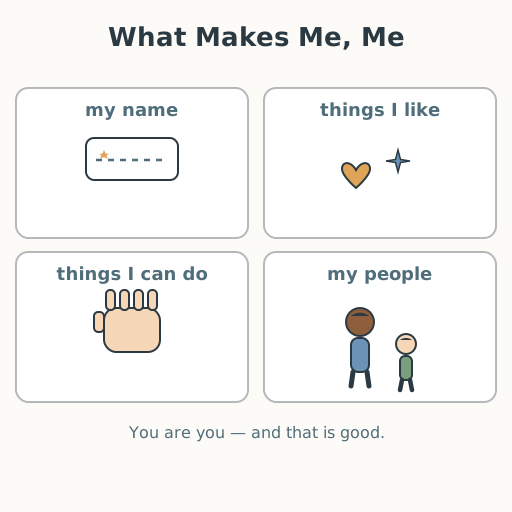
- A "Me" sheet with empty spaces · 1 per learner Spaces for a name, a favorite thing, a thing I can do, and my people
Low-tech / no-cost
- Voice and body Learners tell about themselves aloud or with a movement; no paper needed
- A stick or finger in sand or soil Draw one thing that makes you "you" in the dirt
Enriched / lab & device
- A mirror and printed photos (optional) · per learner A photo of the learner to paste on the "Me" sheet
- A tablet with a drawing app · 1 per pair Make a digital "Me" page with colors and shapes
Works in different contexts
- large-group Each learner shares one thing that makes them unique in a go-around; the group echoes "you are you, and that is good"
- self-directed A learner fills in the "Me" sheet alone, then reads or shows it to a grown-up or older learner
- outdoor-only Each learner finds one natural object that reminds them of themselves — a tall stem, a round stone — and tells why
Lesson 6 — What Makes Me Me
Summary
Learners explore what makes each person one-of-a-kind: their name, the things they like and love, the things they can do, and the people who care for them. They build the first page of a “Me” collage.
Objectives
- Share one thing that makes them unique and one thing they share with others. (D01.S2.K.01)
Connection
No one else in the whole world is exactly like you. Your name, your favorite food, the song you love, the way you laugh — these are yours. At the same time, you share some things with everyone else, and both are worth celebrating.
Materials
- Paper and crayons
- A “Me” sheet with empty spaces (name, favorite thing, something I can do, my people)
Preparation
- Draw or print a “Me” sheet for each learner, or fold plain paper into four spaces.
- Think of one example to share first — the facilitator models being “me.”
Facilitator note
This lesson is written to the learner (“you”) so it works in a classroom and for a self-directed learner. As facilitator, model first by sharing something about yourself. Keep the frame broad and kind: “unique” is about what a learner chooses to share, not about ranking or comparing. Avoid asking learners to label themselves in ways that feel private. Every answer is welcomed equally.
Procedure
- Gather (5 min). Think: what is one thing that is true about you and no one else here? It could be your name, a favorite thing, or something you can do.
- Four corners of me (15 min). Look at your “Me” sheet. Fill each space: your name, one thing you like or love, one thing you can do, and the people who care for you. Draw or tell each one.
- Share one (10 min). Choose one thing that makes you you, and share it with a partner. Listen to theirs too. Notice how different they are — and how good that is.
- A hand of me (10 min). Trace your hand. On each finger, draw one thing that makes you you. Five fingers, five things.
- Close (5 min). Remember: you are you, and that is good. No one else can be you.
Differentiation
- Support: Offer two prompts at a time and allow a single drawing instead of four.
- Extension: Invite learners to add a sixth thing to their hand and describe why they chose it.
Assessment
- Formative (portfolio): Can the learner name at least one thing that makes them unique?
- Artifact (portfolio): The “Me” sheet and hand tracing, saved for the Lesson 10 celebration.
Resources
- CASEL SEL Framework (foundational competencies): https://casel.org/fundamentals-of-sel/
Home connection
Ask the grown-ups at home to tell you one thing that makes you you. Add it to your “Me” sheet the next day.