Lesson 08 — Brushing My Teeth
Learners practice brushing their teeth step by step, learn when and how long to brush, and discover why clean teeth help a body eat, talk, and smile.
Objectives
Objectives
- D03.S4.K.01 Show a self-care routine (washing hands, brushing teeth) and tell when to ask a grown-up for help.
Essential question
How do I care for my teeth?
Key vocabulary
Materials
Standard materials
- A toothbrush and toothpaste · per learner Each learner's own brush (or a demonstration brush)
- A cup of water · per learner For rinsing
- A large tooth model or a picture · 1 To show how to brush every surface
Low-tech / no-cost
- A clean finger and water Where there is no brush, cleaning teeth with a clean finger and water, or a chewing stick, also helps — teach what is available
- Voice and body Practice the brushing motion on your own teeth with your finger while saying the steps; no brush needed to learn
Enriched / lab & device
- Disclosing or timing aids · 1 set A two-minute timer or a song so learners brush long enough
- A tooth model with large teeth · 1 Practice the brushing motion on a big model before doing it on real teeth
Works in different contexts
- large-group Demonstrate on a big model or picture, then have the whole group practice the motion with a finger while singing a brushing song
- self-directed A learner brushes their own teeth following the steps, singing a song to time two minutes, then checks in a mirror if one is available
- outdoor-only Brush at an outdoor tap or with a cup of water; practice the circular motion with a finger or a clean twig if no brush is available
- multi-age Older learners demonstrate the steps and help younger ones reach back teeth and rinse without swallowing
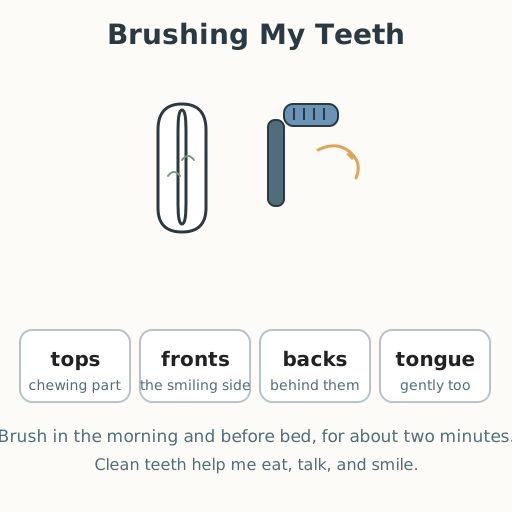
Lesson 8 — Brushing My Teeth
Summary
Learners practice brushing their teeth step by step — morning and night, all surfaces, for about two minutes — and discover that clean teeth help a body eat, talk, and smile. They learn that people around the world keep teeth clean in different ways.
Objectives
- Show a self-care routine (brushing teeth) with growing independence. (D03.S4.K.01)
Connection
Your teeth work hard every day — biting, chewing, and helping you talk and smile. They are a part of your body worth caring for. People everywhere clean their teeth, though not all the same way: some use a brush and paste, some use a clean finger, and in many places people have long used a small chewing stick. Caring for teeth is caring for your body.
Materials
- A toothbrush and toothpaste (each learner’s own, or a demonstration brush)
- A cup of water for rinsing
- A large tooth model or picture
Preparation
- Ensure each learner has their own clean toothbrush (never share brushes).
- Set up a place to practice, with water and a place to spit safely.
- Have a two-minute song ready to time the brushing.
Facilitator note
This lesson is written to the learner (“you”). As facilitator, never share toothbrushes and supervise so toothpaste is not swallowed. Honor every context: where brushes or paste are unavailable, teach a clean-finger or chewing-stick method without shame. Where a learner cannot brush their own teeth, a caregiver or older peer can help — the goal is clean teeth, not doing it alone.
Procedure
- Gather (5 min). Smile at a friend. Your teeth help you eat, talk, and smile. Today you will learn to care for them.
- Meet the toothbrush (5 min). Hold your brush. A little water and a small dab of toothpaste is all you need — a dot the size of a pea.
- Learn the steps (10 min). Practice the motion with your finger first:
- Brush the tops (the chewing part) with small circles.
- Brush the fronts.
- Brush the backs.
- Brush the tongue side gently too.
- Spit out the foam — do not swallow the paste.
- Brush for real (15 min). Brush your own teeth, going around every part. Sing a short song in your head — about two minutes is enough. Rinse with a little water.
- When do we brush? (5 min). Name the times: in the morning and before bed. Share with a partner one time you will remember.
- Close (5 min). Feel your teeth with your tongue — smooth and clean. Clean teeth are a way of saying “I care for my body.”
Differentiation
- Support: Practice with a finger first, then brush together; use a picture card showing the steps.
- Extension: Invite learners to make up their own two-minute brushing song and to count how many teeth they can feel with their tongue.
Assessment
- Formative (observation): Can the learner show the brushing steps and name one time to brush, with growing independence?
- Self: The learner feels their teeth and reports whether they feel clean.
Resources
- World Health Organization, “Oral health” (caring for teeth and mouth): https://www.who.int/news-room/fact-sheets/detail/oral-health