Lesson 03 — Asking for a Turn with Kind Words
Learners practice asking for a turn with kind words — "please" and "may I" — and discover that kind words make asking and waiting feel better for everyone.
Objectives
Objectives
- D02.S1.K.01 Take turns and share materials during play with a gentle reminder.
Essential question
How do kind words help us ask for a turn?
Key vocabulary
Materials
Standard materials
- A few popular toys or objects · 1 set Things worth wanting, so asking feels real
- A "kind words" poster or cards · 1 Pictures of "please," "may I," and "thank you"
Low-tech / no-cost
- Voice and body Practice saying the kind words aloud with a partner, no props needed
- A shared object to ask for One found object that learners take turns asking to use
Enriched / lab & device
- A puppet or doll · 1 The puppet models asking with kind words, then the learner tries
- A recording device · 1 Learners record themselves asking with kind words and listen back
Works in different contexts
- large-group Chant the kind words together, then have pairs practice while the group listens for "please" and "may I"
- self-directed A learner practices asking a grown-up or sibling with kind words and notices how it changes the answer
- outdoor-only Ask to borrow a digging stick or a ball using kind words before a shared game begins
- multi-age An older learner asks a younger one to share, modeling the words, then invites the younger to try
- level-grouped Learners who are ready add "thank you" after their turn; others practice just "please"
Lesson 3 — Asking for a Turn with Kind Words
Summary
Learners learn that grabbing gets one thing, while kind words build friendship. They practice asking for a turn with “please” and “may I,” and see how kind words change the way asking and waiting feel.
Objectives
- Take turns during play with a gentle reminder, using kind words to ask. (D02.S1.K.01)
Connection
When you want a toy someone else is using, you can grab — or you can ask with kind words. “Please, may I have a turn?” sounds very different from a snatch, and it makes the other person much more likely to say yes. Kind words are a small tool that makes asking fair and friendly.
Materials
- A few popular toys or objects
- A “kind words” poster or cards (please, may I, thank you)
Preparation
- Choose a couple of objects everyone will want.
- Post or hold the “kind words” cards where all can see them.
- Arrange pairs for practice.
Facilitator note
This lesson is written to the learner (“you”) so it works in a classroom and for a self-directed learner. As facilitator, model the words warmly and often, and praise the asking — not just the outcome. If a learner says no to a request, honor that too: asking with kindness does not force a yes, and both voices matter. Every language and culture has its own kind words — invite learners to share how they ask kindly in the languages they speak at home, so the skill, not the English phrase, is the point.
Procedure
- Gather (5 min). Think of a time you really wanted a toy someone else had. What did you do? What could you say instead of grabbing?
- Meet the kind words (10 min). Learn two phrases: “please” and “may I have a turn?” Say them together. Listen to how gentle they sound.
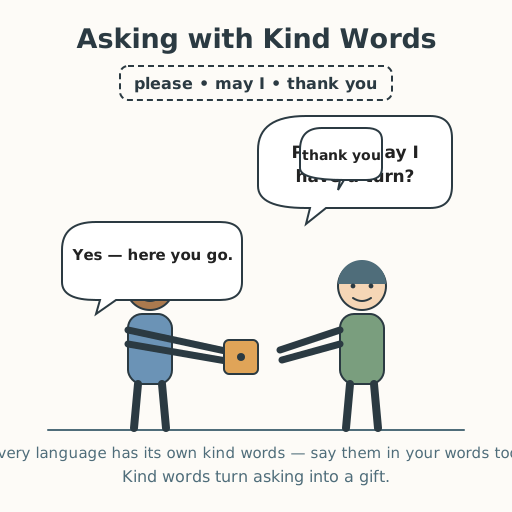
- Practice asking (15 min). One partner holds a toy. The other asks: “Please, may I have a turn?” The first partner says “yes” and passes it. Then switch. Say “thank you” when you receive it.
- Try it for real (10 min). Use the kind words when you actually want a turn during play. If you forget, a friend gives a gentle reminder: “ask with kind words.”
- Close (5 min). Talk: how did asking feel? How did being asked feel? Remember — kind words turn asking into a gift.
Differentiation
- Support: Practice with the facilitator or an older learner first, then with a peer.
- Extension: Invite learners to think of other kind words (for example, “after you”) and try them out.
Assessment
- Formative (observation): Does the learner use “please” or “may I” when asking for a turn, with only a gentle reminder?
- Artifact (portfolio): A drawing of two learners asking and sharing kindly.
Resources
- CASEL SEL Framework (foundational competencies): https://casel.org/fundamentals-of-sel/
Home connection
This week at home, practice asking with “please” and “may I.” Notice how the people around you answer when you ask kindly.