Lesson 05 — How Is My Friend Feeling?
Learners read the clues a friend gives with face, voice, and body, and practice naming what a friend might be feeling.
Objectives
Objectives
- D02.S2.K.01 Describe how a friend or story character might feel in a simple situation.
Essential question
How can I tell how a friend is feeling by looking and listening?
Key vocabulary
Materials
Standard materials
- Feeling face cards · 1 set Happy, sad, angry, scared, calm faces
- A mirror (optional) · 1
Low-tech / no-cost
- Voice and body One learner makes a face or a sound; others guess the feeling
- A friend's real face Use a partner's face as the "card" — look and guess together
Enriched / lab & device
- Photos of real children showing feelings · 1 set Diverse faces from magazines or a photo pack for guessing games
- A tablet with a photo app · 1 per group Learners capture their own feeling faces and build a class guessing game
Works in different contexts
- large-group Hold up each face large enough for all to see; the whole group names the feeling together
- self-directed A learner looks at each card, makes the face in a mirror, and names the feeling aloud
- outdoor-only Guess feelings from body language — how a friend stands or moves when happy or sad — without any cards
- multi-age An older learner acts out a feeling for younger ones to guess, then they swap roles
- level-grouped Learners who are ready guess from body language alone; others use face cards for support
Lesson 5 — How Is My Friend Feeling?
Summary
Learners turn their attention outward: from noticing their own feelings (Unit 1) to noticing a friend’s. They read the clues a face, voice, and body give, and practice naming what a friend might be feeling.
Objectives
- Describe how a friend might feel in a simple situation. (D02.S2.K.01)
Connection
Every day, your friends tell you how they feel without saying a word — a smile, a slumped shoulder, a teary eye, a loud laugh. When you notice those clues, you can understand your friend and know how to help. Reading feelings is a language everyone can learn, in every place on Earth.
Materials
- Feeling face cards (happy, sad, angry, scared, calm)
- A mirror (optional)
Preparation
- Print or draw a set of feeling face cards.
- Arrange pairs or a circle for the guessing game.
Facilitator note
This lesson is written to the learner (“you”) so it works in a classroom and for a self-directed learner. As facilitator, describe each face aloud as well as showing it, so learners who cannot see the card can still join. Keep feelings open: a guess is a guess, and the “right” answer is always “let’s ask them.”
Procedure
- Gather (5 min). Look at a friend near you. What is their face doing right now? Can you guess how they feel?
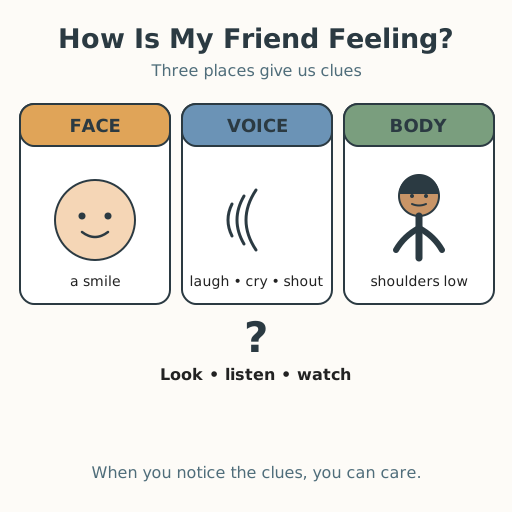
- Meet the clue-finders (10 min). Three places tell us feelings: the face, the voice, and the body. For each feeling card, look at the face, hear the voice, and watch the body. Describe what you notice: “a smile,” “eyes down,” “arms crossed.”
- Guess the feeling (15 min). One partner makes a feeling with their face and body. The other guesses: “I think you feel happy.” Then swap. Try sad, angry, scared, and calm too.
- A simple situation (10 min). I will tell a tiny story: “A friend’s block tower falls down.” How might that friend feel? Guess, then say what clue you used.
- Close (5 min). Remember: friends show feelings with face, voice, and body. When you notice, you can care.
Differentiation
- Support: Use only two feeling cards (happy, sad) and pair with an older buddy.
- Extension: Ask learners to describe the clue they used (eyebrows, shoulders, voice) along with the feeling.
Assessment
- Formative (observation): Can the learner name how a friend might feel in a simple situation and point to a clue?
- Artifact (portfolio): A drawing of a friend showing a feeling, with the feeling labeled.
Resources
- CASEL SEL Framework (foundational competencies): https://casel.org/fundamentals-of-sel/
Home connection
At home, play “guess my feeling” with your family — make a face and let them guess, then guess theirs.