Lesson 06 — Feelings in Stories
Learners follow a story character's feelings, guessing how the character feels and why, and see that characters — like friends — show feelings through what happens to them.
Objectives
Objectives
- D02.S2.K.01 Describe how a friend or story character might feel in a simple situation.
Essential question
How can I guess how a story character feels?
Key vocabulary
Materials
Standard materials
- A picture book with strong emotional moments · 1 A story where a character feels clearly happy, sad, or scared
- Paper and crayons · per learner
Low-tech / no-cost
- A told or remembered story Tell a simple story aloud and pause to ask "how does the character feel?"
- Acted-out story Act out a short scene with a partner and guess the feeling, no book needed
Enriched / lab & device
- A felt board or puppets · 1 set Retell the story with characters learners can move as they guess feelings
- A tablet with a read-aloud app · 1 per group A story with pictures and voice so learners can pause and guess
Works in different contexts
- large-group Read or tell the story aloud, pausing at each feeling moment for the whole group to guess together
- self-directed A learner looks through a picture book alone and guesses each character's feeling from the picture
- outdoor-only Tell a story about animals or weather outdoors and guess how each part feels — the thirsty plant, the hiding rabbit
- multi-age An older learner reads the story while younger ones point to a feeling face at each moment
- level-grouped Learners who are ready explain *why* the character feels that way; others just name the feeling
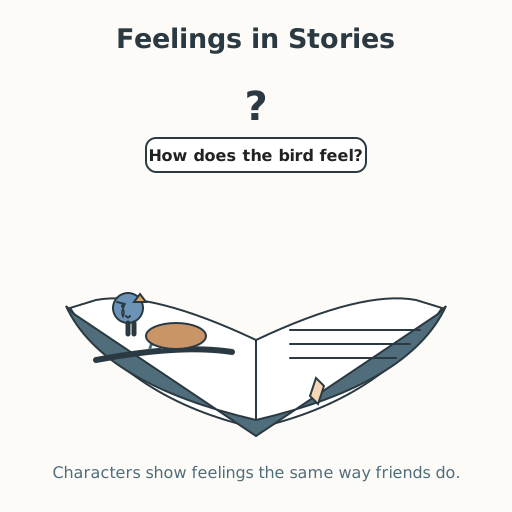
Lesson 6 — Feelings in Stories
Summary
Learners practice reading feelings at one remove: in a story. As they follow a character through moments of joy, sadness, and fright, they guess what the character feels and why — the same skill they will use with real friends.
Objectives
- Describe how a story character might feel in a simple situation. (D02.S2.K.01)
Connection
Story characters feel things just like you do. When the little bird loses its nest, it feels scared; when it finds it again, it feels glad. Stories from every land let us practice understanding feelings that are not our own — which is exactly what makes us kind friends.
Materials
- A picture book with strong emotional moments
- Paper and crayons
Preparation
- Choose a story with clear feeling moments.
- Mark two or three places to pause and ask “how does the character feel?”
Facilitator note
This lesson is written to the learner (“you”) so it works in a classroom and for a self-directed learner. As facilitator, choose a story from any culture — the point is the feeling, not the setting — and describe the pictures aloud for learners who cannot see them well. Honor every guess; ask “what makes you think so?” rather than “is that right?”
Procedure
- Gather (5 min). We will read a story and play “feeling detective.” Our job is to guess how the character feels.
- Listen and watch (10 min). As we read, look at the character’s face and body and listen to the words. What is happening to them?
- Pause and guess (15 min). At each pause, I will ask: “How does the character feel?” Guess, and tell me the clue — “their face is droopy,” “they are crying,” “they are jumping.” Is it happy, sad, scared, or angry?
- Ask why (10 min). For one feeling, ask: why do they feel that way? What happened? That is the story’s secret — feelings come from what happens.
- Close (5 min). Remember: characters show feelings the same way friends do. When you read a face, you read a heart.
Differentiation
- Support: Offer a feeling face card to point to at each pause instead of naming the feeling.
- Extension: Ask learners to retell the story’s happiest moment and the feeling that goes with it.
Assessment
- Formative (observation): Can the learner name how a story character feels and point to a clue?
- Artifact (portfolio): A drawing of a story character showing a feeling.
Resources
- CASEL SEL Framework (foundational competencies): https://casel.org/fundamentals-of-sel/
Home connection
At story time, pause and ask your family: “How does this character feel? How can you tell?”