Lesson 08 — Being a Good Listener
Learners practice giving a friend their full attention — in whatever way their own body listens best — and discover that listening is how we learn what a friend feels and needs.
Objectives
Objectives
- D02.S2.K.01 Describe how a friend or story character might feel in a simple situation.
Essential question
How do I listen so a friend feels heard?
Key vocabulary
Materials
Standard materials
- A "talking object" (a shell, stick, or ball) · 1 Whoever holds it is the one speaking
- Feeling face cards · 1 set To point to how the speaker might be feeling
Low-tech / no-cost
- Voice and body Practice giving attention — eyes toward the speaker or away, hands still or busy — with no props
- A found object as the talking stick A stone or twig that marks whose turn it is to speak
Enriched / lab & device
- A pair of soft headphones (pretend or real) · 1 set To make the idea of "listening" playful and visible
- A recording device · 1 Learners record a short "how I feel" message and practice listening back
Works in different contexts
- large-group Pass one talking object so only one voice is heard at a time; the group practices giving attention together
- self-directed A learner asks a family member "how do you feel today?" and practices listening without interrupting
- outdoor-only Practice listening to nature first — birds, wind, water — then to a friend, with calm bodies
- multi-age An older learner tells a short story while younger ones practice giving attention, then retell one thing
- level-grouped Learners who are ready retell what a partner said; others practice just waiting and showing they heard
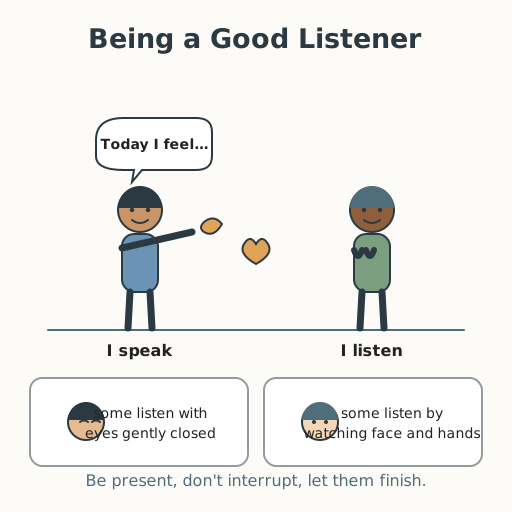
Lesson 8 — Being a Good Listener
Summary
Learners practice giving a friend their full attention — each in the way their own body listens best — and learn that listening is how we come to understand what a friend feels and needs.
Objectives
- Describe how a friend might feel by listening carefully to them. (D02.S2.K.01)
Connection
Listening is how we learn what is inside another person — their joy, their worry, their need. When you stop, give your attention, and let a friend finish speaking, you give them a gift: the feeling of being heard. Good listening is kindness you do with your whole self.
Materials
- A “talking object” (a shell, stick, or ball)
- Feeling face cards
Preparation
- Choose a talking object to mark whose turn it is to speak.
- Arrange pairs and a circle.
- Have feeling face cards ready for guessing.
Facilitator note
This lesson is written to the learner (“you”) so it works in a classroom and for a self-directed learner. As facilitator, model attention yourself and narrate it: “I am turning toward you and giving you my attention; I will let you finish.” Say the important part aloud: different bodies listen differently. Some keep their eyes on the speaker, some look away or close their eyes to hear better; some keep their hands still, some need to move a little. No one way is more correct — what matters is being present and letting the speaker finish. Never insist on eye contact or a fixed posture: in some cultures and for some autistic learners, looking away is listening. For learners who listen with their eyes (sign language or lip-reading), “listening” means watching the speaker’s face and hands — honor that as full listening too. Keep speaking turns short at this age — one sentence is plenty.
Procedure
- Gather (5 min). What does it feel like when someone really listens to you? What does it feel like when they don’t? Today we learn to be the kind who listens.
- What listening looks like for you (10 min). A good listener gives a friend their full attention. Different bodies listen differently: some keep their eyes on the speaker, some look away or close their eyes to hear better; some keep their hands still, some move a little. What matters is: be present, don’t interrupt, and let them finish. Find the listening body that works for you.
- One turn at a time (10 min). Pass the talking object. Only the one holding it speaks or signs; everyone else listens (with ears or eyes). Say or sign one true thing: “Today I feel…”
- Listen and guess (15 min). As your partner speaks, give them your attention — watch their face and body, or just listen with your ears, whichever helps you. After, point to a feeling card or say: “I think you feel happy.” Ask them — were you right? Then swap.
- Close (5 min). Remember: listening is how we understand a friend’s heart. Give your attention, let them finish, and show you heard. That is the gift.
Differentiation
- Support: Practice listening for a very short turn (one word or a wave) before longer turns.
- Extension: After listening, learners retell one thing their partner said, to show they heard it.
Assessment
- Formative (observation): Can the learner give a speaking partner their attention (in any posture) and name how that partner felt?
- Artifact (portfolio): A drawing of “a good listener” — however the learner pictures listening.
Resources
- CASEL SEL Framework (foundational competencies): https://casel.org/fundamentals-of-sel/
Home connection
At home, ask someone “how are you feeling?” and practice listening with your whole self. Then tell them what you heard.