Lesson 11 — My Neighborhood
Learners name their neighborhood as a community they belong to and describe one thing people do together in it, honoring that neighborhoods look different the world over.
Objectives
Objectives
- D02.S3.K.01 Name a community they belong to and one thing people do together in it.
Essential question
What places and people make up my neighborhood, and what do people do together there?
Key vocabulary
Materials
Standard materials
- Paper and crayons · per learner
- A large shared paper · 1 For a class map of the neighborhood
Low-tech / no-cost
- Voice and body Name neighborhood places aloud and act out what people do together there
- A ground map Draw a big map of the neighborhood in the soil and mark the places people share
Enriched / lab & device
- A neighborhood walk (with an adult) · 1 Point to the places and helpers that make up the neighborhood
- A tablet with a map app · 1 per group Find the school or meeting place on a map and talk about who is nearby
Works in different contexts
- large-group Build a group map on the shared paper, each learner adding one place or person
- self-directed A learner draws their own neighborhood and labels the places people share
- outdoor-only Walk the edges of a shared space and name the places and helpers — a shop, a well, a meeting tree
- multi-age Older learners write the names of places on the map while younger ones draw them
- level-grouped Learners who are ready describe what people do together in a place; others name the place itself
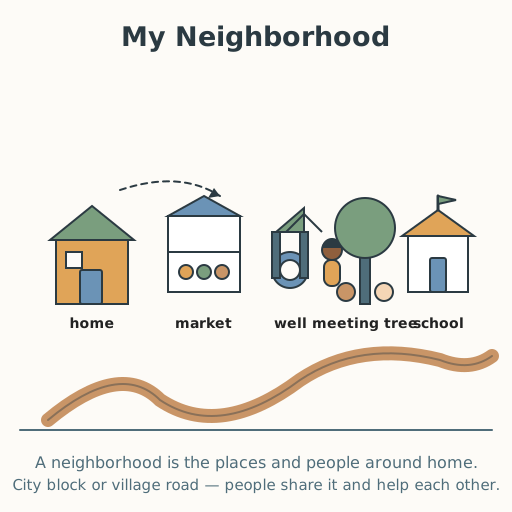
Lesson 11 — My Neighborhood
Summary
Learners widen the circle once more — from family and class to the neighborhood. They name their neighborhood as a community they belong to and one thing people do together there, and see that neighborhoods everywhere are places where people share space and help each other.
Objectives
- Name their neighborhood as a community they belong to and one thing people do together in it. (D02.S3.K.01)
Connection
Your neighborhood is a bigger community than your family or class — the streets, buildings, fields, and people around your home. People in a neighborhood share a place and do things together: buying food at a market, drawing water, gathering to talk, caring for a shared path or well. Whether your neighborhood is a city block, a village, or a few homes along a road, it is a place where people belong to each other.
Materials
- Paper and crayons
- One large shared paper for a class map of the neighborhood
Preparation
- Prepare the shared paper for a group map.
- Think of neighborhood places to prompt memory: home, market, water source, school, meeting place, field, path.
Facilitator note
This lesson is written to the learner (“you”) so it works in a classroom and for a self-directed learner. As facilitator, keep “neighborhood” concrete and local — the places a learner actually sees. Honor every kind of neighborhood equally: dense city streets, rural roads, coastal villages, mountain hamlets. None is the default; all are real communities.
Procedure
- Gather (5 min). Think about the place around your home — the paths, buildings, fields, or streets. That is your neighborhood.
- Places and people (10 min). Name the places in a neighborhood: homes, a market, a school, a well or tap, a meeting tree, a field, a path. Who do you see there?
- What people do together (15 min). In your neighborhood, what do people do together? (Buy and sell food, fetch water, play, worship or gather, fix a shared path, watch over each other’s homes.) Tell a partner one thing.
- Map it (10 min). On the shared paper, draw one neighborhood place and add it to our map. Look — together we have drawn our whole neighborhood.
- Close (5 min). Remember: your neighborhood is your community. You belong to the places and people around you.
Differentiation
- Support: Offer picture cards of neighborhood places to point to instead of naming.
- Extension: Invite learners to name one way people in the neighborhood help each other, and explain.
Assessment
- Formative (observation): Can the learner name their neighborhood and one thing people do together in it?
- Artifact (portfolio): The shared neighborhood map (or a photo of it).
Resources
- CASEL SEL Framework (foundational competencies): https://casel.org/fundamentals-of-sel/
Home connection
On your way home, notice one place people in your neighborhood share. Tell a grown-up what people do together there.