Lesson 13 — Caring for Our Classroom
Learners care for their shared classroom space — wiping, sorting, and tidying — and discover that caring for a shared space is a way of caring for each other and for the world we share.
Objectives
Objectives
- D02.S4.K.01 Help a classmate or care for a shared space when shown how.
Essential question
How do we care for our shared classroom space?
Key vocabulary
Materials
Standard materials
- Cleaning and tidying tools · 1 set A cloth, a small broom or brush, a basket for toys
- Paper and crayons · per learner
Low-tech / no-cost
- Hands and a song A tidy-up song while everyone puts things away together, no tools needed
- A found-cloth or leaf brush Use what is at hand to sweep and tidy a shared space
Enriched / lab & device
- A classroom jobs chart · 1 Pictures of care jobs (water plants, straighten books, wipe table) learners can rotate through
- A tablet with a timer app · 1 A tidy-up challenge — care for the room before the timer ends
Works in different contexts
- large-group Split the room into small zones and have each group care for one zone, then tour the room together
- self-directed A learner chooses one care job — wiping, sorting, straightening — and does it, then checks their work
- outdoor-only Care for a shared outdoor space — clear a path, gather stray items, water plants — and notice the change
- multi-age Older learners pair with younger ones to share a care job and model how it is done
- level-grouped Learners who are ready rotate jobs independently; others do one job with a model beside them
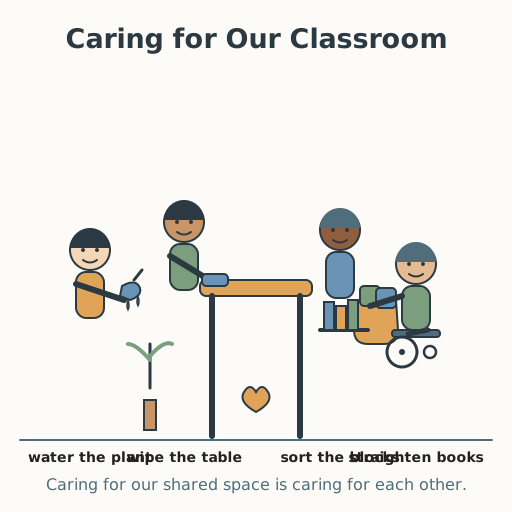
Lesson 13 — Caring for Our Classroom
Summary
Learners put helping hands to work on the shared space itself. They wipe, sort, and tidy the classroom together, and see that caring for a shared space is caring for the people in it — and a small model of caring for our shared Earth.
Objectives
- Care for a shared space when shown how. (D02.S4.K.01)
Connection
Our classroom belongs to everyone, so everyone helps care for it. When you wipe a table or put a toy back, you are not just cleaning — you are caring for every friend who uses that space. The same is true of bigger shared spaces: a path, a well, a garden, a river, the Earth itself.
Materials
- Cleaning and tidying tools (cloth, small broom or brush, basket)
- Paper and crayons
Preparation
- Choose simple care jobs learners can do: wipe a table, sort blocks, straighten books, water a plant.
- Gather the tools and place them where learners can reach them.
Facilitator note
This lesson is written to the learner (“you”) so it works in a classroom and for a self-directed learner. As facilitator, show each job first (“watch, then try”) and keep it joyful — a tidy-up song or a shared goal beats a command. Frame care as belonging: we care for what is ours together, not because we must obey but because we love the space and the people in it.
Procedure
- Gather (5 min). Look around the room. It is our shared space — everyone’s. Who should care for it? All of us, together.
- Learn the care jobs (10 min). I will show you how: wipe the table, sort the blocks, straighten the books, water the plant. Watch, then choose one.
- Care for our space (15 min). Do your care job. Work beside your friends. If you finish, look for another way to help.
- Notice the change (10 min). Step back and look. How does the room feel now? We made it welcoming for everyone.
- Close (5 min). Remember: caring for our shared space is caring for each other. What we do here, we can do for our wider world.
Differentiation
- Support: Pair with an older buddy and do one job together, step by step.
- Extension: Invite learners to plan one new care job for the class and explain why it matters.
Assessment
- Formative (observation): Can the learner complete a care job for the shared space when shown how?
- Artifact (portfolio): A before-and-after drawing or note about the cared-for space.
Resources
- CASEL SEL Framework (foundational competencies): https://casel.org/fundamentals-of-sel/
Home connection
At home, care for one shared space — sweep a step, tidy a corner, water a plant. Tell a grown-up how the space looks and feels afterward.