Lesson 02 — Retelling What I Heard
Learners practice retelling a story by finding one important part and saying it in their own words, then put simple story pictures in order.
Objectives
Objectives
- D04.S1.K.01 Listen to a story or speaker and retell one important part in their own words.
Essential question
How do I tell back one important part of a story in my own words?
Key vocabulary
Materials
Standard materials
- A familiar short story · 1 Reuse the story from Lesson 1, or another the learners know well
- Story sequence cards · 1 set A few simple pictures showing the main events, to put in order
Low-tech / no-cost
- Hand gestures Learners use their fingers to count "one, two, three" story parts as they retell
- Drawn story pictures Learners draw one picture of the part they remember, then tell about it
Enriched / lab & device
- A tablet to record retellings · 1 per pair Learners record themselves retelling, then listen back and check what they remembered
Works in different contexts
- large-group Retell as a group "echo" — the facilitator starts each part and the whole group joins in with the words and actions
- self-directed A learner retells the story to a toy, a grown-up, or a recording, then checks: did I include one important part?
- outdoor-only Walk through the story in three steps across the ground — one step per part — telling each part aloud as you go
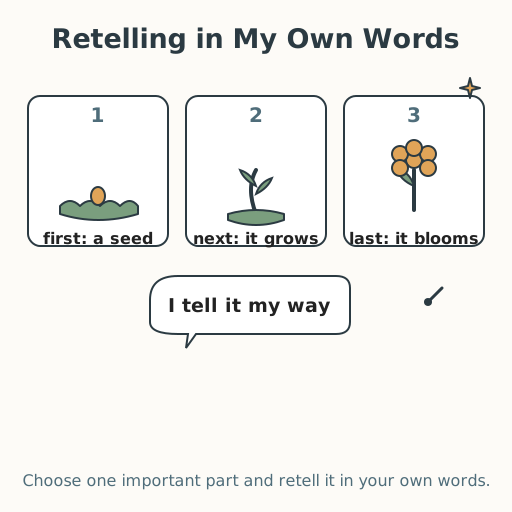
Lesson 2 — Retelling What I Heard
Summary
Learners retell a familiar story by choosing one important part and putting it into their own words. They discover that their own words are a good way to tell a story back.
Objectives
- Listen to a story and retell one important part in their own words. (D04.S1.K.01)
Connection
When you hear something wonderful, you want to tell someone about it. Retelling is how a story lives on — one person listens, then tells it again in their own way. There is no single “right” way to tell a story back; your own words are a good way, because they are yours.
Materials
- A familiar short story (reuse the story from Lesson 1)
- Story sequence cards — a few pictures of the main events (optional)
Preparation
- Re-read or re-tell the familiar story.
- Lay out or prepare simple pictures of its main events.
Facilitator note
This lesson is written to the learner (“you”) so it works in a classroom and for a self-directed learner. Celebrate every retelling — a one-sentence retelling is a real retelling. Learners may retell in their home language; that counts fully. A retelling may also be signed, drawn, pointed to on sequence cards, or acted out — all are real retelling, so a learner who does not speak aloud is never asked to. The goal is “one important part in my own words,” not a perfect summary, and never a memorized script.
Procedure
- Gather (5 min). Think of a story you love. If you told it to a friend, how would you start?
- Hear it again (10 min). Listen to the familiar story one more time. As you listen, hold up a finger for each important part you notice. How many parts did you count?
- Find the important part (10 min). Choose ONE part that feels important to you. Maybe it is the biggest surprise, the funniest moment, or the part that changed everything. There is no wrong choice — important to you is what matters.
- Retell in your own words (15 min). Tell that one part to a partner, in your own words, in whatever language feels best. You do not have to say it exactly how the storyteller said it.
- Close (5 min). Remember: your own words can carry a story. When you retell, the story becomes a little bit yours too.
Differentiation
- Support: Offer two pictures of story parts and let the learner point to the one they will retell; model one sentence to begin.
- Extension: Invite learners to retell two parts and put them in order using the sequence cards.
Assessment
- Formative (performance): Can the learner share one important part of the story in their own words — spoken, signed, drawn, pointed, or acted out — without repeating it word-for-word?
- Artifact (portfolio): A drawn picture of the part they chose, with a dictated sentence.
Resources
- CASEL SEL Framework (foundational competencies; communication and relationship skills): https://casel.org/fundamentals-of-sel/
Home connection
At home, listen to a story or a piece of news from a grown-up, then retell one important part in your own words and ask if you got it right.