Lesson 03 — Stories Have a Beginning, Middle, and End
Learners discover that stories move in order — a beginning, a middle, and an end — and practice telling a story back one part at a time in that order.
Objectives
Objectives
- D04.S1.K.01 Listen to a story or speaker and retell one important part in their own words.
Essential question
How do I find the beginning, middle, and end of a story?
Key vocabulary
Materials
Standard materials
- A short story with a clear order · 1 A story with an obvious beginning, middle, and end (a journey, a meal, a day)
- Three picture cards · 1 set One picture for the beginning, one for the middle, one for the end
Low-tech / no-cost
- Three stones, leaves, or sticks Three found objects stand in for "first, next, last" as learners walk the story's order
- Body positions Learners curl small for the beginning, stand for the middle, and stretch tall or sit for the end
Enriched / lab & device
- Three hoops or mats laid on the floor · 1 set Learners step into "beginning," "middle," and "end" spaces while telling each part
Works in different contexts
- large-group Split the group into three teams — beginning, middle, end — and let each team act out its part when called
- self-directed A learner draws three boxes and puts one picture in each — first, next, last — then tells the story across the boxes
- outdoor-only Mark three spots on the ground (a rock, a puddle, a tree); walk to each spot in order while telling that part
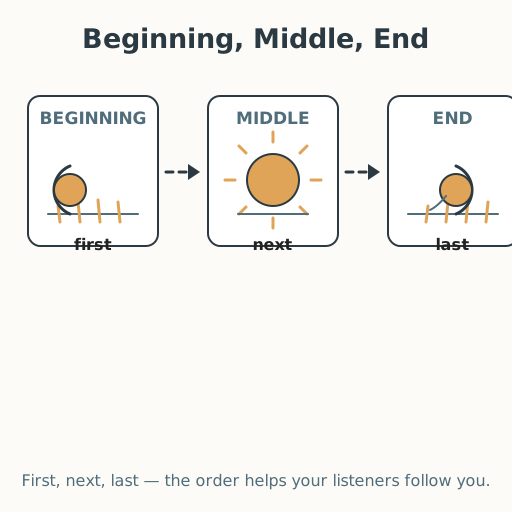
Lesson 3 — Stories Have a Beginning, Middle, and End
Summary
Learners notice that stories, like days and meals and journeys, have an order — a beginning, a middle, and an end. They retell a story by walking or acting through the three parts in sequence.
Objectives
- Listen to a story and retell one important part in their own words. (D04.S1.K.01)
Connection
Everything that happens has a before, a during, and an after — a day, a meal, a walk home. Stories are the same: they start, something happens in the middle, and then they end. Knowing the order helps you hold a whole story in your mind and tell it back so others can follow along.
Materials
- A short story with a clear order (a journey, a meal, a day)
- Three picture cards — beginning, middle, end (optional)
Preparation
- Choose a story with an unmistakable three-part order.
- Prepare three picture cards or three found objects to stand in for first, next, last.
Facilitator note
This lesson is written to the learner (“you”) so it works in a classroom and for a self-directed learner. Keep the order concrete and physical — moving the body through “first, next, last” helps children hold the idea before they can say it. Some stories have more than three parts; at this age, three is plenty, and “middle” can be loose. Accept any part a learner names as long as it is genuinely from the story. Acting out, pointing to the three cards, or drawing the three parts all count as retelling — a learner who does not speak aloud can still tell the story’s order with their body, hands, or pictures.
Procedure
- Gather (5 min). Think about your morning so far. What happened first? What happened next? What happened last? You just told a story in order.
- Hear the story (10 min). Listen to the story and look for its three parts: the beginning (how it starts), the middle (what happens), and the end (how it finishes).
- Find the three parts (10 min). With a partner, say what happened first, next, and last. Use three fingers to count them.
- Walk the story (15 min). Stand on a “first” spot, a “next” spot, and a “last” spot — three stones, three hoops, or three drawn boxes. Step to each spot and tell that part aloud. Your body helps your words remember the order.
- Close (5 min). Remember: first, next, last. That order is the shape of a story, and it helps your listeners follow you.
Differentiation
- Support: Tell the story in just two parts (first and last); offer the three picture cards and let the learner point to them in order.
- Extension: Invite learners to tell a story from their own day with a clear beginning, middle, and end.
Assessment
- Formative (observation): Can the learner place three parts of the story in order — first, next, last — while telling?
- Formative (oral): Can the learner retell at least one part and say whether it came first, next, or last — by saying, pointing, drawing, or acting?
Home connection
At home, retell your day to a grown-up in three parts — first, next, last — and see if they can guess which part was the middle.