Lesson 05 — Meet the Letters of My Language
Learners meet the letters or characters of their own home writing system — whatever script that is — by looking at them, shaping them with hands and loose parts, and learning to name a few.
Objectives
Objectives
- D04.S2.K.01 Recognize and name the letters or characters of their home writing system and match some to their sounds.
Essential question
What do the letters or characters of my writing system look like?
Key vocabulary
Materials
Standard materials
- Letter or character cards in the learners' home writing system · 1 set The marks of whatever script the learners use at home — Latin, Arabic, Devanagari, Chinese characters, Cyrillic, Ethiopic, or another
- A tray of loose parts · 1 set Sticks, pebbles, seeds, or clay for building mark shapes with hands
Low-tech / no-cost
- Marks drawn in sand, dust, or on paper The facilitator draws the home writing system's marks large, and learners trace them with a finger
- Body shapes Learners make the shape of a mark with their whole body or hands
Enriched / lab & device
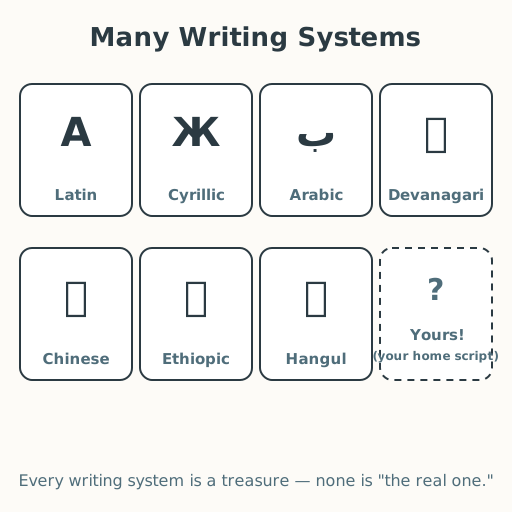
- Printed cards in two or more writing systems side by side · 1 set Shows that many scripts exist and each is a full, beautiful system — none is "the real one"
- A tablet with a tracing or writing app · 1 per pair Learners trace and draw the marks of their own writing system
Works in different contexts
- large-group Draw one mark very large so all can see; the whole group shapes it in the air with a finger, then names it together
- self-directed A learner picks one mark from their writing system, builds it with loose parts, and says its name aloud
- outdoor-only Draw the marks in sand or soil with a stick, or form them from twigs and stones; trace each one with a finger
Lesson 5 — Meet the Letters of My Language
Summary
Learners meet the marks of their own home writing system — letters or characters, in whatever script their family uses — by looking, tracing, and building their shapes. They begin to name a few.
Objectives
- Recognize and name the letters or characters of their home writing system and match some to their sounds. (D04.S2.K.01)
Connection
The words you hear can also be written down as marks. Every writing system has its own set of marks — and yours is the one your family uses at home. These marks are like a code that carries your words across time and space, so someone far away can read what you thought.
Materials
- Letter or character cards in the learners’ home writing system
- A tray of loose parts — sticks, pebbles, seeds, or clay (optional)
Preparation
- Prepare cards showing the marks of each learner’s home writing system. If learners use more than one script, prepare more than one set.
- Gather loose parts for building shapes.
Facilitator note
This lesson is written to the learner (“you”) so it works in a classroom and for a self-directed learner. This lesson is script-agnostic: a learner’s home writing system may use the Latin alphabet, Arabic script, Devanagari, Chinese characters, Cyrillic, Ethiopic, Hangul, or another system entirely. Never assume the English alphabet. Ask families which marks their child uses at home, and prepare those. Teach the lesson in the learners’ home language where possible. No writing system is “the right one” — each is a complete, equal way of writing. For a learner with low or no vision, offer the marks as raised or three-dimensional shapes (traced in sand, built from loose parts, or molded in clay) so a mark can be known by touch and by its spoken name, not only by sight.
Procedure
- Gather (5 min). Look around: can you see any written marks anywhere? What do you think they are for?
- Meet the marks (10 min). Look at the cards of your home writing system. These are the marks your family uses to write words. Each mark has a shape and a name. Trace one with your finger.
- Build a mark (15 min). Choose one mark. Build its shape with sticks, pebbles, seeds, or clay. Or make its shape with your whole body. Say its name out loud.
- Name a few (10 min). Show a partner the mark you built. Can you name it? Can your partner find the same mark on a card?
- Close (5 min). Remember: your writing system is yours, and it is a treasure. The marks you use are just as real and just as good as any other writing system’s marks.
Differentiation
- Support: Offer just two or three marks to choose from; let a learner match a loose-parts shape to an identical card rather than naming it.
- Extension: Invite learners to build or name several marks and compare their shapes — which are round, which have lines, which have dots?
Assessment
- Formative (observation): Can the learner recognize a mark from their home writing system when shown it?
- Formative (oral): Can the learner name one or more marks of their writing system?
Home connection
At home, ask a grown-up to show you the marks of your writing system. Practice naming them together, and build one out of anything you can find.