Lesson 06 — Letters Have Sounds
Learners discover that each mark in their writing system is a partner of a sound, and practice matching a few marks to the sounds they carry in their home language.
Objectives
Objectives
- D04.S2.K.01 Recognize and name the letters or characters of their home writing system and match some to their sounds.
Essential question
What sound goes with each letter or character of my writing system?
Key vocabulary
Materials
Standard materials
- Letter or character cards from the learners' home writing system · 1 set Reuse the cards from Lesson 5
- A bag of small objects or picture cards · 1 set Familiar objects whose names begin with a mark's sound (chosen to match the learners' home writing system)
Low-tech / no-cost
- Voice and mouth Learners feel the sound of a mark in their mouth as they say it, and match it to a mark by ear
- Found objects A stone, a leaf, a spoon — anything whose name begins with a target sound
Enriched / lab & device
- A sound-matching game with recorded sounds · 1 per pair Learners hear a sound, then point to the mark that makes it
Works in different contexts
- large-group Say a sound aloud and let the whole group echo it together, then hold up the mark that matches
- self-directed A learner picks an object, says its name, feels the first sound, and finds the mark that begins it
- outdoor-only Hunt for objects outdoors whose names begin with a target sound; bring each one back and match it to its mark
Lesson 6 — Letters Have Sounds
Summary
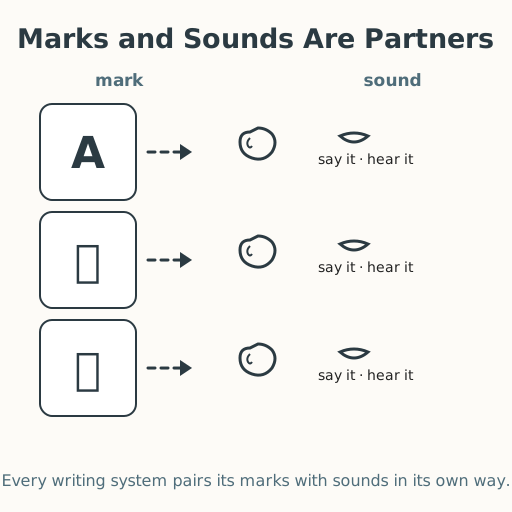
Learners learn that marks and sounds are partners: each letter or character of their home writing system carries a sound, and they practice matching a few marks to the sounds they make in their own language.
Objectives
- Recognize and name the letters or characters of their home writing system and match some to their sounds. (D04.S2.K.01)
Connection
Each mark in your writing system is a friend of a sound. When you know which mark goes with which sound, you can begin to unlock words — to read what others wrote and write what you want to say. Marks and sounds are partners that work together.
Materials
- Letter or character cards (reuse from Lesson 5)
- A bag of small objects or picture cards whose names begin with a mark’s sound
Preparation
- Choose a few marks and their sounds from the learners’ home writing system.
- Gather small objects or picture cards whose names begin with those sounds.
Facilitator note
This lesson is written to the learner (“you”) so it works in a classroom and for a self-directed learner. Sounds are matched to the learner’s home writing system and home language — this may be an alphabet (such as Latin or Cyrillic), a script that pairs marks with sounds (such as Arabic or Devanagari), or a character-based system where a character maps to a syllable or a whole word. Do not assume “one letter = one sound” in the English way; honor how the learners’ own system works. No accent is “correct”; every learner’s pronunciation is welcomed. For a learner who is deaf or hard of hearing, shift the goal from hearing to seeing and feeling: match a mark by its shape, its name, the way the mouth forms its sound, or a gesture or sign that goes with it — recognition, not auditory discrimination, is the heart of this lesson. A learner who does not speak aloud can point to the mark, move to it, or match it with a picture instead of saying the sound.
Procedure
- Gather (5 min). Say your name slowly. Listen: what is the very first sound?
- Meet the partners (10 min). Look at your mark cards. Each mark has a sound that lives inside it. Say the mark’s sound together, and feel where the sound lives in your mouth.
- Hunt for sounds (15 min). Pick an object from the bag. Say its name slowly and feel the first sound. Which mark starts that sound? Put the object on that mark’s card.
- Match more (10 min). With a partner, choose another object and find its mark. Check together: does the sound match?
- Close (5 min). Remember: marks and sounds are partners. Every writing system has its own way of pairing them, and yours works perfectly for your language.
Differentiation
- Support: Work with one mark and one sound at a time; let the learner echo the sound many times before matching.
- Extension: Invite learners to find the ending sound of an object’s name and match it to a mark, or collect more objects for the same sound.
Assessment
- Formative (observation): Can the learner match a mark to the sound it makes in their home writing system?
- Formative (oral): Can the learner name the sound of one or more marks — or match a mark to its sound by pointing, moving, or using a picture or gesture?
Home connection
At home, play “first sound” with a grown-up: say the names of things around you, feel the first sound, and find the mark that starts it.