Lesson 07 — Letters All Around Me
Learners discover that writing is all around them — on signs, labels, and packages — and hunt for the marks of their home writing system in their own environment.
Objectives
Objectives
- D04.S2.K.01 Recognize and name the letters or characters of their home writing system and match some to their sounds.
Essential question
Where do I find letters and writing in my everyday world?
Key vocabulary
Materials
Standard materials
- Environmental print samples · 1 set A sign, a food label, a shop name, a book cover — real writing from the learners' world, in their home writing system
- A "mark hunt" recording sheet · per learner Boxes to tick or draw in for each mark found
Low-tech / no-cost
- A walk around the room or home Learners point to real writing on jars, clothes, boxes, and signs — no printed samples needed
- Voice and finger Learners trace marks in the air and name them
Enriched / lab & device
- A camera or tablet · 1 per group Learners photograph writing they find and build a class "wall of marks"
Works in different contexts
- large-group Walk as a group and call out marks you find together; record each find on a big shared chart
- self-directed A learner hunts for writing around the room or home, points to marks they recognize, and ticks them on a sheet
- outdoor-only Hunt for writing outdoors — on shop signs, road signs, food stalls, and packages — and name the marks you find
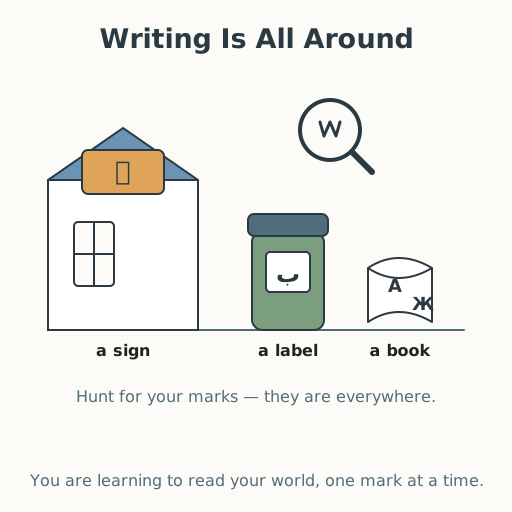
Lesson 7 — Letters All Around Me
Summary
Learners go on a “mark hunt” to find writing in their everyday world — on signs, labels, and packages — and practice recognizing and naming the marks of their home writing system where they actually appear.
Objectives
- Recognize and name the letters or characters of their home writing system and match some to their sounds. (D04.S2.K.01)
Connection
Writing is not only in books — it is on signs, jars, shirts, buses, and screens. The marks of your writing system are waiting to be found everywhere. Once you start looking, you see them all around you, and they begin to mean something.
Materials
- Environmental print samples — a sign, a label, a book cover
- A “mark hunt” recording sheet (optional)
Preparation
- Gather a few real examples of writing from the learners’ environment (in their home writing system).
- Prepare a simple recording sheet with boxes to tick or draw in.
Facilitator note
This lesson is written to the learner (“you”) so it works in a classroom and for a self-directed learner. Use writing from the learners’ real environment and home writing system — if the community writes in Arabic, Devanagari, or Chinese characters, hunt for those marks, not the English alphabet. If learners are new to the community’s script, honor both: their home marks and the ones around them are both welcome. Pointing and naming are the goals; reading full words is not expected. For a learner with low or no vision, adapt the hunt to touch — raised lettering on jars and boxes, or marks formed in clay or soil — so they can “find” and name marks by feel.
Procedure
- Gather (5 min). Where do you see writing every day? Think of one place.
- Look at real writing (10 min). Look at the samples: a sign, a label, a book cover. Can you find any marks you know? Point to them and say their name or sound.
- Go on a mark hunt (15 min). Walk around your room, home, or school. Find marks from your writing system on jars, clothes, boxes, and signs. Point, name, and tick each one on your sheet.
- Share your finds (10 min). Tell a partner one mark you found and where you found it. Did you find any mark more than once?
- Close (5 min). Remember: writing is all around you, and you are learning to read your world one mark at a time.
Differentiation
- Support: Give the learner one specific mark to hunt for, and celebrate each time they point to it.
- Extension: Invite learners to count how many times they found one mark, or to find the first mark of their own name somewhere in the environment.
Assessment
- Formative (observation): Can the learner locate and point to marks of their home writing system in real environmental print?
- Formative (oral): Can the learner name a mark they found?
Home connection
At home, go on a mark hunt with a grown-up. Find and name the marks of your writing system on food, clothes, and signs, and count how many you find.