Lesson 08 — My Name in Marks
Learners meet their own name as marks in their home writing system, build its shape, and begin to name the letters or characters that make it up.
Objectives
Objectives
- D04.S2.K.01 Recognize and name the letters or characters of their home writing system and match some to their sounds.
- D04.S3.K.01 Draw, dictate, or write marks to express an idea and tell what they mean.
Essential question
What are the marks that make up my name?
Key vocabulary
Materials
Standard materials
- Name cards for each learner · 1 per learner Each learner's name written in their home writing system, large and clear
- Loose parts for building names · 1 set Sticks, stones, seeds, or clay to form the marks of a name
Low-tech / no-cost
- Names written in sand or dust The facilitator writes each name large; learners trace and copy it with a finger
- Finger and voice Learners trace the marks of their name in the air while saying each mark's name
Enriched / lab & device
- Name cards in two scripts · 1 per learner For multilingual learners, the name written in each of their writing systems side by side
- A tablet drawing app · 1 per pair Learners trace and copy the marks of their name on screen
Works in different contexts
- large-group Write each learner's name large one at a time; the group traces the marks in the air together while the owner points to each mark
- self-directed A learner studies their own name card, builds the marks with loose parts, and says each mark's name
- outdoor-only Write names in soil or sand with a stick, or form them from twigs and leaves; each learner walks along their own name saying the marks
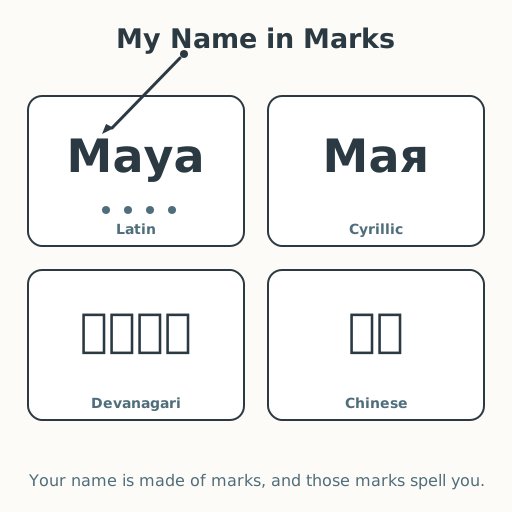
Lesson 8 — My Name in Marks
Summary
Learners study their own name written in their home writing system, build its marks with their hands, and begin to name the letters or characters that make it up. Their name becomes their first “word” they know by sight.
Objectives
- Recognize and name the letters or characters of their home writing system and match some to their sounds. (D04.S2.K.01)
- Draw, dictate, or write marks to express an idea and tell what they mean. (D04.S3.K.01)
Connection
Your name is one of the first words you can call your own. It is made of the marks of your writing system, arranged in an order that means only you. Your name belongs to you wherever it is written, and writing it is a way of saying “this is me.”
Materials
- A name card for each learner, written in their home writing system
- Loose parts for building names — sticks, stones, seeds, or clay (optional)
Preparation
- Write each learner’s name large and clear, in the script their family uses at home.
- Gather loose parts.
Facilitator note
This lesson is written to the learner (“you”) so it works in a classroom and for a self-directed learner. Write each name in the learner’s home writing system — this may be Latin, Arabic, Devanagari, Chinese characters, Cyrillic, or another script. If a child’s name uses more than one script, write it in each. Never “correct” a name’s spelling into a different script or language. A name is a gift and a belonging; honor it exactly as the family gives it.
Procedure
- Gather (5 min). What is your name? Who gave it to you, or what does it mean? Your name is yours.
- Meet your name card (10 min). Look at your name written in your writing system. Point to each mark. How many marks are in your name? Which mark do you like best, and why?
- Build your name (15 min). Build your name with sticks, stones, seeds, or clay. Or trace it with your finger in sand, dust, or the air. Say each mark’s name as you go, if you can.
- Show and tell (10 min). Show a partner your name in marks. Tell them one mark’s name or sound. Can they find the first mark of your name?
- Close (5 min). Remember: your name is made of marks, and those marks spell you. Every name, in every writing system, is worth writing beautifully.
Differentiation
- Support: Let a learner trace over their name card rather than build from scratch; praise naming even one mark.
- Extension: Invite learners to write or build their name a second time without looking, or to name every mark in their name and match each to its sound.
Assessment
- Formative (observation): Can the learner point to and name one or more marks of their own name?
- Artifact (portfolio): A photograph or drawing of the learner’s built or traced name, kept as their first piece of “writing.”
Home connection
At home, ask a grown-up to write your name in your home writing system. Practice writing or building it together, and learn the name of each mark.