Lesson 03 — How Many Are There?
Learners practice the big idea that the last number they say when counting is the answer to "how many," and they check their counts by counting again.
Objectives
Objectives
- D05.S1.K.01 Count objects up to 20 and say how many there are.
Essential question
When I finish counting, how do I say how many there are?
Key vocabulary
Materials
Standard materials
- Several small collections of different sizes · 3-5 per learner or pair E.g., 3 shells, 7 beans, 12 pebbles, 20 leaves — each in its own cup or pile
- A hiding cloth or box · 1 To hide a collection while a partner guesses, then reveal it to count
Low-tech / no-cost
- Found objects in piles Pebbles, seeds, and sticks grouped into small piles of different sizes
- A hand or cloth for hiding Cover a small pile with a hand or cloth to play the "how many?" game
Enriched / lab & device
- Number cards 1-20 · 1 set To match each counted group to its number card
- Count-and-reveal cards · 1 set Cards with pictured groups of dots or objects to count and name
Works in different contexts
- large-group Hold up one collection at a time; the whole group counts together and says the total in one voice, then the facilitator writes the number where all can see it
- self-directed A learner counts each of several collections, says the total aloud, and writes or draws a mark for each total to compare them
- outdoor-only Count different natural collections outdoors — a pile of petals, a line of sticks, a handful of pebbles — and say how many in each
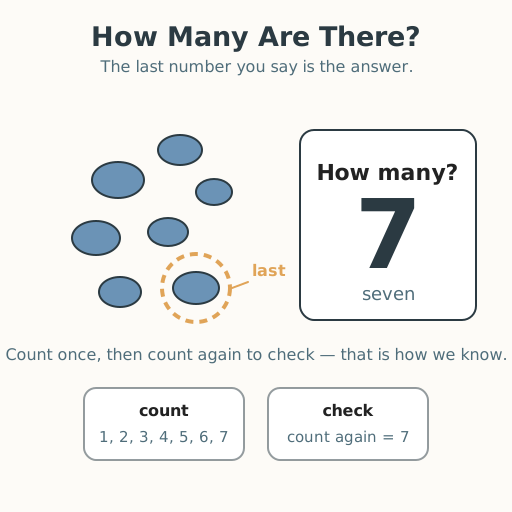
Lesson 3 — How Many Are There?
Summary
Learners deepen the idea of cardinality — that the last number spoken when counting a group is the answer to “how many there are.” They count several collections of different sizes, say the total for each, and check by counting again.
Objectives
- Count a group of objects and name the total number (“how many”). (D05.S1.K.01)
Connection
Whenever someone asks “how many?” they are asking you to count — the fish in the net, the eggs in the basket, the people at the table. The answer is the last number you say when you count, and then you can count again to be sure. Counting and checking is how people everywhere make sure nothing is lost and everyone gets their fair share.
Materials
- Several small collections of different sizes (3, 7, 12, 20 items), each in its own cup or pile
- A cloth or box for hiding a collection
Preparation
- Prepare 3-5 collections of different sizes per learner or pair (for example 3 shells, 7 beans, 12 pebbles, 20 leaves).
- Arrange them so each collection has a clear, separate spot.
Facilitator note
This lesson is written to the learner (“you”). The key idea is cardinality: the last counting word is the number of things in the set — a concept young children master at different times and must be allowed to arrive at gradually (Clements & Sarama, 2014). Some learners will touch-and-count perfectly and still answer “five” no matter how many there are; that is a normal step on the way, not a failure. When that happens, ask gently, “What was the last number you said?” rather than correcting. Never rank learners or praise only the fastest. Count in the home language. Learners who are blind or low-vision can count by moving objects one at a time into a cup and noticing the growing pile by feel; learners who are deaf or hard of hearing can sign the numbers. Learners with limited hand or body movement name totals by voice or sign while a partner moves each object, or indicate each object with eye-gaze or a mouth stick for a partner to move and count. The “how many?” game should feel like play, never like a test.
Procedure
- Gather (5 min). Look at your collections. Some look big, some look small. You cannot always tell how many just by looking — you have to count.
- Count and name (15 min). Pick one collection. Count it, touching each thing and saying one number for it. The last number you say is how many. Say it clearly: “There are seven.” Do this for each collection.
- Count again to check (10 min). Count the same collection a second time. Does the last number match? Counting twice and getting the same answer is how you know your count is true.
- The how-many game (10 min). With a friend, one of you hides a small pile under a cloth. The other peeks for only a blink, then must count carefully to say “how many.” Switch turns. No rushing — slow counting is good counting.
- Close (5 min). Remember: the last number you say is your answer. Count once, then count again to check. That is how we know.
Differentiation
- Support: Use very small collections (1-4) and count hand over hand, pausing on the last object to say the total together.
- Extension: Invite learners to line up their collections from fewest to most without counting first, then count to check their guess.
Assessment
- Formative (observation): When a learner finishes counting, do they state the last number as the total?
- Self: Ask the learner to count one collection twice and tell whether their two answers matched.
Resources
- Clements, D. H., & Sarama, J. (2014). Learning and Teaching Early Math: The Learning Trajectories Approach (2nd ed.). Routledge. (Cardinality — the last counting word names the quantity.)
Home connection
At home, find two or three small collections (beans, spoons, toys). Count each one, say “how many,” then count again to check. Ask a grown-up to hide a few things so you can count and say how many.