Lesson 04 — Patterns All Around Us
Learners discover what a pattern is — something that repeats — and go on a hunt to find patterns in cloth, baskets, buildings, music, and nature, in every culture.
Objectives
Objectives
- D05.S2.K.01 Continue or copy a simple repeating pattern of colors, shapes, or sounds.
Essential question
What is a pattern, and where do I find patterns in my world?
Key vocabulary
Materials
Standard materials
- Objects in two colors or two kinds · a handful per learner E.g., red and green leaves, smooth and rough stones, two kinds of seeds
- Pictures or real examples of patterned things · as available A woven basket, striped cloth, a tiled floor, a shell, a feather
Low-tech / no-cost
- The world around you Patterns live in floorboards, brick walls, fences, leaves, footsteps, and sky — look and listen, no supplies needed
- Voice and body Clap-stomp-clap-stomp is a pattern you can make with only your own body
Enriched / lab & device
- Images of world patterns · 1 set Printed pictures of woven baskets, striped and zigzag textiles, and tile work from many traditions
- Patterning beads or blocks · per learner Beads or blocks in two or three shapes/colors for building repeating patterns
Works in different contexts
- large-group Do a whole-group "pattern hunt" around the room, calling out every pattern the class spots, then make one big sound pattern together
- self-directed A learner walks the space (or their home) with a "pattern eyes" challenge and lists or draws three patterns they find
- outdoor-only Hunt for patterns outdoors — stripes on bark or feathers, rows of leaves, waves, bird calls, or the repeating beat of footsteps
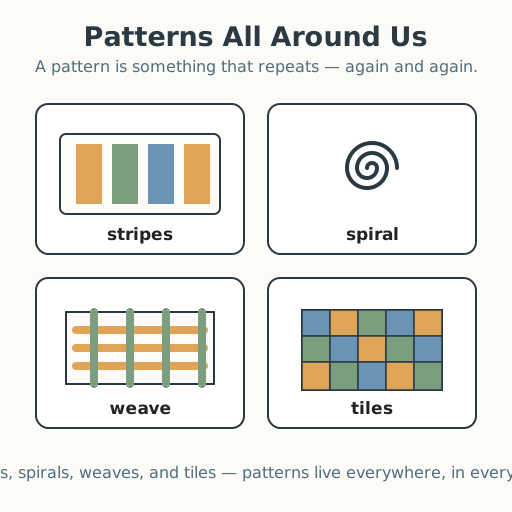
Lesson 4 — Patterns All Around Us
Summary
Learners learn that a pattern is something that repeats — again and again — and go on a hunt for patterns in the world around them: striped cloth, woven baskets, tile floors, music, dance, and nature. They discover that people everywhere make patterns, and that finding patterns is a way of seeing.
Objectives
- Recognize a simple repeating pattern in colors, shapes, or sounds. (D05.S2.K.01)
Connection
Patterns are everywhere you look and listen. A striped cloth repeats red-blue-red-blue. A woven basket crosses over-under-over-under. Music repeats a beat, and your footsteps fall left-right-left-right. People in every land make patterns — in woven cloth, in baskets, in songs and dances — because a pattern is simply something that happens again and again. Today you will hunt for them.
Materials
- A handful of objects in two colors or two kinds (red and green leaves, two kinds of seeds)
- Pictures or real examples of patterned things (a basket, striped cloth, a shell)
Preparation
- Gather a few patterned examples (cloth, basket, tiled surface, feather) or pictures of them.
- Choose an indoor or outdoor area rich enough to hunt for patterns.
Facilitator note
This lesson is written to the learner (“you”). The idea to plant is simply “a pattern repeats.” Do not yet demand that learners extend or build patterns — that is the next lesson. Here, let them see patterns everywhere and feel the delight of recognition. Center patterns from many cultures as equals: woven baskets, kente and other striped and zigzag textiles, molas, beadwork, tile mosaics, and the repeating beats of drum music are all examples of people making order through repetition — none is “better,” each is beautiful in its own tradition. Be careful not to treat only printed or European patterns as “real” patterns. Honor sound and movement patterns (clapping, drumming, dance steps) as fully equal to visual ones, and invite learners who are blind or low-vision to find patterns by touch and sound, and learners who are deaf or hard of hearing to find them by sight and rhythm they can feel. Learners with limited movement find and share patterns by voice or sign — saying what repeats, or choosing examples with eye-gaze or a mouth stick — while a partner points or traces. There is no “wrong” pattern to notice.
Procedure
- Gather (5 min). Say a little rhythm with me: clap-stomp, clap-stomp, clap-stomp. What kept happening? The same thing, again and again. That is a pattern — it repeats.
- Meet patterns (10 min). Look at the patterned examples. Trace the stripes or the weave with your finger and say it: “over-under, over-under.” Listen to a beat: “tap-tap-rest, tap-tap-rest.” A pattern is anything that happens again and again.
- Pattern hunt (20 min). Go on a hunt, indoors or outdoors. Use your eyes, ears, and hands. Find three patterns. They might be stripes, rows, waves, beats, or footsteps. Tell a friend where you found each one.
- Share (5 min). Come back and share one pattern you found. Can the group say what repeats in it?
- Close (5 min). Remember: patterns are everywhere, in every land and every life. Finding them is a way of seeing the order and beauty around you.
Differentiation
- Support: Hunt for one pattern together, then say its repeat aloud (“red-blue, red-blue”) while tracing it, before hunting independently.
- Extension: Invite learners to find a pattern and say which part is the “repeat” — the little piece that happens over and over.
Assessment
- Formative (observation): Can the learner point to a repeating pattern and name what repeats (color, shape, or sound)?
Home connection
At home, hunt for three patterns with a grown-up — in cloth, on the floor, in music, or in nature — and tell each other what repeats.