Lesson 05 — Making and Continuing Patterns
Learners move from seeing patterns to making them: they build simple repeating patterns of colors, shapes, and sounds, and practice continuing a pattern by predicting what comes next.
Objectives
Objectives
- D05.S2.K.01 Continue or copy a simple repeating pattern of colors, shapes, or sounds.
Essential question
How do I make a pattern and keep it going — what comes next?
Key vocabulary
Materials
Standard materials
- Objects in two or three kinds or colors · about 20 per learner or pair E.g., two kinds of seeds, two colors of stones, blocks in two shapes
- A line or strip to build along · 1 per learner or pair A strip of paper, a ruler, or a drawn line to lay the pattern on
Low-tech / no-cost
- Found objects in two kinds Leaves vs. stones, big vs. small, or two colors of anything gathered nearby
- Voice and body Patterns of claps, stomps, taps, and rests — no objects needed at all
Enriched / lab & device
- Patterning beads and string · per learner Beads in two or three shapes or colors to thread into repeating patterns
- Shape and color tiles · 1 set Tiles in a few shapes and colors for building and extending longer patterns
Works in different contexts
- large-group Build one long pattern as a class — each learner adds the next piece in turn — so continuing a pattern becomes a shared job
- self-directed A learner builds a pattern with two kinds of objects, then covers the last piece and asks themselves "what comes next?" before checking
- outdoor-only Make patterns on the ground with leaves and stones, or with claps and stomps, and continue a friend's pattern
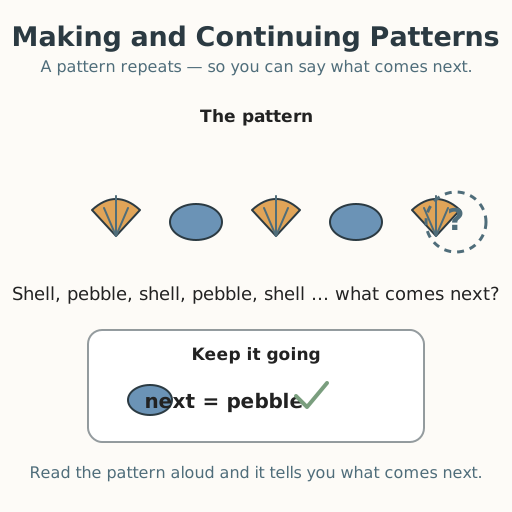
Lesson 5 — Making and Continuing Patterns
Summary
Learners move from seeing patterns to making them. They build simple repeating patterns with objects and with their voices and bodies, and practice continuing a pattern by answering the big question: “what comes next?”
Objectives
- Continue or copy a simple repeating pattern of colors, shapes, or sounds. (D05.S2.K.01)
Connection
A weaver does not think about every single thread — she knows the pattern and keeps it going, over-under-over-under. A drummer keeps the beat going, and a dancer keeps the steps going. When you know a pattern, you can keep it going and know what comes next. Today you will be the one who makes the pattern and keeps it alive.
Materials
- About 20 objects in two or three kinds or colors (two kinds of seeds, two colors of stones, blocks in two shapes)
- A line or strip to build along
Preparation
- Give each learner or pair a collection of objects in at least two kinds/colors and a strip or line to build on.
- Clear space for sound-and-movement patterns.
Facilitator note
This lesson is written to the learner (“you”). Building and extending a simple repeating pattern (like AB or AAB) is the target skill here; keep the patterns simple and let learners work with two, and then three, elements at their own pace. The magic question is always “what comes next?” — asked with curiosity, never as a trick. Learners will make “mistakes” (two reds in a row, a skipped element); ask them to read their pattern aloud (“red-blue-red-blue…”) and let the rhythm reveal the fix — do not rush to correct. Sound and movement patterns are fully equal to object patterns and are a gift for learners who learn best with their bodies and ears. Learners who are blind or low-vision can build patterns by feel (smooth-bumpy-smooth) and by sound; learners who are deaf or hard of hearing can build visual patterns and feel a drumbeat through a surface. Learners with limited hand or body movement build patterns by voice or sign — saying the sequence aloud while a partner lays each piece, or choosing each next piece with eye-gaze or a mouth stick. Every learner’s pace is honored, and no one’s pattern is “better” — a correct pattern made slowly is just as true as a fast one.
Procedure
- Gather (5 min). You already know a pattern repeats. Today you will be the pattern maker.
- Copy a pattern (10 min). Watch a friend make a tiny pattern: red, blue, red, blue. Now copy it with your own objects. Copying is how we learn a pattern by heart.
- Make your own (15 min). Build a pattern with two kinds of things. Say it aloud as you lay it: “leaf, stone, leaf, stone.” Or make a sound pattern: clap, stomp, clap, stomp.
- Continue — what comes next? (10 min). Look at your pattern. Cover the last piece. Ask yourself: what comes next? Lay it down, then check. Now try a friend’s pattern and keep it going for them.
- Close (5 min). Remember: a pattern is alive when someone keeps it going. You can always ask “what comes next?” and find the answer by reading the pattern.
Differentiation
- Support: Start by copying a two-piece repeating pattern made by the facilitator, saying each piece aloud together, before the learner makes their own.
- Extension: Invite learners to build a three-element pattern (red-blue-yellow, red-blue-yellow) and to leave a gap in the middle for a partner to fill.
Assessment
- Formative (observation): Can the learner continue a simple repeating pattern by placing the correct next piece?
- Performance: The learner’s built pattern, checked for a clear repeat that they can say aloud.
Home connection
At home, make a pattern with two kinds of things (spoons and cups, or two colors of anything), say it aloud, and ask a grown-up “what comes next?”