Lesson 06 — Meet the Shapes
Learners meet four common shapes — circle, square, triangle, and rectangle — feel their sides and corners, and find them in the room, the garden, and the wider world.
Objectives
Objectives
- D05.S3.K.01 Name and match common shapes and use position words (over, under, beside).
Essential question
What shapes can I name, and where do I see them around me?
Key vocabulary
Materials
Standard materials
- Shape examples · a few of each Real objects and cut shapes — a plate (circle), a book (rectangle), a block (square), a tent or folded paper (triangle)
- Paper shapes in four kinds · 1 set per learner Cut circles, squares, triangles, and rectangles of various sizes
Low-tech / no-cost
- Found shapes A plate, a box top, a leaf, a door, a window, a ball — the room and outdoors are full of shapes
- Finger-drawn shapes Draw each shape in the air or in sand/earth with a finger; no paper needed
Enriched / lab & device
- Shape tiles or blocks · 1 set Wooden or plastic shapes for feeling sides and corners with the hands
- Shape poster with varied world examples · 1 A poster showing circles, squares, triangles, and rectangles in buildings, baskets, and nature from different places
Works in different contexts
- large-group Hold each shape up large, trace its sides and corners in the air together, and call out things in the room that match each shape
- self-directed A learner feels each shape's sides and corners, names it, and finds or draws two real things that are that shape
- outdoor-only Find shapes outdoors — the round sun, a triangular roof or leaf, a square window, a rectangular door — and trace them in the earth
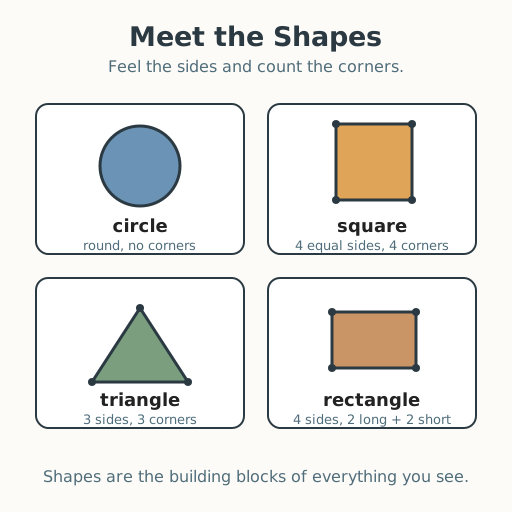
Lesson 6 — Meet the Shapes
Summary
Learners meet four common shapes — circle, square, triangle, and rectangle — by feeling their sides and corners and finding them in real objects: a round plate, a square window, a triangular roof, a rectangular door. They discover that the same shapes appear in buildings, baskets, and nature all over the world.
Objectives
- Name common shapes (circle, square, triangle, rectangle). (D05.S3.K.01)
Connection
Shapes are everywhere, in every place people live. The sun and the moon look round like a circle; many windows and doors are squares and rectangles; roofs and tents often rise to a triangle. Whether a house is made of brick, wood, cloth, or stone, and whether it stands in a city or on a hillside, the same shapes hold it up. Today you will learn their names and find them all around you.
Materials
- A few real shape examples (plate, book, block, folded paper triangle)
- A set of paper shapes (circles, squares, triangles, rectangles)
Preparation
- Gather real objects that are clear examples of each shape.
- Cut or prepare paper shapes in the four kinds, various sizes.
Facilitator note
This lesson is written to the learner (“you”). The goal is naming and recognizing four shapes by their attributes — a circle is round with no corners; a square has four equal sides and four corners; a triangle has three sides; a rectangle has four sides with two long and two short. Teach the shapes through touch and feel first — sides and corners are the real, physical facts of a shape, before names or marks. Use real objects from the learners’ world (a plate, a door, a tent, a woven mat). Draw on global examples without ranking: roundhouses, pyramid shapes, triangular roofs, and rectangular doorways exist in many traditions, and none is “the” right way to build. Learners who are blind or low-vision should feel each shape’s sides and corners and count them by touch; learners who are deaf or hard of hearing can name shapes in sign. Learners with limited movement can feel shapes hand-under-hand with a partner (the partner’s hand under theirs, guiding) or name and count sides and corners aloud while a partner traces. Never quiz or rush; naming shapes is a beginning, and every learner’s pace is honored.
Procedure
- Gather (5 min). Look around. The things near you are made of shapes. Today you will meet four of them.
- Meet the shapes (15 min). Feel each shape with your hands and say its name. A circle is round with no corners. A square has four equal sides and four corners. A triangle has three sides and three corners. A rectangle has four sides — two long and two short. Trace each one with your finger.
- Shape hunt (15 min). Find one real thing that is each shape. A plate is a circle. A door is a rectangle. Can you find a square? A triangle? Point and name them.
- Draw it (5 min). With a finger, draw each shape in the air, or in sand or earth if you are outdoors. Say its name as you draw.
- Close (5 min). Remember: shapes are the building blocks of everything you see. Once you know their names, you see them everywhere.
Differentiation
- Support: Introduce one shape at a time; give learners a shape to hold and match to the same shape, before asking them to name it.
- Extension: Invite learners to count the sides and corners of each shape and to notice that a square is a rectangle with all four sides equal.
Assessment
- Formative (observation): Can the learner point to and name each of the four shapes in real objects?
Home connection
At home, hunt with a grown-up for the four shapes — a circle, a square, a triangle, and a rectangle — and name each one you find.