Lesson 07 — Matching Shapes
Learners practice matching shapes by finding things that are the same shape, and by fitting shapes to their outlines, sharpening their eye for what makes two things alike.
Objectives
Objectives
- D05.S3.K.01 Name and match common shapes and use position words (over, under, beside).
Essential question
How do I find and match shapes that are the same?
Key vocabulary
Materials
Standard materials
- Pairs of shapes · several pairs of each kind Matching pairs of circles, squares, triangles, and rectangles, in different sizes
- Shape outlines · 1 set Outlines of each shape drawn or cut, to place a shape onto its match
Low-tech / no-cost
- Real objects that match by shape A plate with a plate, a box with a box, a ball with a ball — match real things that share a shape
- Finger-traced outlines in earth or sand Trace a shape in the ground and find the object that fits its outline
Enriched / lab & device
- Shape-matching board or puzzle · 1 per learner or pair A board where each shape fits only into its own matching hole
- Shadow/outline cards · 1 set Cards pairing each solid shape with its outline for a memory-style match
Works in different contexts
- large-group Give each learner one shape, then have them walk to find the classmate holding the matching shape, forming pairs across the room
- self-directed A learner lays out outline cards, matches each shape to its outline, and checks each pair by name
- outdoor-only Match found shapes outdoors — two round stones, two triangular leaves, two rectangular bricks — and say why they match
Lesson 7 — Matching Shapes
Summary
Learners practice matching: they find pairs of shapes that are the same, and fit shapes onto matching outlines. Matching is how they learn to look closely and to say why two things go together — by their shape.
Objectives
- Match common shapes and identify shapes that are the same. (D05.S3.K.01)
Connection
Matching is something you already do every day — you find the shoe that matches the other shoe, the lid that fits the pot, the sock that goes with the sock. When things share the same shape, they match. People who weave baskets, cut cloth, or lay tiles match shapes all day long, so everything fits together. Today you will be the matcher.
Materials
- Several matching pairs of shapes (circles, squares, triangles, rectangles), in different sizes
- A set of shape outlines (drawn or cut) to match onto
Preparation
- Prepare matching pairs of shapes, including some pairs of different sizes, so learners must rely on shape, not size.
- Draw or cut a set of outlines for each shape.
Facilitator note
This lesson is written to the learner (“you”). Matching is a step toward noticing attributes — what makes a triangle a triangle even when it is big, small, or turned on its side. Keep the focus on shape (sides and corners), not on color or size, and include rotated or different-sized shapes so learners learn that a triangle is still a triangle when it points down. Match real objects too — a plate with a plate, a box with a box — so matching stays grounded in life. Draw on global craft examples without ranking: basket-weavers, tile-layers, and cloth-cutters in many cultures match and fit shapes every day; none is the model to copy, all are real. Learners who are blind or low-vision can match shapes by feel, fitting each shape into its outline or finding two shapes with the same number of sides and corners by touch. Learners with limited movement match by voice or sign — telling a partner which shapes go together, or choosing each pair with eye-gaze or a mouth stick. Never turn matching into a race; careful matching is the goal, and every pace is honored.
Procedure
- Gather (5 min). Look at your shapes. Some are the same, some are different. Today you will find the ones that match.
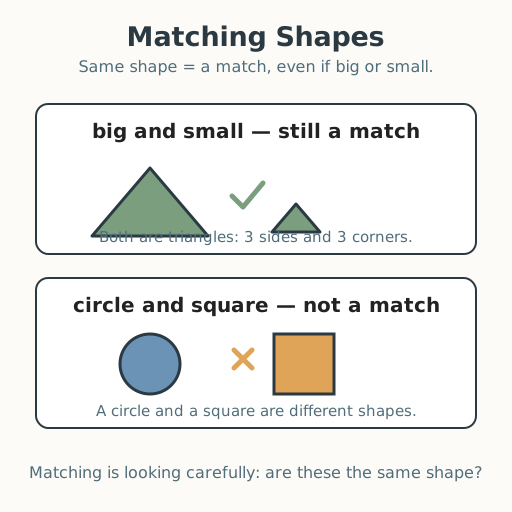
- Match pairs (15 min). Find two shapes that are the same shape. Say why they match: “Both are triangles — three sides and three corners.” A big triangle and a small triangle still match, because shape is about sides and corners, not size.
- Match to outlines (15 min). Lay out the shape outlines. Place each shape onto the outline it fits. Try a shape on the wrong outline first — what happens? It does not fit. The right match fits.
- Check your matches (5 min). Look at each pair and name it. Does every shape have a partner?
- Close (5 min). Remember: matching is looking carefully and asking “are these the same shape?” It is how things fit together in the world.
Differentiation
- Support: Start with matching identical shapes (same size, same color) before moving to matching across size or rotation.
- Extension: Invite learners to match shapes across rotation and size, and to explain their match using the number of sides and corners.
Assessment
- Formative (observation): Can the learner match two shapes that are the same and tell why they match?
- Self: Ask the learner to check their own matches by naming each pair.
Home connection
At home, match real things by shape — two round plates, two rectangular books, two triangular snacks — and tell a grown-up why each pair matches.