Lesson 08 — Where Is It? Over, Under, Beside
Learners use position words — over, under, beside, on, in — to say where things are, moving objects and their own bodies to match each word.
Objectives
Objectives
- D05.S3.K.01 Name and match common shapes and use position words (over, under, beside).
Essential question
How do I say where a thing is — over, under, or beside?
Key vocabulary
Materials
Standard materials
- A small toy or object · 1 per learner or pair A block, a shell, a toy animal — anything small and easy to move
- A table or box to move around · 1 A place to put things over, under, on, in, and beside
Low-tech / no-cost
- Your own body and a friend Put your hand over your head, under the table, beside a friend — no objects needed
- Found objects A stone, a leaf, and a stick moved over, under, and beside things outdoors
Enriched / lab & device
- Position picture cards · 1 set Cards showing a cat over, under, beside, in, and on a box, to name each position
- A small obstacle course of cushions and boxes · 1 A soft course for moving under, over, and beside things with the whole body
Works in different contexts
- large-group Play "move your body" as a whole group — everyone puts a hand over their head, under a chair, beside a friend — calling positions together
- self-directed A learner moves one object to several positions and says each position word aloud, then tests themselves with their eyes closed
- outdoor-only Use a tree or rock outdoors — put a stone under the tree, over the rock, beside the path — and say each position
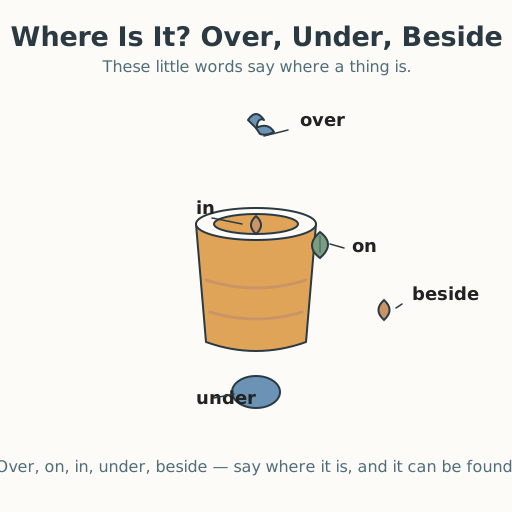
Lesson 8 — Where Is It? Over, Under, Beside
Summary
Learners learn to say where a thing is using position words — over, under, beside, on, in. They move objects and their own bodies to match each word, turning position words into something they can feel and act out.
Objectives
- Use position words (over, under, beside) to describe where things are. (D05.S3.K.01)
Connection
Every day you answer “where?” — your shoe is under the bed, a bird flies over the tree, you sit beside a friend. These little words tell people exactly where to look, in every language. When you can say where a thing is, you can help someone find it, and find your own way in the world.
Materials
- A small toy or object per learner or pair
- A table or box to move things around
Preparation
- Give each learner or pair a small object to move.
- Provide a table, box, or other object to place things over, under, on, in, and beside.
Facilitator note
This lesson is written to the learner (“you”). Position words are spatial reasoning made speakable, and young children learn them best by doing — putting a body or an object in the position and saying the word at the same time. Teach each word with a clear, repeated action (hand over head, hand under the table, hand beside a friend) so the word and the place stick together. Model with your own body first, then invite learners to do it. Notice that position words are relative — “beside me” is different from “beside you” — and let learners discover this by standing in different places. This relativity is the same in every language and culture, so the concept is global even when the words differ. Learners who are blind or low-vision can feel the positions (a hand on a hand that is over, under, beside); learners who are deaf or hard of hearing can act out and sign each position. Learners with limited movement describe positions by voice or sign — telling a partner where to place an object, or choosing a position with eye-gaze or a mouth stick — instead of moving it themselves. Keep it playful and never quiz-like; naming where things are is a skill that grows with lots of joyful practice.
Procedure
- Gather (5 min). Pick up your small object. It is somewhere right now — in your hand. Today you will learn the words that say where.
- Meet the position words (15 min). Say each word and do it with your body. Put your hand over your head. Put your hand under the table. Put your hand beside a friend. Now do it with your object: put it on the table, in the box, over the box, under the box, beside the box.
- Move and say (15 min). Move your object to a new place and say where it is in a full sentence: “The shell is under the table.” Try as many positions as you can.
- Hide and describe (5 min). With a friend, one of you hides the object and says only its position: “It is beside the box.” Can the other find it?
- Close (5 min). Remember: little words like over, under, and beside tell people exactly where to look. They help you find, and be found.
Differentiation
- Support: Teach one position word at a time (start with on and under), matching the word to the action before adding more.
- Extension: Invite learners to describe positions from another person’s point of view (“beside me” vs. “beside you”) and to give two-word directions (“under, then over”).
Assessment
- Formative (observation): Can the learner place an object over, under, or beside another and say the position word correctly?
- Performance: The learner acts out positions with their body while naming them.
Home connection
At home, play “where is it?” with a grown-up: hide a small thing and tell each other its position — over, under, or beside — so the other can find it.