Lesson 09 — Sorting Into Groups
Learners sort objects into groups by one feature — color, size, or kind — and learn to line up or count the groups to tell which has more, without ranking the groups as better or worse.
Objectives
Objectives
- D05.S4.K.01 Sort objects into groups by one feature and tell which group has more.
Essential question
How do I sort things into groups by one feature and tell which group has more?
Key vocabulary
Materials
Standard materials
- A mixed collection of objects · one pile per learner or pair Objects that differ in one clear feature, e.g., red and blue buttons, or big and small leaves
- Two mats, plates, or hoops · 2 per learner or pair Two clear places to put the two groups
Low-tech / no-cost
- Found objects sorted by one feature Sticks vs. stones, green vs. brown leaves, big vs. small pebbles
- Two drawn circles in the earth Draw two rings in sand or dirt and sort objects into them
Enriched / lab & device
- Sorting trays with compartments · 1 per learner or pair A tray with two or three sections for tidy sorting
- Attribute blocks in two colors and two sizes · 1 set Blocks that differ by color and size, so learners choose one feature to sort by
Works in different contexts
- large-group Sort one big shared pile as a class, then line the two groups up side by side and decide together which has more
- self-directed A learner sorts their pile by one feature, counts or lines up each group, and says which has more
- outdoor-only Gather a mixed pile outdoors (leaves, stones, seeds) and sort it into two rings drawn in the earth, then compare the groups
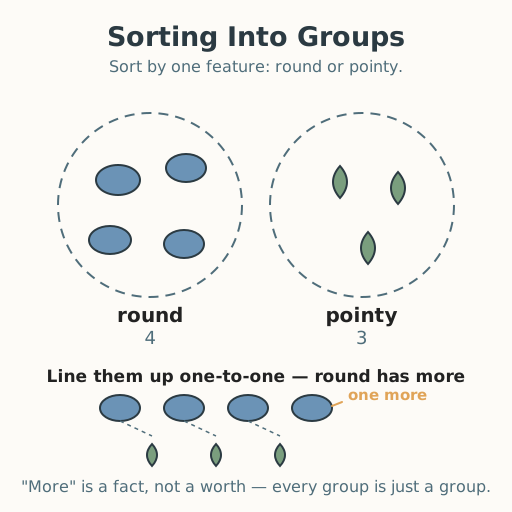
Lesson 9 — Sorting Into Groups
Summary
Learners sort a mixed collection into groups by one feature — color, size, or kind — and then compare the groups to tell which has more. They discover that sorting is how people everywhere organize their world, and that “more” is a fact, never a judgment about a group’s worth.
Objectives
- Sort objects into groups by one feature and tell which group has more. (D05.S4.K.01)
Connection
Sorting is something people do everywhere, every day — a gardener separates big seeds from small ones for planting, a market seller groups fruit by kind, a family sorts laundry into piles. When things are sorted, you can find them, count them, and see which group has more. Sorting is a way of caring for the things around you.
Materials
- A mixed collection of objects (red and blue buttons, or big and small leaves)
- Two mats, plates, or hoops for the two groups
Preparation
- Give each learner or pair one mixed pile that differs by one clear feature.
- Provide two clear places (mats, plates, hoops) for the two groups.
Facilitator note
This lesson is written to the learner (“you”). The key skill is classification by one attribute and a simple comparison (which group has more). Let learners choose their own feature to sort by — color, size, or kind are all fine — and ask them to say the rule (“all the red ones here, all the blue ones there”). Comparing “more” is best done by matching one-to-one in two lines, or by counting each group; both are valid, and neither should be rushed. A central value point: “more” is a fact, not a worth. A smaller group is not “worse,” and a bigger group is not “better” — we say “which has more” without ranking, so sorting stays a tool of care, not competition. Sorting is a human activity everywhere (seeds, laundry, market goods), so draw on many examples and honor each. Learners who are blind or low-vision can sort by touch (smooth vs. rough, big vs. small by feel); learners who are deaf or hard of hearing can sign the rule and count in sign. Learners with limited movement sort by voice or sign — directing a partner (“red here, blue there”) or choosing each object with eye-gaze or a mouth stick while a partner moves it. Every learner’s pace is honored.
Procedure
- Gather (5 min). Look at your mixed pile. It is a jumble. What could you do to make sense of it? You could sort it into groups.
- Choose a rule (10 min). Pick one feature to sort by — color, size, or kind. Say your rule: “All the red ones here, all the blue ones there.” Sort your pile into the two places.
- Compare the groups (15 min). Now find out which group has more. Line the two groups up side by side, one to one, or count each group. Which has more? Which has fewer? Remember: “more” just tells a fact — it does not make one group better.
- Sort a new way (10 min). Mix everything up again. Can you sort by a different feature this time? Say your new rule and compare the groups again.
- Close (5 min). Remember: sorting is how we organize the world so we can see it. One feature at a time — that is all it takes.
Differentiation
- Support: Provide a pile that differs in one obvious way (two colors) and sort it together first, saying the rule aloud, before the learner sorts alone.
- Extension: Invite learners to sort by two features in turn (first color, then size) and to say which group has more each time, and why “more” changed.
Assessment
- Formative (observation): Can the learner sort by one feature and state the rule (“all the…”)?
- Artifact (portfolio): A photo or drawing of the learner’s two sorted groups, with a note of which had more.
Home connection
At home, sort something real with a grown-up — spoons and forks, or socks by color — say your sorting rule, and tell which group has more.