Lesson 10 — Counting, Shapes & Patterns
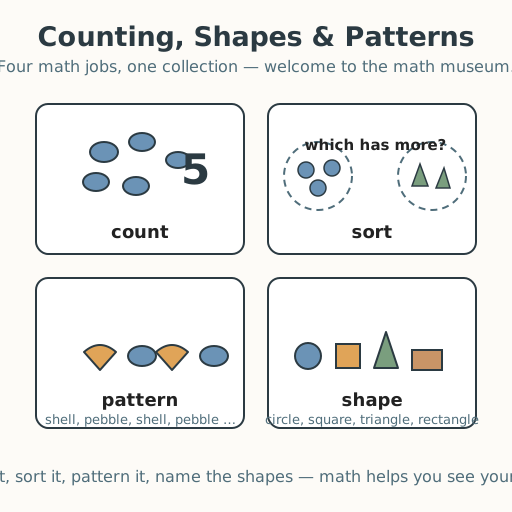
Learners bring the whole unit together in a playful capstone: they count a collection, sort it, build a pattern, and name its shapes — then share their work in a class "math museum" where every piece is valued.
Objectives
Objectives
- D05.S1.K.01 Count objects up to 20 and say how many there are.
- D05.S2.K.01 Continue or copy a simple repeating pattern of colors, shapes, or sounds.
- D05.S3.K.01 Name and match common shapes and use position words (over, under, beside).
- D05.S4.K.01 Sort objects into groups by one feature and tell which group has more.
Essential question
How do counting, shapes, and patterns work together to help me see my world?
Key vocabulary
Materials
Standard materials
- A mixed collection of objects · one pile per learner or pair Objects that can be counted, sorted, and arranged into patterns (seeds, buttons, leaves, stones, blocks)
- Paper and drawing tools · per learner For making a "math museum" card about their work
Low-tech / no-cost
- Found objects and the ground Count, sort, and pattern with pebbles, seeds, and leaves, and draw in the earth — no paper needed
- Voice and body Count aloud, clap patterns, and make shapes with arms and hands
Enriched / lab & device
- Class "math museum" display space · 1 A table or shelf where each learner's counting, sorting, and pattern work can be shown
- Camera or tablet · 1 per group To photograph each learner's work for the museum labels
Works in different contexts
- large-group Run the four stations as a carousel — counting, sorting, patterns, shapes — with the whole group rotating, then gather to share each "museum" piece
- self-directed A learner works through all four jobs at their own pace, then arranges their favorite piece and tells (or draws) what they did
- outdoor-only Build the whole capstone outdoors — count a natural collection, sort it, make a pattern of it, and find shapes in the sky and landscape
Lesson 10 — Counting, Shapes & Patterns
Summary
The capstone of the unit: learners do all four things they have learned — count, sort, make a pattern, and name shapes — with one collection of real objects, and share their work in a class “math museum” where every piece is celebrated as it is.
Objectives
- Count objects up to twenty and say how many there are. (D05.S1.K.01)
- Continue or copy a simple repeating pattern. (D05.S2.K.01)
- Name and match common shapes. (D05.S3.K.01)
- Sort objects into groups by one feature and tell which group has more. (D05.S4.K.01)
Connection
All month you have been a mathematician — counting real things, finding patterns, naming shapes, and sorting into groups. Today you put it all together, the way people do every day all over the world: a weaver counts her threads and follows a pattern; a builder names his shapes and sorts his stones; a gardener sorts her seeds and counts how many. Math is how you see the world more clearly.
Materials
- A mixed collection of objects (seeds, buttons, leaves, stones, blocks)
- Paper and drawing tools for a “museum card”
Preparation
- Set up four small “stations” or jobs: count, sort, pattern, shape.
- Prepare a space (table, shelf, or cloth on the ground) to display finished work as a “math museum.”
Facilitator note
This lesson is written to the learner (“you”). It is a celebration, not a test — the goal is for each learner to show what they can do and feel proud, never to be ranked against others. Run the four jobs as flexible stations (or as a self-directed checklist for one learner). Every child works at their own pace and may choose which job to linger on; mastery is individual, and the “museum” belongs to everyone together (philosophy §8). Keep the global lens alive: the same four moves — counting, sorting, patterning, shaping — live in weaving, building, farming, and music across the world, and no tradition is the model to copy. When learners share, praise the thinking (“you counted carefully,” “your pattern repeats”) rather than speed or size. For learners who are blind or low-vision, counting, sorting, and patterning can all be done by touch and sound, and shapes by feel; for learners who are deaf or hard of hearing, the sharing can be signed or drawn. Learners with limited movement complete each job by voice or sign, directing a partner to move, sort, or pattern objects, or choosing with eye-gaze or a mouth stick — the thinking is theirs. The museum is for everyone, and every piece has a place.
Procedure
- Gather (5 min). You have learned four math superpowers. Name them: counting, sorting, patterns, and shapes. Today you will use them all.
- Count your collection (10 min). Take your pile and count it, touching each thing. How many are there? Say the number.
- Sort it (10 min). Now sort the same pile into groups by one feature — color, size, or kind. Which group has more?
- Make a pattern (10 min). With some of your things, build a repeating pattern. Say it aloud and keep it going. Can a friend continue it?
- Find the shapes (5 min). Look at your things and around you. Name one circle, one square, one triangle, and one rectangle. Where are they?
- Open the math museum (5 min). Choose your favorite piece — your counted pile, your sorted groups, or your pattern — and put it in the museum. Tell a friend what you did, or draw a card for it.
Differentiation
- Support: Offer one job at a time with a partner, and let a learner contribute a single piece (a counted pile or a simple pattern) to the museum.
- Extension: Invite learners to combine jobs — for example, sort, then count each group and make a pattern with the larger group — and to label their museum piece.
Assessment
- Formative (observation): Across the four jobs, does the learner demonstrate counting to a total, sorting by one feature with a “more” comparison, a repeating pattern, and naming shapes?
- Artifact (portfolio): The learner’s chosen “museum” piece, kept as a record of the unit.
Home connection
At home, do a “math tour” with a grown-up: count one collection, sort it, make a pattern with it, and name the shapes around you — then tell each other which job you liked best.