Lesson 03 — Art Is a Voice
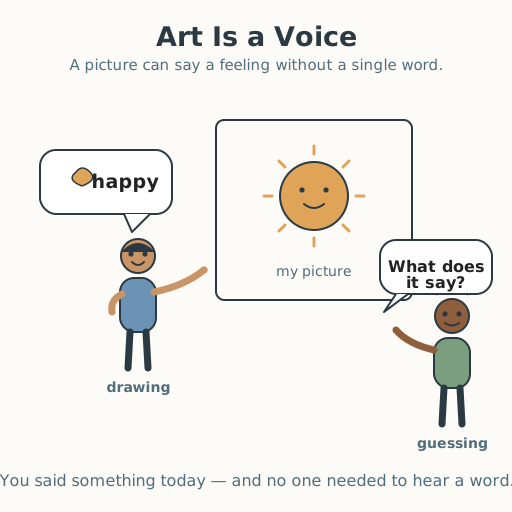
Learners draw a picture that shows a feeling, then share it and let others guess what it says. Art is a voice that needs no words, and people everywhere use it.
Objectives
Objectives
- D07.S1.K.01 Create art with different materials and describe what they made.
Essential question
How can my art say something without words?
Key vocabulary
Materials
Standard materials
- Paper and crayons or paint · per learner
- A set of feeling pictures · 1 set Happy, sad, calm, excited, cozy faces or scenes drawn or printed
Low-tech / no-cost
- A face and hands Show a feeling with your face, then draw it; no cards needed
- Sand, soil, or a wall to draw on Make a feeling picture on the ground with a stick or finger
Enriched / lab & device
- Mixed media — cloth, yarn, buttons, glue · per group Collage a feeling using many textures, not just drawing
- A tablet with a drawing app · 1 per pair Try drawing the same feeling with a finger on screen and compare
Works in different contexts
- large-group Hold up a feeling picture and ask the whole group to guess the feeling, then everyone draws their own version at once
- multi-age Older learners can write or scribe the feeling word next to their picture while younger learners draw the face or scene
- self-directed A learner picks a feeling, draws it, then shows a grown-up or friend and asks them to guess what it says
- level-grouped Group by how abstract the learner works — some draw a face, some a whole scene — and celebrate all of it as "saying something"
- outdoor-only Find or make a picture outside that shows a feeling — a stormy sky, a bright flower — and describe what it "says"
Lesson 3 — Art Is a Voice
Summary
Learners discover that a picture can “say” a feeling without a single word. They draw a feeling, share it, and guess what others’ pictures say. People in every part of the world use pictures, weaving, carving, and paint to share what is inside them.
Objectives
- Create art with different materials and describe what they made. (D07.S1.K.01)
Connection
Have you ever seen a picture and known, right away, that it felt happy or stormy or calm? A drawing can speak before you say a word. All over the world, people make pictures, patterns, weavings, and carvings to share feelings and stories — art is a voice that does not need words.
Materials
- Paper and crayons or paint
- A set of feeling pictures (happy, sad, calm, excited, cozy)
Preparation
- Draw or print a simple set of feeling pictures to show as examples.
- Set out drawing supplies where everyone can reach them.
Facilitator note
This lesson is written to the learner (“you”) so it works in a classroom and for a self-directed learner. As facilitator, frame art as communication, not decoration: “your picture is saying something.” When guessing, never say a feeling is wrong — say “I see something a little different; tell me what it says to you.” Honor non-speaking learners fully; a pointing guess is a real guess.
Procedure
- Gather (5 min). Look at the feeling pictures. What does each one seem to say — happy, sad, calm, excited, cozy? You can say it or point to it.
- Choose a feeling (5 min). Pick one feeling you want your picture to say. Feel it in your face and body first: how would you show it?
- Draw your voice (15 min). Draw a picture that says that feeling. It can be a face, a place, colors, or shapes — whatever says it for you.
- Share and guess (15 min). Show your picture. Ask a friend, “What does my picture say?” Then tell them what it says to you. Every answer is a good answer.
- Close (5 min). Remember: art is a voice. You said something today, and no one needed to hear a word.
Differentiation
- Support: Offer a single feeling to draw and let the learner trace or color a simple face.
- Non-visual path: Show a feeling with sound (a happy hum, a slow sad sigh) or with touch (soft cloth for calm, rough bark for stormy), then build a textured “picture” or sound-story instead of a drawn one.
- Extension: Invite learners to draw a picture with two feelings in it and tell where each one lives.
Assessment
- Formative (observation): Does the learner make a picture that they connect to a feeling, in words or by pointing?
- Artifact (portfolio): The feeling picture, kept in the portfolio.
Home connection
Make a picture for someone at home that says how you feel about them, and ask them to guess what it says before you tell them.