Lesson 06 — Moving Like Animals
Learners use their whole bodies to move like animals — crawling, leaping, swimming, slithering. They watch, copy, and invent, discovering that the body can pretend.
Objectives
Objectives
- D07.S3.K.01 Move or pretend to be a person, animal, or character in response to a story or music.
Essential question
How can my body become an animal?
Key vocabulary
Materials
Standard materials
- A set of animal picture cards · 1 set A bird, fish, snake, frog, cat, elephant — local or well-known animals
- Open floor space · enough to move
Low-tech / no-cost
- Voice and body only Call out an animal and everyone moves as it, with no cards or props
- A story or song about animals Move as the animals in a told story, not from printed cards
Enriched / lab & device
- A mirror or camera · 1 per group Watch your own animal movement or film it to compare
- Simple cloth or scarves · 1 per learner Use a scarf as wings, a tail, or water to move through
Works in different contexts
- large-group Call one animal at a time and have the whole group move together across the open space, then freeze
- multi-age Older learners can suggest animals and lead the movements; younger learners copy and add their own twist
- self-directed A learner picks an animal, moves as it, and checks in a mirror or with a shadow to see if it looks like the animal
- level-grouped Group by how much the learner already uses their whole body — some do one part (arms as wings), others the full animal — and nudge each a step further
- outdoor-only Watch real animals if you can — birds, ants, a bug — then move like them right where you are
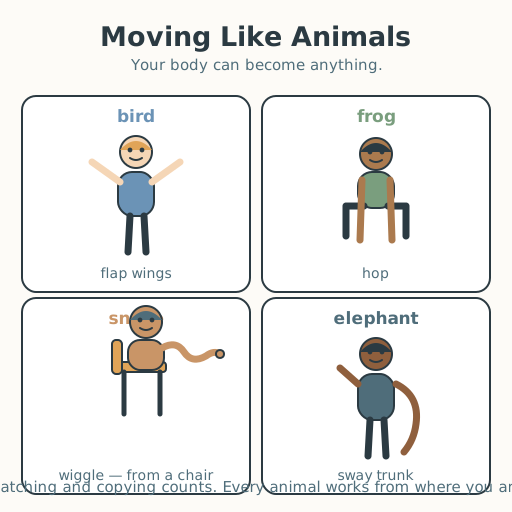
Lesson 6 — Moving Like Animals
Summary
Learners turn their bodies into animals. They crawl like a cat, leap like a frog, slither like a snake, and fly like a bird, watching and copying each other and inventing new ways to move. The moving body is the first and most honest instrument of pretending.
Objectives
- Move or pretend to be a person, animal, or character in response to a story or music. (D07.S3.K.01)
Connection
Have you ever watched a bird hop, a cat stretch, or an ant hurry? Animals move in amazing ways, and your body can try them all. In stories and dances everywhere in the world, people move like animals to play, to celebrate, and to understand them.
Materials
- Animal picture cards (bird, fish, snake, frog, cat, elephant)
- Open floor space
Preparation
- Clear a safe open space to move.
- Choose a few animals everyone can try; pick animals learners might know.
Facilitator note
This lesson is written to the learner (“you”) so it works in a classroom and for a self-directed learner. As facilitator, move along with the learners — your modeling is the best instruction. Encourage big, free movement, but keep the space safe. Never rank whose animal is “best”; the goal is expression, and every animal movement is right. Invite learners who use a chair, move differently, or prefer to stay seated to adapt each animal from where they are — an animal is in the hands, arms, and face as much as the legs.
Procedure
- Gather (5 min). Stand in open space. Shake out your arms and legs. Your body is ready to pretend.
- Watch and copy (10 min). Look at each animal card. How does it move? Try it: crawl low like a cat, hop like a frog, slither on your belly like a snake.
- Move like many animals (15 min). Call an animal and move as it across the space. Then freeze. Now another! Fly like a bird, swim like a fish, stomp like an elephant.
- Invent an animal move (10 min). Make up your own animal movement — a mix of two animals, or an animal no one has seen. Teach it to a friend.
- Close (5 min). Remember: your body can become anything. Animals all over the world have their own ways of moving, and now you have tried them.
Differentiation
- Support: Do one animal at a time, moving a single body part first (arms as wings) before the whole body.
- Seated/adapted: Every animal works from a chair or the floor — a bird flaps only its arms, a snake is a wiggling hand, an elephant sways a slow arm; “crawling” becomes reaching and pulling. Watching and copying counts as full movement.
- Extension: Invite learners to move like a baby animal and then the grown animal, and describe the difference.
Assessment
- Formative (observation): Does the learner move their body in a way that shows an animal?
- Performance: The learner’s animal movement, observed live.
Home connection
At home or outside, watch an animal for a minute and try to move like it. Show a grown-up your animal walk and let them guess which animal it is.