Lesson 07 — Pretending to Be a Character
Learners become characters from a simple story using voice, face, and body. They discover that pretending is a way to understand other people's lives and feelings.
Objectives
Objectives
- D07.S3.K.01 Move or pretend to be a person, animal, or character in response to a story or music.
Essential question
How do I become a character in a story?
Key vocabulary
Materials
Standard materials
- A simple story · 1 A short tale with a few characters (a helper, a seeker, a kind neighbor)
- Open floor space · enough to move
- A simple prop (optional) · 1 per learner A cloth, basket, or hat to help become the character
Low-tech / no-cost
- Voice, face, and body only Become a character with no props at all; the body is the costume
- A told story Hear the story aloud and act the characters as you go
Enriched / lab & device
- A set of simple dress-up cloths · 1 box Scarves, hats, and cloths to choose a character's look
- A camera or tablet · 1 per group Film the scene and watch it back to see the characters
Works in different contexts
- large-group Assign roles in a told story and have groups of learners play the same character together, then swap roles
- multi-age Older learners tell or read the story while younger learners act it out, then trade places
- self-directed A learner chooses a character, acts them out with voice, face, and body, and tells a grown-up or friend who they are
- level-grouped Some learners focus on one part of the character (just the voice or just the walk); others use voice, face, and body together
- outdoor-only Act the story outside using found things — a stick for a walking cane, a leaf for a dish — to become the character
Lesson 7 — Pretending to Be a Character
Summary
Learners step into a story and become its characters. Using their voice, face, and body, they play a helper, a seeker, a kind neighbor. Pretending lets a child feel what another person feels — a small, safe lesson in walking in someone else’s shoes.
Objectives
- Move or pretend to be a person, animal, or character in response to a story or music. (D07.S3.K.01)
Connection
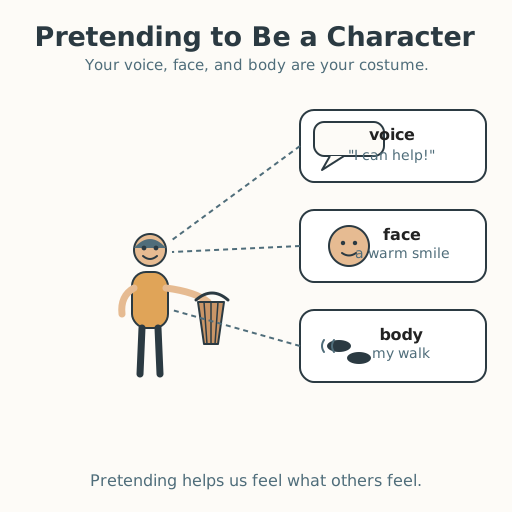
When you play make-believe, you get to be someone else for a while — a cook, a builder, a helper, a hero. People everywhere tell stories and act them out to share ideas and to understand each other. Your voice, face, and body are your costume.
Materials
- A simple story with a few characters
- Open floor space
- A simple prop (optional): a cloth, basket, or hat
Preparation
- Choose or tell a short story with two or three clear characters.
- Clear a space for acting and set out any simple props.
Facilitator note
This lesson is written to the learner (“you”) so it works in a classroom and for a self-directed learner. As facilitator, choose or tell a story where characters are kind and recognizable, from any culture, told respectfully as a story to play with. Never push a shy learner to perform; watching and copying is full participation. Celebrate every character — there is no “correct” way to play one.
Procedure
- Gather (5 min). Sit and listen to a short story. Who is in it? What do they do?
- Meet the characters (10 min). Pick a character. How do they stand? How do they talk — fast, slow, high, low? Try it: their walk, their voice, their face.
- Become the character (15 min). Act out a small part of the story as your character. Use your voice, your face, and your whole body. Trade characters and try another.
- Show and guess (10 min). Act your character for a friend. Can they guess who you are? Then tell them how it felt to be that person.
- Close (5 min). Remember: pretending helps us feel what others feel. There is a whole world of characters in every story.
Differentiation
- Support: Give one simple character and one action (“you are the helper carrying the basket”); let the learner copy.
- Seated/adapted: A character lives in the face, voice, and hands — play the whole character from a chair; a “walk” becomes a lean, a nod, or a hand gesture, and acting with just the face or voice is full participation.
- Extension: Invite learners to add a new character to the story and act how that character would join in.
Assessment
- Formative (observation): Does the learner use voice, face, or body to show a character?
- Performance: The learner’s character, observed live.
Home connection
With someone at home, pick a person from a story or a memory and both pretend to be them for a minute. Ask each other how it felt.