Lesson 03 — How Things Change
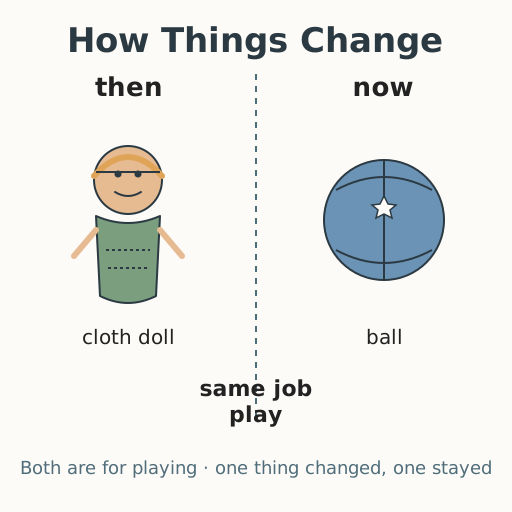
Learners compare an old and a new way of doing an everyday job — lighting a room, carrying water, playing — and name what changed and what stayed the same.
Objectives
Objectives
- D08.S1.K.01 Tell a "then and now" story about themselves or their family and how something changed.
Essential question
How do everyday things change over time?
Key vocabulary
Materials
Standard materials
- Old-and-new object cards · 1 set Pairs for the same job done differently, such as a candle and a lamp, a water pot and a tap, a simple toy and a newer toy
- A real old object (optional) · 1 or more Something safe to hold, such as a hand fan or a metal spoon
Low-tech / no-cost
- Real found pairs Two ways to do one job, such as a cup and a gourd for drinking, or a basket and a bag for carrying
- Voice and body Act out the jobs — carry water on your head, then turn a tap — with no objects needed
Enriched / lab & device
- Short video or slideshow · 1 per group Clips of the same job done in different times and places, such as fetching water or lighting a room
- Touch table · 1 table Old and new objects placed side by side for careful hands-on comparison
Works in different contexts
- large-group Pass one pair at a time around the circle so every learner can hold it, then act out the job together
- self-directed The learner matches old-and-new pairs alone, then tells one way they are the same and one way they are different
- outdoor-only Find two natural tools for one job outside, such as a big leaf and a small leaf for carrying water, and compare them
Lesson 3 — How Things Change
Summary
Learners look at old and new ways of doing an everyday job — lighting a room, carrying water, or playing — and name what changed and what stayed the same. History here is told through objects, not dates.
Objectives
- Tell a “then and now” story about themselves or their family and how something changed. (D08.S1.K.01)
Connection
Long ago, and still today in many homes, people lit a room with a candle or a lantern; in other homes a lamp turns on with a switch. Both give light — that part stayed the same. People everywhere have found many good ways to do the same jobs.
Materials
- Old-and-new object cards (a candle and a lamp, a water pot and a tap, a simple toy and a newer toy)
- A real old object (optional)
Preparation
- Gather old-and-new pairs as cards or real objects.
- Clear a space for acting out the jobs.
Facilitator note
Written to the learner (“you”) so it works in a classroom and for a self-directed learner. Hold all ways with respect: never rank “old” as worse or “new” as better. Some learners’ families still light rooms with candles or carry water — these are valid, living ways, not museum curiosities. The point is change and sameness, not progress or superiority.
Procedure
- Gather (5 min). Sit comfortably. Think of a job people do every day: getting light, getting water, playing.
- Meet the pairs (10 min). Look at an old-and-new pair that does the same job. Which is old? Which is new? What does each one do?
- Act it out (15 min). Pretend to light a candle, then flip a switch. Pretend to carry water in a pot, then turn a tap. Feel the difference with your body.
- Name it (10 min). For one pair, say one thing that changed (“now it is faster”) and one thing that stayed the same (“both give light”).
- Close (5 min). Things change over time, and people everywhere find many ways to do the same important jobs.
Differentiation
- Support: Compare just one pair and act out only one job.
- Extension: Invite learners to draw a third way the same job might be done in the future, and tell what stayed the same.
Assessment
- Formative (observation): Can the learner say one thing that changed and one that stayed the same for an old-and-new pair?
- Formative (oral): Does the learner tell a tiny then-and-now story about a tool or job?