Lesson 09 — Fair and Unfair
Learners hear a gentle, blame-free story about being treated fairly or unfairly, name which is which, and retell it in their own words.
Objectives
Objectives
- D08.S4.K.01 Retell a gentle story about someone being treated fairly or unfairly.
Essential question
What does it mean to be treated fairly or unfairly?
Key vocabulary
Materials
Standard materials
- A gentle fair/unfair story · 1 A short story about sharing turns or being left out, with a kind ending, told or read by the facilitator
- Two feeling cards · 1 set A "fair" face and an "unfair" face for pointing, or just two labeled spots
Low-tech / no-cost
- A made-up class story Tell a simple story about toys and turns; no book needed
- Two holding spots A "fair" spot and an "unfair" spot drawn on the floor for acting and sorting
Enriched / lab & device
- A set of fair/unfair picture scenes · 1 set Simple scenes of sharing, taking turns, and being left out, for sorting and retelling
- Puppets or dolls · 1 set For acting out a fair and an unfair turn, then retelling it
Works in different contexts
- large-group Tell the story once, then act out the fair and unfair turns with two learners while the group points to the matching spot
- self-directed The learner listens to or reads the story, sorts the picture scenes into fair and unfair, and retells one in their own words
- outdoor-only Act out a game of turns outside with a ball or stick — first everyone gets a turn (fair), then one person is left out (unfair) — and name each
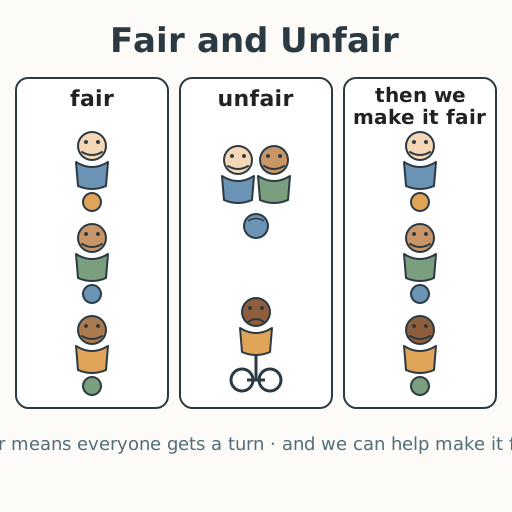
Lesson 9 — Fair and Unfair
Summary
Learners hear a gentle, blame-free story about someone being treated fairly or unfairly. They name which is which, notice how it felt, and retell the story in their own words.
Objectives
- Retell a gentle story about someone being treated fairly or unfairly. (D08.S4.K.01)
Connection
Fair means everyone gets a turn and no one is left out for no reason; unfair means someone is treated differently for no good reason. You see fair and unfair every day — who gets a turn, who is included, who is listened to. Noticing it kindly is the first step to making things fairer.
Materials
- A gentle fair/unfair story (about sharing turns or being left out, with a kind ending)
- Two feeling cards or labeled spots: “fair” and “unfair”
Preparation
- Choose or write a short, gentle story with one fair moment and one unfair moment, ending kindly and without blame.
- Set up the two labeled spots or cards.
Facilitator note
Written to the learner (“you”) so it works in a classroom and for a self-directed learner. Keep the story gentle and blame-free. The goal is noticing and naming, not shaming a character. End with repair — someone makes it fair. Avoid scary or heavy unfairness at this age. Let learners retell in their own words; every retelling is a step toward understanding fairness.
Procedure
- Gather (5 min). Sit comfortably. Think of a time everyone got a turn. How did that feel?
- Hear the story (15 min). Listen to the story. There is a part where someone is treated fairly, and a part where someone is treated unfairly.
- Name it (10 min). Point to the “fair” spot or the “unfair” spot for each part. How did the person feel in each part?
- Retell it (10 min). Tell the story back in your own words. Change the order if you like, but keep the fair part and the unfair part clear.
- Close (5 min). Fair means everyone gets a turn and is included. We can notice fair and unfair, kindly, and help make things fairer.
Differentiation
- Support: Tell just the unfair part and ask one question: “How did they feel?” Then show the repair.
- Non-speaking: A learner may retell by pointing to the fair and unfair spots, acting the two parts out with their body, or ordering picture cards, instead of speaking.
- Extension: Invite learners to make up a tiny new ending where the unfair part becomes fair, and act it out.
Assessment
- Formative (observation): Can the learner point to or say which part was fair and which was unfair?
- Formative (oral): Does the learner retell the story, keeping the fair and unfair parts clear?