Lesson 04 — What Made Me Feel That Way?
Learners work backward from a feeling to find its cause, matching situations to feelings and stating the link with the frame "I felt ___ when ___."
Objectives
Objectives
- D01.S1.01.02 Connect a feeling to the situation that caused it, using the frame I felt ___ when ___.
Essential question
How do I find the situation that caused my feeling?
Key vocabulary
Materials
Standard materials
- Scenario picture cards · 1 set Simple pictures of situations (a gift, a lost toy, a new friend, a storm)
- Feeling face cards (seven faces) · 1 set
- Paper and crayons · per learner
Low-tech / no-cost
- Told-aloud situations Describe each situation with words and body; no picture cards needed
- Voice and body Act out the feeling and the situation together, then say the sentence
Enriched / lab & device
- Storybook with clear emotional moments · 1 per group Learners find a page, name the character's feeling, and connect it to what happened
- Tablet · 1 per group Sort digital picture cards of situations to the feelings they cause
Works in different contexts
- large-group Hold up a scenario card; the group calls the feeling, then one volunteer says the full "I felt ___ when ___" sentence
- self-directed A learner matches each scenario picture to a feeling and writes or draws one matching sentence
- outdoor-only Find a real situation outdoors (a dropped leaf, a tall climb) and name the feeling it causes, then say the sentence
- level-grouped Learners ready to extend explain why different situations can cause the same feeling, or the same situation different feelings
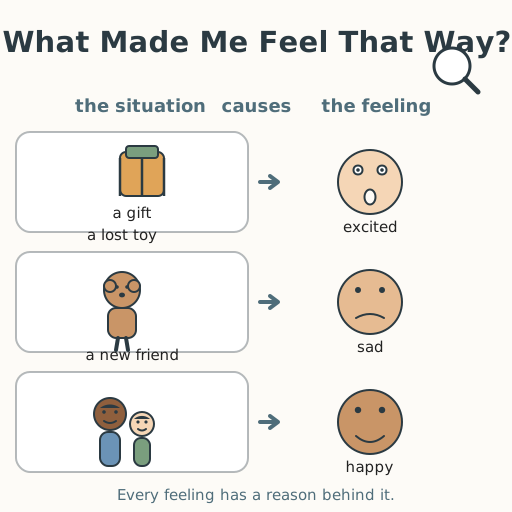
Lesson 4 — What Made Me Feel That Way?
Summary
Learners practice the second half of the feeling sentence: finding the situation that caused a feeling. They match situations to feelings, then state the link using “I felt ___ when ___,” and notice that a feeling always has a reason behind it.
Objectives
- Connect a feeling to the situation that caused it, using the frame “I felt ___ when ___.” (D01.S1.01.02)
Connection
Sometimes the feeling is easy to see but the reason is a puzzle. You feel angry — but why? Was it a toy that was taken, or a plan that changed? Finding the when is like being a detective of your own heart. Once you know the cause, you can understand your feeling and decide what to do about it.
Materials
- Scenario picture cards (a gift, a lost toy, a new friend, a storm, a finished drawing)
- Feeling face cards (happy, sad, angry, scared, proud, lonely, excited)
- Paper and crayons
Preparation
- Prepare the scenario picture cards (draw them if printed ones are unavailable).
- Set out the feeling cards.
- Clear space for acting out situations.
Facilitator note
This lesson is written to the learner (“you”). Model “working backward”: hold up a scenario, wonder aloud about the feeling, and say the sentence. Accept that one situation can cause different feelings in different learners — that is real, not an error. Keep the focus on the link between situation and feeling, not on a single “correct” answer.
Procedure
- Gather (5 min). Remember the frame: “I felt ___ when ___.” Today you become the detective: start with the feeling, then hunt for the when.
- Situation cards (15 min). Look at each scenario picture. What feeling might it cause? Say the full sentence. (A gift → “I felt excited when I got a gift.” A lost toy → “I felt sad when I lost my toy.”)
- Act it out (10 min). Choose a scenario card and act out the situation, then freeze in the feeling. A partner names the feeling and the cause, using the frame.
- Draw the link (10 min). Draw a picture of a situation from your own life, and write or say the sentence beneath it: “I felt ___ when ___.”
- Close (5 min). Every feeling has a reason. Finding the reason is the first step to understanding yourself.
Differentiation
- Support: Give a choice of two feeling cards for each scenario; the learner picks and says the sentence.
- Extension: Explain how the same situation could make two different people feel two different things.
Assessment
- Formative (observation): Can the learner connect a given situation to a plausible feeling and state it with the frame?
Home connection
Be a detective at home: notice a feeling you have today, then name the situation that caused it, using “I felt ___ when ___.”