Lesson 08 — Telling My Story
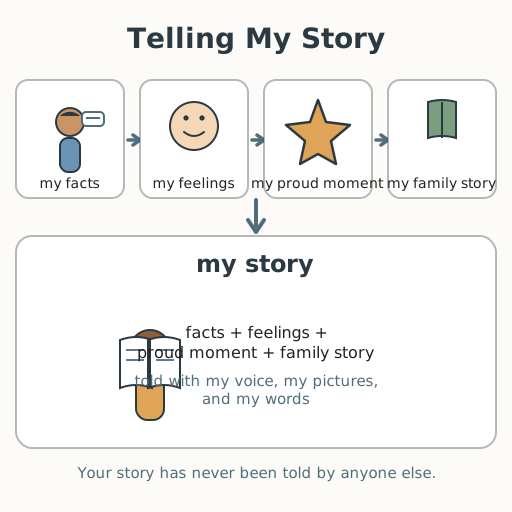
Learners bring together the pieces of the unit — facts, feelings, a proud moment, and a family story — into one telling of "my story," noticing that stories can be told aloud, on paper, or through pictures.
Objectives
Objectives
- D01.S2.01.02 Name a family story or tradition and tell what it means to them.
Essential question
How do I put my facts, feelings, and family story together into my story?
Key vocabulary
Materials
Standard materials
- My Story page template · 1 per learner Space for a self-portrait, a few facts, and a family story or tradition
- Crayons and pencils · per learner
- A listening partner guide · 1 per pair Two or three gentle questions to ask a storyteller
Low-tech / no-cost
- A folded paper booklet Fold a sheet into a small book and draw each part of the story on a page
- Voice and a partner Tell the story aloud to a partner; no paper or template needed
Enriched / lab & device
- A story recording corner · 1 per group A device to record each learner telling their story, with permission, for a class "story archive"
- Printed story booklet · 1 per learner A keepsake booklet with room to add photos or drawings across the year
Works in different contexts
- large-group Learners present in small circles of three or four so every voice gets a turn and a listener
- self-directed A learner assembles their story page or booklet alone, then reads it back to a trusted listener
- outdoor-only Tell stories in a circle outdoors; use a "talking stone" passed from speaker to speaker
- level-grouped Learners ready to extend add a "next" — one hope or a wish for their story going forward
Lesson 8 — Telling My Story
Summary
Learners gather the pieces they have built this unit — their facts, their feelings, a proud moment, and a family story or tradition — and tell them as one story. They discover that stories can be told aloud, drawn, or written, and that every person’s story is worth hearing.
Objectives
- Name a family story or tradition and tell what it means to them. (D01.S2.01.02)
Connection
A story is how we hold the pieces of ourselves together and share them with others. Long before books, people told their stories out loud around fires, and families passed them down. Today you can tell your story with your voice, with pictures, or with words — but the story itself is the treasure. Your story has never been told by anyone else, and it is worth hearing.
Materials
- “My Story” page or booklet template
- Crayons and pencils
- A listening partner guide (two or three gentle questions)
Preparation
- Prepare the “My Story” page or booklet (self-portrait, facts, family story).
- Set out drawing supplies.
- Arrange small sharing circles.
Facilitator note
This lesson is written to the learner (“you”). Prepare the page or booklet, then support learners as they assemble and tell. Storytelling is the oldest technology of all — celebrate that stories live in voices and pictures, not only in books or on screens. Keep listening gentle and unrushed; every story, however small, is honored. A learner who does not want to speak may show their page instead.
Procedure
- Gather (5 min). Think back over this unit: your facts, your feelings, your proud moment, your family story. Today you weave them into one story — your story.
- Assemble the pieces (15 min). On your page or in your booklet, put together: a self-portrait, two or three facts about you, one proud moment, and one family story or tradition.
- Practice telling it (10 min). Tell your story to a partner, using the page as your guide. The partner listens and asks one gentle question (“What does that tradition mean to you?”).
- Share in a small circle (10 min). In a group of three or four, take turns telling your story. Listen like a treasure-keeper: quietly, kindly, fully.
- Close (5 min). Your story is yours — no one else has it. Telling it is how people come to know you, and how you come to know yourself.
Differentiation
- Support: Use the page as a picture script; the learner points while an older peer or facilitator voices the words.
- Extension: Add a “next” page — one hope for your story going forward.
Assessment
- Formative (observation): Can the learner tell their story, including a family story or tradition and what it means?
- Artifact (portfolio): The “My Story” page or booklet, kept in the portfolio.
Home connection
Tell your story to someone at home tonight — the same story you told today — and ask them to tell you a piece of their own.