Lesson 10 — Wait and Stop
Learners practice the first steps of self-regulation — waiting for a turn and stopping a behavior when asked — and then gather the whole unit into a light capstone: naming a feeling, a fact, a family story, and a calming strategy.
Objectives
Objectives
- D01.S3.01.02 Wait for a turn and stop a behavior when asked, with support.
- D01.S3.01.01 Use one calming strategy, such as a deep breath, counting, or finding a safe space, when upset, with a gentle reminder.
- D01.S1.01.01 Name and show a growing set of feelings such as proud, lonely, and excited in themselves and others.
- D01.S1.01.02 Connect a feeling to the situation that caused it, using the frame I felt ___ when ___.
- D01.S2.01.01 Describe themselves with several facts such as age, likes, abilities, and family, and tell one thing they are proud of.
- D01.S2.01.02 Name a family story or tradition and tell what it means to them.
Essential question
How do I wait for my turn and stop a behavior when asked?
Key vocabulary
Materials
Standard materials
- A "talking object" (stone, shell, or ball) · 1 Only the person holding it speaks, so everyone practices waiting
- Stop-and-wait cue cards · 1 set A "wait" card and a "stop" card with friendly pictures
- A simple group game · 1 Any turn-taking game, such as passing a ball or a circle chant
Low-tech / no-cost
- Hands and voice Practice waiting by holding an empty hand; the "stop" signal is a gentle open palm and a calm word
- A found talking object Any stick, stone, or leaf can be the talking object — no special props needed
Enriched / lab & device
- A visual turn-taking chart · 1 A magnetic or pocket chart showing whose turn is next
- A short timer or sand timer · 1 per group A visible way for learners to see how long a turn lasts
Works in different contexts
- large-group Pass the talking object around a big circle; the whole group watches and waits, and the "stop" cue is practiced as a group freeze
- self-directed A learner practices with a partner or sibling, taking turns with the object and asking for a stop and a go
- outdoor-only Play a movement game with start-and-stop calls outdoors — run, then freeze on the stop signal, then wait for "go"
- level-grouped Learners ready to extend reflect on the capstone: name one feeling word, one fact about themselves, one family story, and one calming strategy
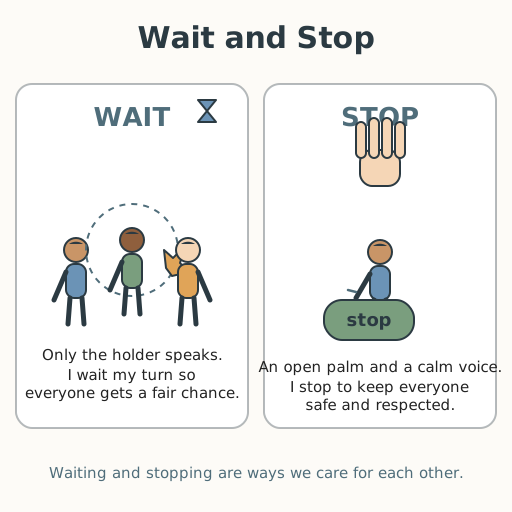
Lesson 10 — Wait and Stop
Summary
Learners practice two first steps of self-regulation — waiting for a turn and stopping a behavior when asked, with gentle support. The lesson doubles as a light capstone: learners gather what they have learned this unit and share one feeling word, one fact about themselves, one family story, and one calming strategy.
Objectives
- Wait for a turn and stop a behavior when asked, with support. (D01.S3.01.02)
- Use one calming strategy when upset, with a gentle reminder. (D01.S3.01.01)
- Name and show a growing set of feelings. (D01.S1.01.01)
- Connect a feeling to its cause using “I felt ___ when ___.” (D01.S1.01.02)
- Describe themselves with several facts and tell one thing they are proud of. (D01.S2.01.01)
- Name a family story or tradition and tell what it means to them. (D01.S2.01.02)
Connection
Waiting and stopping are hard — even for grown-ups. When many people share one space, we take turns so everyone gets a fair chance, and we stop when a safe grown-up asks so that everyone stays safe and respected. These are not punishments; they are how we care for each other. Practicing them, with a gentle reminder, is how we learn to choose our actions instead of just reacting.
Materials
- A talking object (stone, shell, or ball)
- Stop-and-wait cue cards (“wait,” “stop”)
- A simple group game (pass the ball, or a circle chant)
Preparation
- Prepare the talking object and the wait/stop cue cards.
- Choose a simple turn-taking game.
- Arrange a circle.
Facilitator note
This lesson is written to the learner (“you”). Keep the “stop” cue calm and kind — an open palm and a soft word, never a shout or a threat. Wait and stop are skills to be built with support and patience, not obedience drills. The capstone is a celebration, not a test: every learner shares what they can, and every share is honored. Offer the frame and let learners choose which piece to share.
Procedure
- Gather (5 min). Think: is it easy or hard to wait for your turn? Is it easy or hard to stop when someone says stop? Today you practice both — with help.
- The talking object (10 min). Only the person holding the object speaks. When it is not your turn, you wait — hands quiet, ears open. Pass the object around and let each person say their name and one favorite thing.
- Stop, with kindness (10 min). Learn the stop cue: an open palm and a calm voice. Practice a freeze game — move, then stop on the signal, then wait for “go.” Stopping keeps everyone safe; it is a kind thing, not a mean one.
- Turn-taking game (10 min). Play your group game, taking turns and practicing wait and stop as you go. Notice how it feels to be included when everyone waits fairly.
- Capstone circle (10 min). Take the talking object one more time. Share one thing you learned this unit: a feeling word, a fact about you, a family story, or your calming strategy.
- Close (5 min). You can name your feelings, tell your story, calm yourself, and wait and stop. Those are real powers — and they grow with practice.
Differentiation
- Support: Use only the talking object and the stop cue; skip the full capstone and let the learner share just one piece.
- Extension: Reflect on the capstone by drawing all four things — a feeling, a fact, a family story, a calming strategy — on one page.
Assessment
- Formative (observation): Can the learner wait for a turn and stop a behavior when asked, with a gentle reminder?
- Performance: The learner shares one piece from the unit in the capstone circle.
Home connection
Play a turn-taking game at home tonight, and practice the stop cue together — an open palm and a calm voice.