Lesson 05 — Tired and Rested
Learners notice the body's tiredness signals and learn that rest and sleep help energy return. They practice a short rest-and-breathe pause and sort tired from rested.
Objectives
Objectives
- D03.S1.01.02 Notice and name body signals such as hunger, thirst, and tiredness when they feel them.
Essential question
How do I know I am tired, and how does rest help?
Key vocabulary
Materials
Standard materials
- Signal picture cards (tiredness) · 1 set Reuse the tiredness card from Lesson 3, plus a new "rested" card
- A quiet mat or blanket · per learner, if available For the rest-and-breathe pause
Low-tech / no-cost
- Your own body and breath Notice tiredness and practice rest with slow breathing; no mats or cards needed
- Voice Describe tired and rested aloud and act out each with the body
Enriched / lab & device
- Tired or rested? sorting cards · 1 set per pair Picture cards of yawning, heavy bodies and bright, alert bodies to sort
- A timer or soft music player · 1 To time a quiet rest-and-breathe pause
Works in different contexts
- large-group Lead the rest-and-breathe pause for the whole group together, then sort the cards aloud
- self-directed A learner notices their own tiredness, practices the rest-and-breathe pause, and sorts the cards alone
- outdoor-only Find a quiet spot to rest outdoors; notice how a still, shady place helps a tired body feel better
- level-grouped Learners who name tiredness quickly can teach the rest-and-breathe pause to a partner
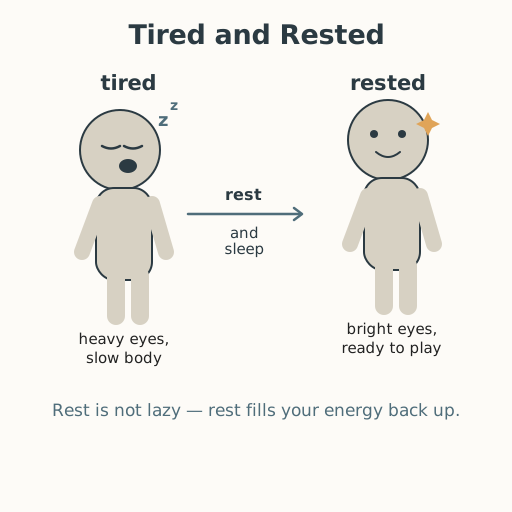
Lesson 5 — Tired and Rested
Summary
Learners notice what tiredness feels like in the body — heavy eyelids, yawning, a slow, heavy feeling — and learn that rest and sleep help energy come back. They practice a short rest-and-breathe pause and sort tired from rested.
Objectives
- Notice and name the body signal of tiredness, and say how rest helps. (D03.S1.01.02)
Connection
Everyone gets tired, every day — after running, after working, or when a day has been long. A tired body sends messages: your eyes want to close, your body feels slow and heavy. Rest is not being lazy; rest is how your body fills its energy back up so you can play and learn again.
Materials
- Signal picture cards (tiredness, rested)
- A quiet mat or blanket (if available)
Preparation
- Set out the tiredness card and a new “rested” card.
- Lay out mats or blankets for the rest-and-breathe pause.
- Clear a calm corner for quiet rest.
Facilitator note
This lesson is written to the learner (“you”) so it works in a classroom and for a self-directed learner. Prepare the cards and a calm resting space, then lead the rest-and-breathe pause. Be gentle about tiredness: never blame a learner for being tired or sleepy, and never assume how much rest a learner got last night — homes differ. Rest here is framed as kind care, not as a punishment or a fix for misbehavior. A short quiet pause is enough; it can be done sitting, lying, or with eyes closed or open.
Procedure
- Gather (5 min). How does your body feel right now — full of energy, or a little slow and heavy? Look at the tiredness card. Name what a tired body does: yawns, heavy eyelids, slow heavy limbs.
- What is rest? (10 min). When your body is tired, rest helps energy come back. Sleep is a long rest; a quiet pause is a short one. Rest is kind care, not being lazy. Look at the rested card — bright eyes, light body, ready to play.
- Rest-and-breathe pause (10 min). Find a comfy spot on your mat or in your seat. Close your eyes or look softly down. Take three slow breaths in and out. Let your body be still and heavy for one quiet minute. Feel your body settle.
- Tired or rested? sort (10 min). When you hear a clue, point to the card: “yawning and heavy eyelids” — tired; “bright and ready to run” — rested; “you just woke up from a good sleep” — rested.
- Close (5 min). Your body tells you when it needs rest, and rest fills your energy back up. Name one way you can rest today.
Differentiation
- Support: Practice only the rest-and-breathe pause together, with the facilitator modeling slow breaths.
- Extension: Ask learners to draw “my tired body” and “my rested body” and tell the difference.
Assessment
- Formative (observation): Can the learner name tiredness signals (yawning, heavy eyes, slow body) and say that rest or sleep helps?
Resources
- World Health Organization — global health and wellbeing reference: https://www.who.int/