Lesson 06 — Skipping and Galloping
Learners learn two traveling movements — skipping and galloping — and practice them to a steady beat with balance and control, with seated and adapted versions for every body.
Objectives
Objectives
- D03.S2.01.01 Perform basic movements such as skipping, galloping, hopping, and jumping with balance and control.
Essential question
How do I skip and gallop with balance and control?
Key vocabulary
Materials
Standard materials
- A beat source (clapping, drum, or song) · 1 To keep a steady rhythm while skipping and galloping
- Cones, chalk, or rope · 1 set To mark a starting line and a clear path
Low-tech / no-cost
- Voice and clapping Clap or chant a steady beat; no instruments, cones, or rope needed
- Open floor or ground Any clear space to move in works
Enriched / lab & device
- Music player with a steady-beat song · 1 A familiar rhythm to skip and gallop to
- Ribbon streamers or scarves · per learner To hold while moving, adding joy and a focus point for control
Works in different contexts
- large-group Clap a shared beat and move in one direction around a marked loop so everyone has space and a clear path
- self-directed A learner claps their own beat and practices skip and gallop at their own pace, checking each step for control
- outdoor-only Skip and gallop along a clear outdoor path, from one mark to the next, using the ground as the boundary
- multi-age Older learners demonstrate skip and gallop while younger learners copy, taking turns as leader
Lesson 6 — Skipping and Galloping
Summary
Learners learn two big traveling movements — skipping and galloping — and practice them to a steady beat, moving from one mark to the next with balance and control. Every body joins in its own way, with seated and adapted versions offered alongside.
Objectives
- Perform skipping and galloping with balance and control. (D03.S2.01.01)
Connection
All over the world, people move to music — dancing, skipping, and stepping in time. Skipping and galloping are two ways your body can travel while keeping a beat. They grow your balance and control, and they feel joyful — like a song your whole body sings.
Materials
- A beat source (clapping, drum, or song)
- Cones, chalk, or rope to mark a path
Preparation
- Mark a starting line and a clear path with cones, chalk, or rope.
- Clear enough space for everyone to move without bumping.
- Prepare a steady beat to clap, drum, or play.
Facilitator note
This lesson is written to the learner (“you”) so it works in a classroom and for a self-directed learner. Prepare the space and beat, then model each movement slowly before the learners try. This is movement, not a race — celebrate control, rhythm, and joy, never speed or distance. Honor every body: a learner who uses a wheelchair can skip and gallop with their arms and wheels; a learner who needs support can do a seated or step version. Model the adapted versions as real choices, not second choices, so no one is left watching. Keep a visual beat going too — a bouncing hand or a partner tapping — so learners who are deaf or hard of hearing can move in time. Invite everyone to rest and go at their own pace; breath and joy matter more than speed, especially for learners with breathing differences.
Procedure
- Warm up (5 min). March in place to the beat, lifting your knees. Shake out your arms and legs. Your body is awake and ready.
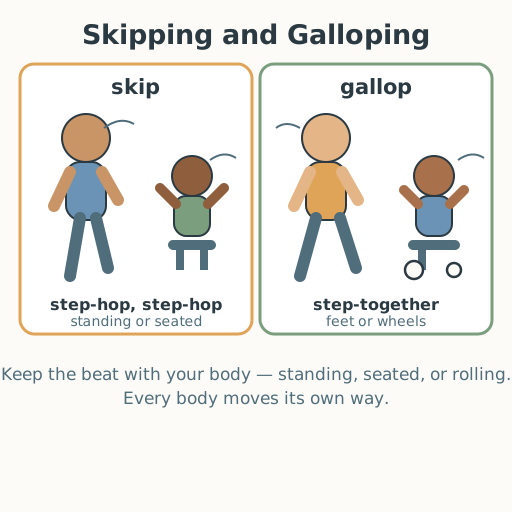
- Learn to skip (10 min). A skip is a step and a hop on the same foot, then step-hop on the other foot: step-hop, step-hop. Try it slowly at first, arms swinging to help you balance.
- Learn to gallop (10 min). A gallop is like a horse: one foot leads in front, and the back foot chases it — step-together, step-together. Try leading with one foot, then switch to lead with the other.
- Move to the beat (15 min). From the starting mark, skip to the other mark, then gallop back. Keep the beat with your feet. If you use wheels, push and glide in the same rhythm; if you are seated, do the skip and gallop with your arms swinging to the beat.
- Close (5 min). Slow your body down and catch your breath. You can skip and gallop now — two new ways to move with balance and control.
Differentiation
- Support: Practice the gallop first (step-together is easier to keep) before moving to the skip; clap the beat slowly.
- Extension: Ask learners to skip in a circle or gallop in a curving path, keeping the beat and control.
Assessment
- Formative (observation): Can the learner skip and gallop with a steady rhythm and control, in their own body’s way?
Home connection
Teach someone at home to skip or gallop, and move to a beat together.