Lesson 07 — Hopping and Jumping
Learners learn to hop on one foot and jump with two feet, and practice landing softly with bent knees for balance and control, with seated and adapted versions for every body.
Objectives
Objectives
- D03.S2.01.01 Perform basic movements such as skipping, galloping, hopping, and jumping with balance and control.
Essential question
How do I hop and jump with balance and control?
Key vocabulary
Materials
Standard materials
- A rope, chalk line, or flat ribbon · 1 To make a "stream" to jump over and a line to hop along
- Floor markers or chalk dots · 1 set Landing spots to aim for when jumping
Low-tech / no-cost
- A drawn line or crack in the ground Any line becomes the "stream" to jump over
- Your own body Hop and jump on the spot; no props needed
Enriched / lab & device
- Soft landing mats · 1 set Cushioned spots for jumping and landing practice
- A small target mat or hoop · 1 per pair A clear landing target to aim for when jumping
Works in different contexts
- large-group Make one long line and take turns hopping along it and jumping over it, keeping plenty of space between learners
- self-directed A learner sets their own line, practices hop and jump at their own pace, and checks each landing for control
- outdoor-only Use a real or drawn line in the dirt as the "stream" to jump over and the path to hop along
- level-grouped Learners who can hop and jump far practice aiming at targets, while others practice on the spot with support
Lesson 7 — Hopping and Jumping
Summary
Learners learn two springing movements — hopping on one foot and jumping with two feet — and practice landing softly with bent knees so they stay balanced and in control. Seated and adapted versions are offered so every body can spring and land in its own way.
Objectives
- Perform hopping and jumping with balance and control. (D03.S2.01.01)
Connection
Think of a frog pushing off the ground, or a child leaping over a puddle. Hopping on one foot and jumping with two are ways your body springs and lands. Learning to land softly, with bent knees, keeps you safe and in control — so you can jump again and again.
Materials
- A rope, chalk line, or flat ribbon to make a “stream”
- Floor markers or chalk dots for landing spots
Preparation
- Lay a rope or draw a line to make a “stream” to jump over.
- Mark landing spots with chalk dots or floor markers.
- Clear space so no one bumps into anyone while hopping and jumping.
Facilitator note
This lesson is written to the learner (“you”) so it works in a classroom and for a self-directed learner. Prepare the line and landing spots, then model hop, jump, and the soft landing before learners try. Emphasize control and a soft landing, never height or distance. Honor every body: a learner who uses a wheelchair can do seated bounces and arm springs; a learner who needs support can hold a friend’s hand or a wall. Offer adapted versions as real choices so every learner is moving, not watching. A visual landing cue (a raised hand or a partner’s tap) lets learners who are deaf or hard of hearing time their springs. Learners with breathing differences may rest and rejoin as often as they need; control and a soft landing matter more than repetitions.
Procedure
- Warm up (5 min). Bounce gently on the spot with both feet. Shake out your arms and legs. Feel your knees ready to bend.
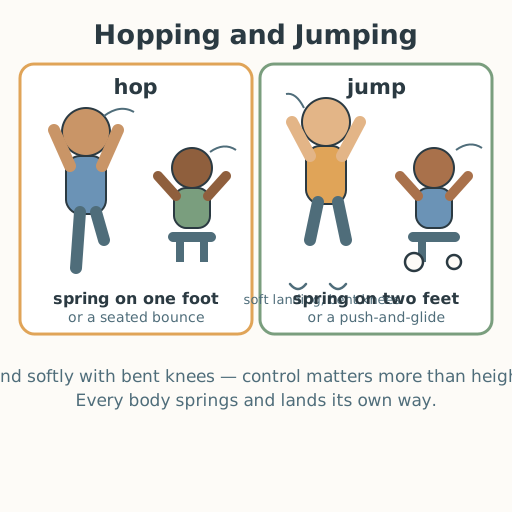
- Learn to hop (10 min). A hop is a spring on one foot. Try a small hop on one foot, then the other. Hold your arms out to balance. Land softly with a bent knee.
- Learn to jump (10 min). A jump is a spring with two feet. Bend your knees, swing your arms, and jump up — then land softly, knees bent. Now jump forward over the “stream,” landing on the marked spot.
- Spring and land game (15 min). Take turns: hop along the line on one foot, then jump over the stream with two feet. Land softly every time. If you use wheels, do a push-and-glide “jump” and a seated bounce; if you are seated, spring with your arms and bounce in your seat to the beat.
- Close (5 min). Slow down and breathe. You can hop and jump and land softly. Your knees and your balance keep you safe.
Differentiation
- Support: Practice the soft landing first (bend knees) before adding the spring; hop in place with a hand held for balance.
- Extension: Ask learners to combine movements — hop twice, then jump over the stream — keeping control the whole way.
Assessment
- Formative (observation): Can the learner hop on one foot and jump with two feet, landing softly with balance and control?
Home connection
Find a safe line at home (a crack, a rope) and practice hopping along it and jumping over it with a soft landing.