Lesson 08 — Balance and Control
Learners practice keeping their bodies steady and in control — balancing on two feet and one, walking a line, and carrying an object while balanced — with seated and supported versions for every body.
Objectives
Objectives
- D03.S2.01.01 Perform basic movements such as skipping, galloping, hopping, and jumping with balance and control.
Essential question
How do I keep my body steady and in control?
Key vocabulary
Materials
Standard materials
- A rope or chalk line · 1 A "balance beam" line to walk along
- Beanbags or small soft objects · per learner To balance on the head or hand while moving
Low-tech / no-cost
- A drawn line or a fallen branch Any line on the ground becomes a balance beam
- A found object (leaf, stone, folded cloth) To balance on the head or hand
Enriched / lab & device
- A low balance beam or plank on the ground · 1 A real, low, stable beam for balance practice
- Balance stepping stones or flat mats · 1 set Raised spots to step from one to the next with control
Works in different contexts
- large-group Make one long line and take turns walking it, with a wall or a friend's hand nearby for anyone who wants support
- self-directed A learner sets their own line, walks it slowly, and practices balancing a beanbag while staying steady
- outdoor-only Balance on a log, a low wall, or a line in the dirt, and carry a leaf or stone on an open hand
- multi-age Older learners model the statue game and steady walking while younger learners copy
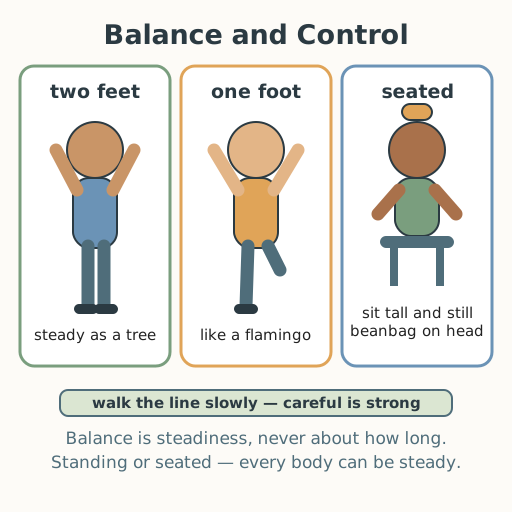
Lesson 8 — Balance and Control
Summary
Learners practice staying steady and in control: balancing on two feet and then one, walking a line heel-to-toe, and carrying a soft object while balanced. They close with a freeze-statue game that turns balance into joy. Seated and supported versions let every body join in.
Objectives
- Perform balancing movements with balance and control. (D03.S2.01.01)
Connection
A bird standing on one leg, a person crossing a narrow bridge, a child carrying a full cup without spilling — all of these are balance. Balance is your body’s way of staying steady and in control, whether you are still or moving. It helps you walk, carry, and play without toppling.
Materials
- A rope or chalk line
- Beanbags or small soft objects to balance
Preparation
- Lay a rope or draw a line for a “balance beam.”
- Set out beanbags or soft objects for balancing.
- Clear space so learners can move and freeze without bumping.
Facilitator note
This lesson is written to the learner (“you”) so it works in a classroom and for a self-directed learner. Prepare the line and beanbags, then model each balance slowly. Balance is about steadiness and control, never about “how long” — celebrate any successful steady moment. Honor every body: seated balance (a beanbag on the head or hand, a straight still back) is real balance too, and a learner who uses a wheelchair can practice keeping steady while gliding or holding a pose. Always offer a wall or a friend’s hand as support; no one should feel they might fall. For the freeze game, use a visible signal too — a raised hand, a flag, or a flicked light — alongside the spoken “freeze,” so learners who are deaf or hard of hearing join in fully. Invite learners with breathing differences (such as asthma) to rest and rejoin whenever they need, moving at their own pace; a calm, steady breath matters more than finishing the sequence.
Procedure
- Warm up (5 min). Stand tall and still like a tree. Sway gently side to side and find your center. Feel your feet press the ground.
- Balance on two, then one (10 min). Stand on two feet, steady as a tree. Now slowly lift one foot and balance on the other. Hold your arms out like branches. Switch feet. Use a wall or a friend’s hand if you want.
- Walk the line (10 min). Walk along the line slowly, one foot in front of the other. Keep your eyes ahead and your body steady. If you use wheels, glide the line slowly and smoothly; if you are seated, sit tall and still, balancing a beanbag on your head or hand.
- Carry and balance (10 min). Put a beanbag on your open hand or your head. Walk the line without dropping it. Move slowly — careful is strong.
- Freeze-statue game (10 min). Move around the space. When you hear “freeze,” stop and hold a steady shape — a tree, a flamingo, a bridge. Stay still and balanced until the word “go.”
Differentiation
- Support: Balance only on two feet at first, then try lifting one foot with support; walk the line with a partner’s hand.
- Extension: Ask learners to walk the line backwards, or balance the beanbag on a different body part (shoulder, knee).
Assessment
- Formative (observation): Can the learner hold a steady balance on one foot (or a seated steady pose) and walk a line with control?
Home connection
Practice standing like a flamingo on one foot — or sitting tall and still — with someone at home, and stay steady together through one slow breath.