Lesson 04 — Reading Feelings
Learners read feelings from three clues — face, voice, and body — and practice guessing a classmate's feeling, then checking their guess by asking.
Objectives
Objectives
- D02.S2.01.01 Guess how a classmate feels by reading their face, voice, or body.
Essential question
How can I tell how a classmate feels?
Key vocabulary
Materials
Standard materials
- Feeling face cards · 1 set Happy, sad, angry, scared, and calm faces in varied skin tones
- Paper and crayons · per learner
Low-tech / no-cost
- A friend's face and body Use real faces, voices, and bodies as the "cards"; no printed cards needed
- Voice only Say a sentence in a happy or sad voice and let others guess the feeling
Enriched / lab & device
- Photo cards of real children · 1 set Photographs of children showing different feelings, for closer reading of real faces
- Camera or tablet · 1 per group Photograph learners making a feeling face, then guess each other's feeling from the photo
Works in different contexts
- large-group Hold each feeling face card up large and have the whole group make the face, voice, and body together before guessing
- self-directed A learner matches feeling cards to faces in a book or a set of photos, then draws three feeling faces of their own
- outdoor-only Act out feelings with the whole body in an open space; guess a partner's feeling from their movements alone
- multi-age An older learner performs a feeling with face, voice, and body while younger learners guess, then they swap
Lesson 4 — Reading Feelings
Summary
Learners discover that feelings show up in three places — the face, the voice, and the body — and practice reading those clues to guess how a classmate feels. They learn that a guess is a guess, and checking it by asking is the kind, careful step.
Objectives
- Guess how a classmate feels by reading their face, voice, or body. (D02.S2.01.01)
Connection
People show feelings even before they say a word: a frown, a quiet voice, tight shoulders. When you learn to read these clues, you become a better friend, because you can notice how someone feels and ask if they are okay.
Materials
- Feeling face cards (happy, sad, angry, scared, calm)
- Paper and crayons
Preparation
- Arrange a circle for gathering.
- Set out the feeling face cards where all can see them.
Facilitator note
Empathy is a skill children build by noticing others (CASEL’s relationship and social-awareness competencies). Keep guessing light and playful, and always add the safety step: a guess must be checked, because faces can fool us. A learner may carry feelings this lesson touches; keep the tone warm and give space. No learner needs to see faces to read feelings: voice and body clues — and asking — are a complete, non-visual path. For a learner with low vision, lead with voice and body and describe the faces aloud. Read the procedure aloud; model each feeling with face, voice, and body.
Procedure
- Gather (5 min). Sit in a circle. Think: how do you know when a friend is happy without them telling you?
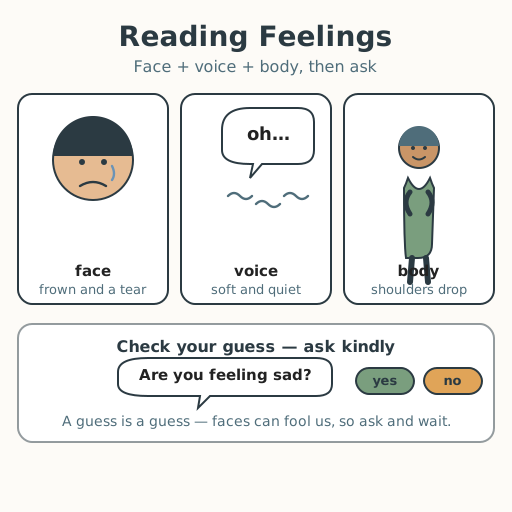
- Three clues (10 min). Feelings show up in three places: your face (a smile, a frown), your voice (loud, soft, shaky), and your body (jumping, curled up, arms crossed). Meet the feeling cards and say each feeling in all three ways.
- Feeling charades (15 min). One person picks a feeling and shows it with face, voice, and body — no words. The others guess. Then the actor says if the guess was right.
- Check your guess (10 min). Guess is a guess — faces can fool us. Practice the kind question: “Are you feeling sad?” Ask it with a soft voice and wait for the answer.
- Close (5 min). Remember: to understand a friend, look, listen, and ask. Reading feelings takes all three.
Differentiation
- Support: Limit to two or three feelings; model each clue one at a time. For a learner with low vision, use voice and body only and say the face clue aloud (e.g., “her mouth is smiling”).
- Extension: Have learners show the same feeling two different ways (a quiet sad and a loud sad) and discuss how feelings are not all one shape.
Assessment
- Formative (observation): Can the learner point to the face, voice, or body clue that reveals a feeling?
- Peer (guess-and-check): Did the learner check their guess by asking the actor?
Resources
- CASEL SEL Framework (social awareness and relationship skills): https://casel.org/fundamentals-of-sel/