Lesson 06 — My Communities
Learners name the communities they belong to — family, class, neighborhood, and more — and see that families and communities come in many shapes, all real and worthy of honor.
Objectives
Objectives
- D02.S3.01.01 Name several communities they belong to, such as family, class, and neighborhood.
Essential question
What communities do I belong to?
Key vocabulary
Materials
Standard materials
- Large paper circles or a community web · 1 per learner Circles for drawing the groups one belongs to, or one big yarn web for the class
- Crayons and yarn · per learner Crayons for drawing; yarn for weaving a shared web
Low-tech / no-cost
- Drawn in the dirt or sand Draw circles in the ground and place pebbles for each community
- Voices only Name and talk about each community aloud with no drawing at all
Enriched / lab & device
- Photos from home (optional, shared with care) · per learner Learners may bring or draw a picture of a community they belong to
- Class map or large mural paper · 1 A big mural where the whole class maps its many communities together
Works in different contexts
- large-group Build one big class web of yarn, each learner holding the thread and naming a community they belong to
- self-directed A learner draws three or more circles — family, class, neighborhood — and writes or draws one thing inside each
- outdoor-only Draw circles in the dirt and place a pebble, leaf, or seed for each community you belong to, then name them aloud
- multi-age Older learners help younger ones write the name of each community inside their circles
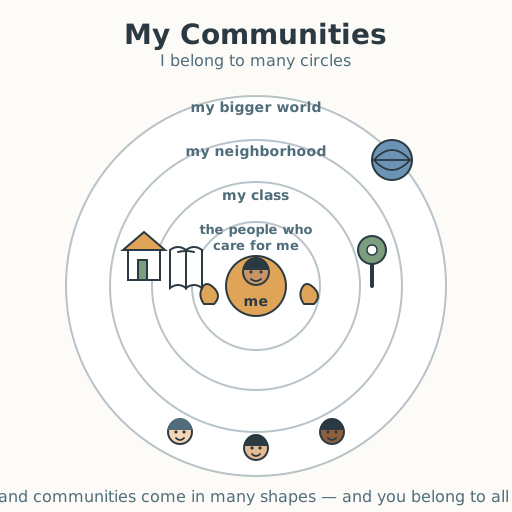
Lesson 6 — My Communities
Summary
Learners name several communities they belong to and draw them in circles or a web. They discover that “family” and “community” come in many shapes — and that every shape is a real family, a real community.
Objectives
- Name several communities they belong to, such as family, class, and neighborhood. (D02.S3.01.01)
Connection
You are never just one person alone — you belong to groups. The people you live with, your class, the place where you live, a team or a place of worship: each is a community you are part of. Belonging to many groups at once is what makes your world rich.
Materials
- Large paper circles or a community web
- Crayons and yarn
Preparation
- Arrange a space for drawing (tables or floor).
- Prepare one large circle per learner, or one big yarn web for the whole class.
Facilitator note
Never define “family” as one shape (two parents, or any single model). Honor every shape — a grandparent raising a child, an aunt, siblings, foster or chosen family, a classroom that feels like family. Some learners may not want to share private family details; drawing and sharing are always optional. Say “the people who care for you” as one open way to name family. Read the procedure aloud.
Procedure
- Gather (5 min). Sit in a circle. Think: what groups are you part of? You belong to more than one!
- Meet the word “community” (10 min). A community is a group of people who belong together. Name some: your family — the people who care for you — your class, your neighborhood, a team, a place you go with others. Share one you belong to.
- Draw your communities (15 min). Draw a circle for each community you belong to. Inside each circle, draw or write who is in it. How many circles do you have?
- Weave a web (10 min). As a class, hold a piece of yarn. Name a community and pass the yarn. Watch the web grow — many communities, one connected class.
- Close (5 min). Remember: families and communities come in many shapes. Every one of them counts, and you belong to all of yours.
Differentiation
- Support: Provide three pre-drawn circles labeled with picture prompts (home, school, neighborhood).
- Extension: Invite learners to add one more community (a team, a place of worship, a group of friends) and share what makes it special.
Assessment
- Formative (observation): Can the learner name at least two or three communities they belong to?
- Artifact (portfolio): The community circles drawing, kept in the learner’s portfolio.