Lesson 07 — What We Do Together
Learners describe one thing a community does together and one way they help out, and see that communities are made strong by everyone's small acts of care.
Objectives
Objectives
- D02.S3.01.02 Describe one thing each community does together and one way they help out.
Essential question
What do my communities do together, and how do I help?
Key vocabulary
Materials
Standard materials
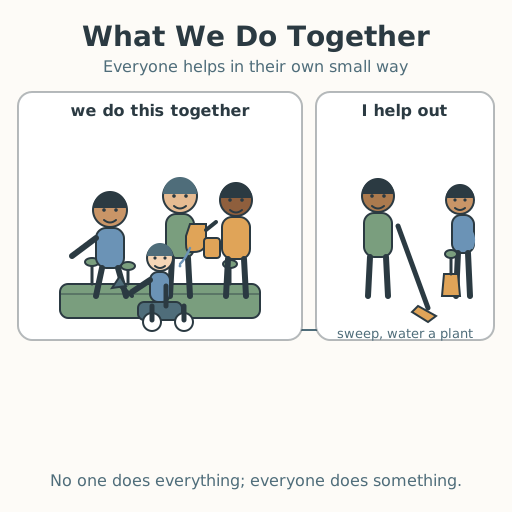
- "Together / help out" chart · 1 Two columns for listing what a community does together and how each person helps
- Crayons and paper · per learner
Low-tech / no-cost
- Talk and act it out Name and act out "together" and "help out" with voices and bodies; no chart needed
- A found object for each job Use real objects (a broom, a bowl, a book) to show a way people help
Enriched / lab & device
- Photos of community work · 1 set Pictures of people planting, cooking, cleaning, or celebrating together, from varied places
- Camera or tablet · 1 per group Photograph one way learners help in class to build a class "helping" poster
Works in different contexts
- large-group Build one shared two-column chart; each learner adds a "together" and a "help out" from their own community
- self-directed A learner picks one community and draws or writes one thing it does together and one way they help out
- outdoor-only Walk the school or neighborhood and name what people do together (plant, sweep, build) and how a child could help
- multi-age Older learners interview younger ones about what their families do together and record it on the chart
Lesson 7 — What We Do Together
Summary
Learners choose one community they belong to, describe one thing the group does together, and name one way they help out. They discover that a community is kept strong by many small acts of care, not by one big hero.
Objectives
- Describe one thing each community does together and one way they help out. (D02.S3.01.02)
Connection
Communities do things together: a family shares a meal, a class learns, a neighborhood keeps a place clean or celebrates a festival. And in every community, each person helps in their own small way. All those small helps are what hold a community together.
Materials
- A “Together / help out” chart
- Crayons and paper
Preparation
- Draw a two-column chart: “What we do together” and “How I help out.”
- Arrange a space for drawing and sharing.
Facilitator note
Keep “help out” concrete and small — wiping a table, watering a plant, carrying groceries, feeding a pet — so every learner can see their own place in it. Honor that some families do paid work and some do care work at home; both are real help. Connect care for shared spaces to caring for the Earth where it arises. Read the procedure aloud; help learners fill in the chart.
Procedure
- Gather (5 min). Sit in a circle. Think: what is one thing your family or class does all together?
- Together and help out (10 min). Look at the chart. “Together” is what the group does (eat, learn, clean, celebrate). “Help out” is what one person does to make it happen (set the table, water the plant, sweep). Name one of each for one community.
- Choose and share (15 min). Pick one community you belong to. Tell a partner: one thing we do together, and one way I help out.
- Draw it (10 min). Draw your community doing its thing together, with you in the picture helping out. Show yourself helping out in the picture.
- Close (5 min). Remember: no one does everything; everyone does something. Small helps make a strong community.
Differentiation
- Support: Provide sentence frames: “My ___ does ___ together. I help by ___.”
- Extension: Ask learners to name a second community and compare how the two help out differently.
Assessment
- Formative (observation): Can the learner name one “together” and one “help out” for a community?
- Artifact (portfolio): The “together and helping” drawing, kept in the learner’s portfolio.