Lesson 08 — Offering Help
Learners practice noticing when a classmate is struggling and offering help before being asked — while learning to offer, not take over, and to accept a kind "no, thank you."
Objectives
Objectives
- D02.S4.01.01 Offer help to a classmate who is struggling, without being asked.
Essential question
How can I offer help without being asked?
Key vocabulary
Materials
Standard materials
- "Struggle" scene cards · 1 set A heavy bag, a stuck zipper, a puzzle piece that will not fit, a friend who cannot reach
- Paper and crayons · per learner
Low-tech / no-cost
- Acted-out struggles Act out a struggle with bodies and voices; no cards needed
- Real classroom help Use a real moment of struggle in the room as the practice scene
Enriched / lab & device
- Short video or story clip · 1 A brief clip of someone noticing another struggling and offering help
- Camera or tablet · 1 per group Film a kind offer of help and replay it to notice what worked
Works in different contexts
- large-group Show a struggle scene to the whole group and have several learners practice different ways to offer help to the "struggling" actor
- self-directed A learner looks at a struggle scene and writes or draws three kind ways to offer help
- outdoor-only Notice real struggles outdoors (carrying, climbing, finding) and practice offering help on the spot
- multi-age Older learners set up a small struggle (a tricky task) and younger learners practice noticing and offering help
Lesson 8 — Offering Help
Summary
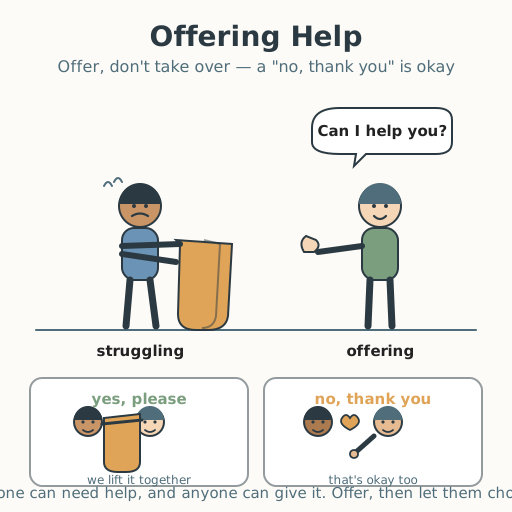
Learners practice the two steps of offering help: notice that someone is struggling, then offer kindly before being asked. They learn that help should be offered, not forced, and that “no, thank you” is always an okay answer.
Objectives
- Offer help to a classmate who is struggling, without being asked. (D02.S4.01.01)
Connection
Sometimes a friend does not ask for help — maybe they are shy, or they think they should manage alone. When you notice and offer first, you give a gift before it is requested. Offering help is how care becomes action between people.
Materials
- “Struggle” scene cards (heavy bag, stuck zipper, tricky puzzle, out-of-reach shelf)
- Paper and crayons
Preparation
- Arrange a circle for gathering and open floor space for acting.
- Set out the scene cards.
Facilitator note
This lesson is about mutual aid, not pity or rescuing. Teach the difference between offering help (“Can I help you?”) and taking over (grabbing the bag). Honor “no, thank you” — consent matters even in helping. Emphasize that anyone can need help and anyone can give it; helping is not a sign of weakness. Read the procedure aloud; model a gentle offer.
Procedure
- Gather (5 min). Sit in a circle. Think: have you ever struggled with something and wished someone would notice?
- Notice the struggle (10 min). Look at the scene cards. A struggle is when someone is trying and it is hard. Say what you notice: “I see someone trying to carry a heavy bag.”
- Offer, don’t take over (15 min). Practice the kind offer: “Can I help you with that?” Offer, then wait for an answer. Do not grab or do it for them. Practice hearing “yes, please” and “no, thank you” — both are fine.
- Help practice (10 min). In pairs, one partner acts out a struggle, the other notices and offers help. Swap roles.
- Close (5 min). Remember: anyone can need help, and anyone can give it. Notice first, offer kindly, and let the other person choose.
Differentiation
- Support: Give a scripted two-line exchange to practice; model waiting for an answer. A learner with limited movement can name, point to, or sign a kind offer while a partner acts it out — the offer is what matters, not the lifting.
- Extension: Ask learners to practice offering help to an adult in a respectful way, and discuss when adults need help too.
Assessment
- Formative (observation): Does the learner notice a struggle and offer help before being asked, and wait for the answer?
- Peer (partner check): Partners name one kind offer they heard.
Resources
- CASEL SEL Framework (relationship skills and responsible decision-making): https://casel.org/fundamentals-of-sel/