Lesson 10 — Reading Back What I Wrote
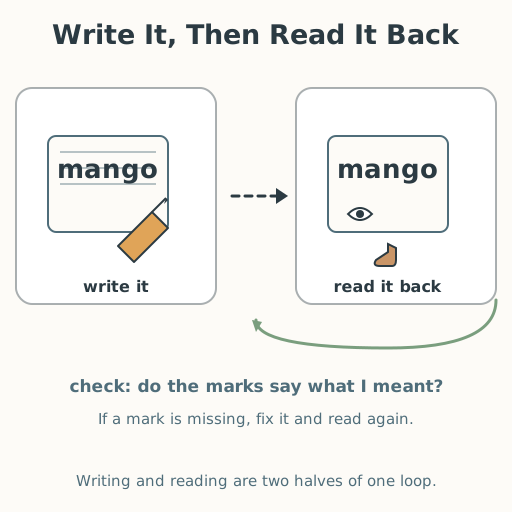
Learners write a simple word, then read it back, checking that the marks match what they meant — completing the loop between writing and reading.
Objectives
Objectives
- D04.S3.01.01 Write letters and simple words to express an idea, and read back what they wrote.
Essential question
How do I read back what I wrote, and check that it says what I meant?
Key vocabulary
Materials
Standard materials
- The learner's own written words from a previous day · 1 per learner Or time to write fresh words today
- A pointer or finger · 1 To point under each mark while reading back
Low-tech / no-cost
- Marks written in sand or on the ground Write and read back using only a stick and earth
- Voice only Point in the air at an invisible word while reading it back aloud
Enriched / lab & device
- A personal writing journal · 1 per learner A place to keep written words and read them back across the year
- A recording device · 1 Record the read-back so learners hear their own reading of their own writing
Works in different contexts
- large-group Invite a few learners to read their own word back to the group while pointing to each mark; the group confirms what it says
- self-directed A learner writes a word, points under each mark, reads it back aloud, and checks the meaning against a picture
- outdoor-only Write a word in the dirt, then read it back to a partner, pointing at each mark as you go
Lesson 10 — Reading Back What I Wrote
Summary
Learners write a simple word or two, then read them back, checking that the marks say what they meant. Reading back closes the loop between writing and reading and builds confidence that their marks carry meaning.
Objectives
- Write letters and simple words to express an idea, and read back what they wrote. (D04.S3.01.01)
Connection
A word you write is a message you send — to a reader, or to your future self. But a message only works if you can read it back and see your idea still there. Reading back is like checking a wrapped gift before giving it: you look to be sure what is inside is what you meant to give.
Materials
- The learner’s own written words (from a previous day, or written fresh today)
- A pointer or finger
Preparation
- Gather the learners’ previously written words, or plan time to write fresh ones.
- Have a pointer or finger ready for tracking.
- Plan to model reading back one word.
Facilitator note
This lesson is written to the learner (“you”) so it works in a classroom and for a self-directed learner. Model reading back a word while pointing to each mark, then guide practice. Celebrate the connection between writing and reading — a learner reading their own marks is a milestone. Do not grade handwriting or spelling here; the goal is that the writer can read their own writing and confirm its meaning. A learner may have composed their word by dictating to a scribe, typing, or choosing marks — reading back that word is still reading their own writing, and it counts equally.
Procedure
- Gather (5 min). Look at a word you wrote before. Can you still tell what it says? Today you will read your own writing back.
- Watch a read-back (5 min). Watch a word being read back: a finger points under each mark, and the voice says the sounds or syllables in order, then the whole word.
- Write fresh (10 min). Write one or two words you know — a thing you like, a place, a person. Write slowly and carefully.
- Read it back (15 min). Point under each mark of your word and read it back aloud, just like the model. Then say what the word means. Check: do the marks say what you meant? If a mark is missing or mixed up, fix it and read again.
- Read to a partner (5 min). Read your word to a partner. Let them check too: does it match what you say it means?
- Close (5 min). You wrote it, and you read it — the marks you made carry your idea. That is reading and writing, working together.
Differentiation
- Support: Read back a single word together, pointing for the learner, then let them try alone.
- Extension: Read back two words in a row and say them as a little sentence.
Assessment
- Formative (self): Can the learner read back their own written word and confirm its meaning, fixing it if needed?
Home connection
Write a word, leave it somewhere a family member will find it, and read it to them when they do.