Lesson 11 — A Complete Sentence
Learners learn the three parts of a complete written sentence — a capital letter, a full thought, and an end mark — and practice fixing broken sentences.
Objectives
Objectives
- D04.S3.01.02 Compose one or more complete sentences about a topic or picture, using a capital letter and an end mark.
Essential question
What makes a written sentence complete — a capital letter, a full thought, and an end mark?
Key vocabulary
Materials
Standard materials
- Example sentences written large · 1 set One correct sentence and one "broken" sentence missing a capital or end mark
- Sentence-fixing strips · 1 set Sentences with a missing capital or end mark for learners to fix
Low-tech / no-cost
- Sentences written on the board or in the dirt No printed strips needed; fix them with a stick or finger
- Voice and gestures Punch the air for the capital, tap for the end mark
Enriched / lab & device
- Magnetic sentence kits · 1 per pair Movable words, capital letters, and end marks to build and fix sentences
- A whiteboard per pair · 1 For writing and fixing sentences wipe-clean
Works in different contexts
- large-group Fix a sentence together on the board, the whole group calling out where the capital and end mark should go
- self-directed A learner looks at each sentence strip, finds what is missing, and rewrites it complete
- outdoor-only Write a broken sentence in the dirt, then "plant" a capital at the start and a pebble as the end mark
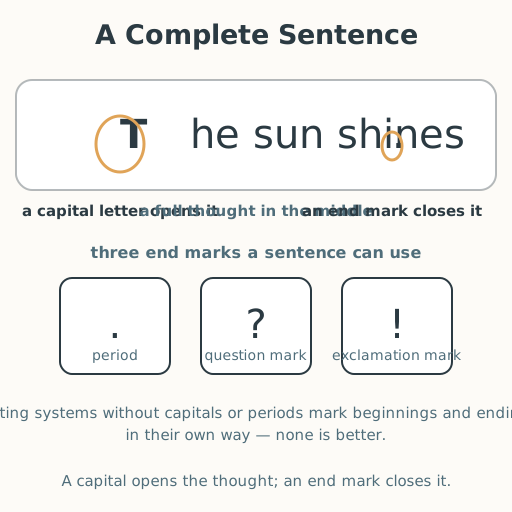
Lesson 11 — A Complete Sentence
Summary
Learners learn that a complete written sentence has three parts: a capital letter at the start, a full thought, and an end mark. They practice finding what is missing and fixing broken sentences.
Objectives
- Compose one or more complete sentences about a topic or picture, using a capital letter and an end mark. (D04.S3.01.02)
Connection
A written sentence is like a package with a clear start and a clear finish. The capital letter is the lid you open at the top, and the end mark is the bottom that tells you the sentence is done. Without them, a reader does not know where a thought begins or ends — like a road with no signs. Today you will learn to mark the start and the finish of a sentence.
Materials
- Example sentences written large (one complete, one “broken”)
- Sentence-fixing strips
Preparation
- Write one complete sentence and one broken sentence (missing capital or end mark) large.
- Prepare fixing strips with missing capitals or end marks.
- Plan to model fixing one sentence.
Facilitator note
This lesson is written to the learner (“you”) so it works in a classroom and for a self-directed learner. Note a small truth with care: the “capital letter and end mark” convention belongs to writing systems that use case and punctuation — honor that other writing systems signal beginnings and endings differently, and never rank them. Teach the learner’s own system’s conventions, with explicit modeling and guided practice (philosophy §13). Keep it concrete and playful. A learner may “fix” a sentence by dictating to a scribe, choosing a capital or end-mark card, typing, or using a gesture (punch the air for the capital, tap for the end mark) — the convention, not the handwriting, is the goal.
Procedure
- Gather (5 min). Look at two sentences: one complete, one broken. Can you spot the difference?
- Meet the three parts (10 min). A complete sentence has three parts: a capital letter to open it, a full thought in the middle, and an end mark — a period (.), a question mark (?), or an exclamation mark (!) — to close it. Say the three parts and point to each in the complete sentence.
- Find what is missing (10 min). Look at the broken sentence. Is the first letter a capital? Is there an end mark? Point to what is missing.
- Fix the sentence (15 min). Take a fixing strip. Find the missing capital or end mark, write it in, and read the complete sentence aloud. Do this for a few sentences, alone or with a partner.
- Close (5 min). A capital opens the sentence and an end mark closes it. Now your readers will know exactly where your thought starts and ends.
Differentiation
- Support: Fix only the missing end mark today, with the capital already in place; point and read together.
- Support (motor-limited): Fix the sentence by dictating to a scribe, choosing a capital or end-mark card, or using a gesture for each part.
- Extension: Fix sentences missing both a capital and an end mark, and choose the right end mark (period, question, or exclamation) for each.
Assessment
- Formative (observation): Can the learner identify and add a missing capital letter or end mark to make a complete sentence?
Home connection
Find one written sentence at home (a label, a book, a message) and point to its capital letter and its end mark.