Lesson 08 — Creating Patterns and Telling the Rule
Learners become pattern *makers*: they create their own repeating patterns from objects, sounds, and movements, then tell the rule in words — and translate a pattern from one medium into another, proving the rule stays the same.
Objectives
Objectives
- D05.S2.01.01 Identify, extend, and create repeating patterns using objects, sounds, or colors, and tell the rule of the pattern.
Essential question
How do I make my own repeating pattern, and how do I tell its rule in words?
Key vocabulary
Materials
Standard materials
- Collections of objects in two or three kinds · 1 set per learner or pair Seeds, shells, buttons, beads, or leaves for building original patterns
- Paper or slate and a drawing tool · per learner To record the pattern and write (or draw) its rule
Low-tech / no-cost
- Found objects and the ground Create patterns from stones, leaves, and seeds, and say the rule aloud
- Voice and body Create clap, tap, and movement patterns and tell their rules
Enriched / lab & device
- Beading or weaving materials · per learner or pair Real thread or loom to create a color pattern with a spoken rule
- Pattern rule cards with picture words · 1 set Cards with words like "red, blue" and "big, small" to match a pattern to its rule
Works in different contexts
- large-group Each small group creates a pattern, presents it, and the class calls out the rule together
- self-directed A learner creates a pattern, says its rule aloud, and records both with objects and a drawing
- outdoor-only Create a repeating pattern along a path with natural objects and tell its rule as you walk it
- multi-age Older learners create a pattern and challenge younger ones to name its rule; younger learners create their own to teach back
Lesson 8 — Creating Patterns and Telling the Rule
Summary
Learners become pattern makers. They create their own repeating patterns from objects, sounds, and movements, then put the pattern into words — the rule — and translate a pattern from one medium into another (sound to color, movement to objects), discovering that the rule stays the same even when the materials change.
Objectives
- Identify, extend, and create repeating patterns using objects, sounds, or colors, and tell the rule of the pattern. (D05.S2.01.01)
Connection
A beadworker doesn’t just copy patterns — she invents them and can tell you her rule: “two red, one gold.” A musician makes a rhythm and can tap its rule on her knee. A tile maker designs a new mosaic and can say how it goes. To make a pattern and tell its rule is to be an author of order — and the same rule can be carried from beads into claps into colors, because the rule is the pattern’s heart, not its material.
Materials
- Collections of objects in two or three kinds
- Paper or slate and a drawing tool
Preparation
- Prepare collections with two or three clearly different kinds or colors.
- Plan to model creating a pattern and stating its rule in words.
- Clear space for movement patterns.
Facilitator note
This lesson is written to the learner (“you”). It is the creative side of pattern work: the learner makes the pattern and puts its rule into words. Model one example — create, then state the rule — as a worked example (philosophy §13). The new, powerful idea is translation: a rule like “red, blue, blue” can be clapped as “loud, soft, soft” and stepped as “hop, step, step” — same rule, different material. Celebrate every original pattern; there is no pattern too simple or too strange, and creativity is never ranked. For learners who are Deaf or hard of hearing, use visual and movement patterns and state the rule in sign; for learners who are blind or low-vision, create sound and touch patterns and tell the rule aloud. A learner who does not speak tells the rule by pointing, arranging cards, or demonstrating it. Every learner’s pattern is a work of art and reason.
Procedure
- Gather — recall the core (5 min). Yesterday you found the repeating part of a pattern — its core. Today you become the maker: you create the pattern and tell its rule.
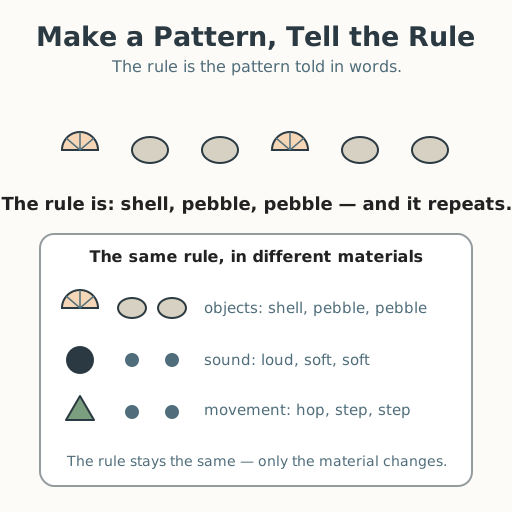
- Worked example — create and name the rule (10 min). Watch and help: choose objects and build a pattern — shell, pebble, shell, pebble. Now say its rule in words: “shell, pebble — and it repeats.” The rule is the pattern told in words.
- Create your own (12 min). Build your own repeating pattern with your objects. Make the core clear, then extend it. When it is done, tell its rule in words: “two seeds, one leaf, and it repeats.”
- Translate your pattern (10 min). Now say your rule a different way. If your rule is “red, blue,” clap it — loud, soft. If your rule is “stone, leaf,” step it — hop, step. The rule stays the same; only the material changes.
- Trade and check (5 min). Show your pattern to a friend. Can they find your rule and say it back? Then try theirs. Agreeing on a rule is how you know your pattern is clear.
- Close (3 min). You are a pattern author. You make the pattern, you say the rule, and you can carry that rule into any material — just as makers do all over the world.
Differentiation
- Support: Create one simple two-part pattern and say the rule together; accept the rule spoken, signed, or shown.
- Support (motor): Create patterns by voice or by directing a partner to place objects; the rule is the learner’s own.
- Extension: Create a three-part pattern, or make two different patterns with the same rule and show how they match.
Assessment
- Formative (observation): Can the learner create a repeating pattern and state its rule in words (or sign)?
- Peer assessment: Can a partner identify and restate the learner’s rule?
Home connection
At home, create a pattern with anything you find — cups, spoons, socks — and teach a grown-up its rule, then see if they can clap the same rule.
Resources
- Clements, D. H., & Sarama, J. (2014). Learning and Teaching Early Math (2nd ed.). Routledge. (Creating and verbalizing repeating patterns as early algebraic reasoning.)