Lesson 09 — Finding the Missing Number
Learners discover how to find a missing number in a number sentence such as 3 + ? = 7 by acting it out with objects and counting on, and they practice explaining how they know — treating the equals sign as a balance that must be fair.
Objectives
Objectives
- D05.S2.01.02 Find the missing number in a simple number sentence such as 3 + ? = 7 and explain how they know.
Essential question
When a number is missing from a number sentence like 3 + ? = 7, how do I find it and explain how I know?
Key vocabulary
Materials
Standard materials
- Small objects · up to 20 per learner or pair Pebbles, seeds, beans, or counters to act out and solve the missing number
- A paper pocket or cup to hide the mystery number · 1 per learner or pair A small cup or folded paper to hide the unknown amount
- Paper or slate and a writing tool · per learner To write the number sentence with the mystery number
Low-tech / no-cost
- Found objects and the ground Hide some objects under a hand or leaf and count on to find how many are hidden
- Fingers and voice Show the known part on fingers and count on to reach the total
Enriched / lab & device
- Number sentence cards with a blank · 1 set Cards like "3 + ☐ = 7" with a blank box for the missing number
- A balance or two-pan scale (optional) · 1 per group To show that both sides of the equals sign must balance
Works in different contexts
- large-group Solve missing-number sentences together with one big class collection, with volunteers moving the objects and the group counting on
- self-directed A learner acts out each sentence with objects, finds the missing number, writes it, and checks by counting on
- outdoor-only Hide a number of stones under a leaf or hand, then count on from the visible part to the total to find the hidden amount
- multi-age Older learners explain the "count on" strategy while younger ones move the objects and find the hidden number together
Lesson 9 — Finding the Missing Number
Summary
Learners discover how to find a missing number in a simple number sentence such as 3 + ? = 7 by acting it out with objects and counting on. They learn to explain how they know, and they come to see the equals sign as a balance — both sides must hold the same amount, just like a fair share.
Objectives
- Find the missing number in a simple number sentence such as 3 + ? = 7 and explain how they know. (D05.S2.01.02)
Connection
Sometimes you know the start and the end but not the middle. A cook knows she needs seven cups of grain for the meal and has measured three — how many more does she scoop? A beadworker has threaded three beads and wants seven on the string — how many beads does she add? The missing number is the “how many more” in the middle, and finding it is like completing a fair balance: what is missing to make both sides the same?
Materials
- Small objects (up to 20)
- A cup or paper pocket to hide the mystery number
- Paper or slate and a writing tool
Preparation
- Prepare several number sentences with a missing number (3 + ? = 7, 5 + ? = 9, 8 − ? = 3, ? + 2 = 6).
- Give each learner or pair objects, a hiding cup, and a writing surface.
- Plan to model one sentence fully before learners try.
Facilitator note
This lesson is written to the learner (“you”). Finding a missing number is a skill, so teach it with a worked example and guided practice (philosophy §13). The two big ideas are (1) counting on from the known part to the total, and (2) the equals sign as a balance — both sides must hold the same, which is also a small, concrete lesson in fairness (ethics). Include missing-addend, missing-subtrahend (8 − ? = 3), and missing-start (? + 2 = 6) forms, but always with objects. The explanation matters as much as the answer — “I know because 3 and 4 more makes 7” is the real learning. For learners who are Deaf or hard of hearing, act out the sentence in sign or with objects; for learners who are blind or low-vision, count on by moving objects and feeling the hidden cup fill. A learner who does not speak shows the missing number by holding up fingers, pointing to a card, or placing the right number of objects. Never rank by speed; a mystery solved with care is a mystery solved.
Procedure
- Gather — recall the two moves (5 min). You can join and take away, and you can write number sentences. Today a number goes missing from the sentence, and you become the detective who finds it.
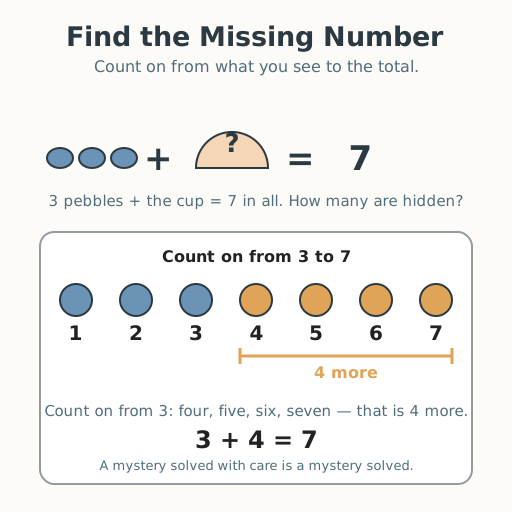
- Worked example — find the missing number (10 min). Look at this sentence: 3 + ? = 7. Put 3 pebbles out. The total must be 7. Count on from 3: four, five, six, seven — that is 4 more. So the missing number is 4: 3 + 4 = 7. Check it: does 3 and 4 make 7? Yes!
- Hide and find (12 min). A friend hides some objects in the cup. You know the total and you can see the part outside. Count on from what you see to the total to find how many are hidden. Write the number sentence with the mystery number filled in.
- Explain how you know (10 min). For each sentence you solve, say how you know: “I counted on from 3 and it took 4 more to reach 7.” Or draw it. Explaining is how a detective proves the case.
- Try a take-away mystery (5 min). Now try 8 − ? = 3. Start with 8, take away until 3 are left — how many did you take? Five! So 8 − 5 = 3.
- Close (3 min). A missing number is just “how many more” or “how many taken.” Find it, and say how you know — that is real reasoning, and it is for everyone.
Differentiation
- Support: Use only missing-addend sentences (3 + ? = 7) with totals under 10; count on together, touching each object.
- Support (motor): A partner moves objects while the learner counts on and directs; use large objects.
- Extension: Write your own missing-number sentence for a friend to solve, and solve sentences where the first number is missing (? + 2 = 6).
Assessment
- Formative (observation): Can the learner find the missing number using objects or counting on, and explain how they know?
- Self-assessment: Can the learner check their own answer by counting on and confirm it reaches the total?
Home connection
At home, play “the hidden beans”: a grown-up hides some beans under a cup, tells you the total, and you count on to find how many are hidden.
Resources
- Carpenter, T. P., Fennema, E., Franke, M. L., Levi, L., & Empson, S. B. (2015). Children’s Mathematics: Cognitively Guided Instruction (2nd ed.). Heinemann. (Missing-addend and missing-number problems and children’s counting-on strategies.)