Lesson 10 — Flat Shapes: Compose and Take Apart
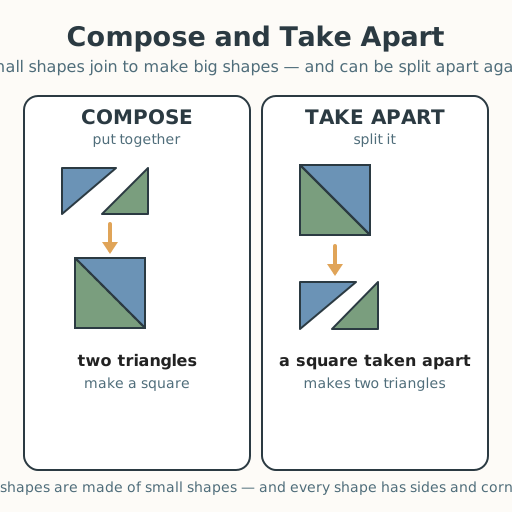
Learners discover that flat shapes are made of sides and corners, and that small shapes can be composed into bigger shapes and taken apart again — two triangles make a square or a bigger triangle. They build with cut shapes and sticks, then trace the parts.
Objectives
Objectives
- D05.S3.01.01 Compose and take apart two- and three-dimensional shapes and describe their sides, corners, and faces.
Essential question
How do small flat shapes fit together to make bigger shapes, and how do I take a shape apart?
Key vocabulary
Materials
Standard materials
- Cut-out flat shapes · 1 set per learner or pair Triangles, squares, and rectangles cut from paper, card, or leaves, in several sizes
- Paper or slate and a drawing tool · per learner To draw the shape built and trace its parts
Low-tech / no-cost
- Sticks, straws, or plant stems Build flat shapes by laying sticks edge to edge on the ground
- The ground and a stick Draw shapes in the dirt and divide them into smaller shapes with a line
Enriched / lab & device
- A tangram-style puzzle set · 1 per learner or pair Seven flat pieces (the Chinese tangram) to compose and take apart many shapes
- Pattern blocks · 1 set per pair Triangles, squares, and hexagons to combine into larger shapes
Works in different contexts
- large-group Build one large shape on the floor as a class, each learner adding a piece, then count its sides and corners together
- self-directed A learner composes a big shape from small ones, takes it apart again, and records both by drawing
- outdoor-only Build flat shapes from sticks and stones on the ground, then split them with a line into smaller shapes
- multi-age Older learners name the shapes and count sides and corners while younger ones place the pieces
Lesson 10 — Flat Shapes: Compose and Take Apart
Summary
Learners discover that flat shapes have sides and corners, and that small shapes can be composed (put together) into bigger shapes and taken apart again — two triangles make a square, two squares make a rectangle. They build with cut shapes and sticks, then trace the parts to see the whole.
Objectives
- Compose and take apart two- and three-dimensional shapes and describe their sides, corners, and faces. (D05.S3.01.01)
Connection
A tiler fits small square tiles into one big floor; a quilt maker sews triangles into a square; a child breaks a cracker into two halves and sees how the pieces once made a whole. From Chinese tangram puzzles to African patchwork and Islamic tile mosaics, people everywhere build big shapes out of small ones — and take them apart again. That is the geometry of making and unmaking.
Materials
- Cut-out flat shapes (triangles, squares, rectangles) in several sizes
- Paper or slate and a drawing tool
Preparation
- Cut or gather flat shapes — triangles, squares, rectangles — in a few sizes.
- Prepare sticks or stems for building shapes with edges.
- Plan to model composing one shape and taking it apart.
Facilitator note
This lesson is written to the learner (“you”). It spirals up from Kindergarten’s “name and match shapes” to composing and taking apart shapes and describing their sides and corners — the new skill. Teach with a worked example (philosophy §13): place two triangles to make a square, then pull them apart again. Use the language of sides and corners with real shapes in hand. Honor geometry from many traditions — the tangram (China), patchwork quilts, and tile mosaics — without ranking any. For learners who are blind or low-vision, use tactile shapes (cut from thick card, felt, or wood) and trace sides and corners with the fingers; for learners who are Deaf or hard of hearing, name shapes in sign and count sides with the hands. A learner who does not speak points to sides and corners or traces them. Geometry is exploration, not a contest of speed.
Procedure
- Gather — recall shapes (5 min). Last year you named shapes — circles, squares, triangles. Today we learn their secret: shapes are made of sides and corners, and small shapes can join to make big ones.
- Worked example — compose a shape (10 min). Watch and help: take two triangles. Put their straight edges together. What do you get? A square! Count its sides (four) and corners (four). Now pull the two triangles apart — the square is taken apart back into triangles.
- Build big shapes (12 min). With your cut shapes, compose a bigger shape. Two squares make a rectangle; two triangles make a bigger triangle. Count the sides and corners of your new shape. What did you make, and what did you make it from?
- Take apart and trace (10 min). Take your big shape apart into its pieces. Draw the big shape, then draw a line to show how it splits into its smaller shapes. Where did the parts fit?
- Build with sticks (5 min). Lay sticks edge to edge to make a triangle, a square, and a rectangle on the ground. How many sticks is each side?
- Close (3 min). Big shapes are made of small shapes, and every shape is made of sides and corners. To compose is to build; to take apart is to see how it was built.
Differentiation
- Support: Compose just one shape (two triangles into a square) and trace it; count sides and corners together.
- Support (blind/low-vision): Use thick tactile shapes; “compose” by fitting raised pieces together and tracing their edges.
- Extension: Use a tangram set to compose several different shapes (a boat, a bird, a house) from the same seven pieces, and draw what you made.
Assessment
- Formative (observation): Can the learner compose a bigger shape from small shapes, take it apart again, and describe its sides and corners?
Home connection
At home, cut a paper square into two triangles and fit them back together, then show a grown-up how the small shapes made the big one.
Resources
- Clements, D. H., & Sarama, J. (2014). Learning and Teaching Early Math (2nd ed.). Routledge. (Composing and decomposing shapes as foundational spatial reasoning.)
- Van de Walle, J. A., Karp, K. S., & Bay-Williams, J. M. (2019). Elementary and Middle School Mathematics (10th ed.). Pearson. (Shape composition and the properties of sides and vertices.)