Lesson 11 — Solid Shapes: Faces, Sides, and Corners
Learners meet solid (three-dimensional) shapes — cubes, spheres, cylinders, cones, and boxes — and learn to find and count their faces, sides, and corners by feeling real objects and tracing flat faces, connecting 3D shapes to the flat shapes they already know.
Objectives
Objectives
- D05.S3.01.01 Compose and take apart two- and three-dimensional shapes and describe their sides, corners, and faces.
Essential question
What makes a solid shape solid, and how do I find its faces, sides, and corners?
Key vocabulary
Materials
Standard materials
- Solid shapes or everyday objects · 1 set per learner or pair A cube (box or block), a ball (sphere), a can (cylinder), a cone, and a box (rectangular prism)
- Paper or slate and a drawing tool · per learner To trace faces and record shapes found
Low-tech / no-cost
- Found objects A ball, a box, a tin can, a clay or mud ball, and a cone-shaped leaf roll to feel and turn in the hands
- Clay, mud, or dough Roll and pat solid shapes with the hands, feeling faces, edges, and corners
Enriched / lab & device
- Wooden or plastic geometric solids · 1 set per pair Cubes, spheres, cylinders, cones, and prisms for close study
- A "feely bag" of solid shapes · 1 per pair A cloth bag to identify solid shapes by touch alone
Works in different contexts
- large-group Pass one solid shape around the circle and have each learner name one feature — a face, a side, or a corner — as it reaches them
- self-directed A learner studies each solid, counts its faces, sides, and corners, and records the numbers in a drawing or table
- outdoor-only Find solid shapes outdoors — a ball, a log (cylinder), a rock, a hut roof (cone) — and feel their faces, edges, and corners
- multi-age Older learners name the shapes and count faces, sides, and corners while younger ones feel and find each shape
Lesson 11 — Solid Shapes: Faces, Sides, and Corners
Summary
Learners meet solid, three-dimensional shapes — cubes, spheres, cylinders, cones, and boxes — and learn to find their faces (flat parts), sides (edges), and corners (vertices) by feeling real objects and tracing their faces. They connect solid shapes to the flat shapes they already know.
Objectives
- Compose and take apart two- and three-dimensional shapes and describe their sides, corners, and faces. (D05.S3.01.01)
Connection
A ball you can roll is a sphere; a box of tea is a box-shaped solid; a cooking pot is a cylinder; the roof of a hut or tent can be a cone. Solid shapes are the shapes that fill space — they have a flat part you can trace (a face), an edge you can run your finger along (a side), and a pointy or square meeting place (a corner). Builders, potters, and basket makers in every land work with solid shapes every day.
Materials
- Solid shapes or everyday objects (a block, a ball, a can, a cone, a box)
- Paper or slate and a drawing tool
Preparation
- Gather solid shapes or everyday objects for each learner or pair.
- Have flat shapes from the last lesson ready to compare.
- Plan to model feeling and counting faces, sides, and corners on one solid.
Facilitator note
This lesson is written to the learner (“you”). It extends the last lesson’s flat shapes into solids, and the new skill is finding and counting faces, sides (edges), and corners (vertices). Teach with a worked example (philosophy §13): feel a cube, count its six square faces, twelve edges, and eight corners. Connect each solid to a flat shape — the cube’s face is a square, the cylinder’s face is a circle. Use everyday objects (boxes, balls, cans, clay) so the lesson is universally available. For learners who are blind or low-vision, this lesson is naturally rich — the hands are the tool; pass each solid and let the learner feel faces, edges, and corners, and use a “feely bag.” For learners who are Deaf or hard of hearing, name shapes in sign and count features with the hands. A learner who does not speak traces or points to each feature. Solid shapes are felt, not just seen — every body can study them.
Procedure
- Gather — recall flat shapes (5 min). Yesterday you built flat shapes with sides and corners. Today we meet shapes you can hold — solid shapes that fill space, like a ball or a box.
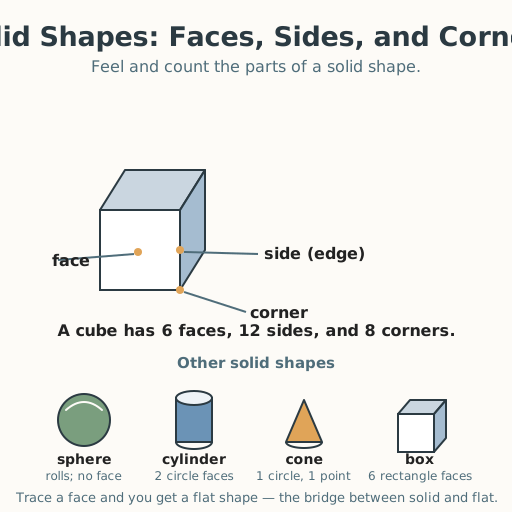
- Worked example — feel a cube (10 min). Watch and help: take a block (a cube). Run your finger over its flat part — that is a face; a cube has six faces, each one a square. Feel where two faces meet — that is a side (edge). Feel where sides meet — that is a corner. Count them: six faces, twelve sides, eight corners.
- Feel each solid (12 min). Hold each shape: a ball (sphere — no flat faces, no corners; it rolls), a can (cylinder — two circle faces and one curved side), a cone (one circle face, one point), a box (rectangular prism — six rectangle faces). Count each one’s faces, sides, and corners.
- Trace a face (8 min). Set a solid on paper and trace one of its faces. What flat shape did you draw? A cube’s face traces a square; a cylinder’s face traces a circle. The flat face is the bridge between solid and flat shapes.
- Find solids around you (5 min). Look around the room or outdoors. Point to one sphere, one cube or box, one cylinder, and one cone. Name its faces, sides, and corners.
- Close (3 min). Solid shapes fill the world — and every solid can be described by its faces, sides, and corners. Now you can see and feel that structure.
Differentiation
- Support: Study just two solids (a cube and a ball); count one feature at a time, hand-over-hand if needed.
- Support (blind/low-vision): Use a feely bag to identify each solid by touch and count its features with the fingers.
- Extension: Count and record the faces, sides, and corners of every solid in a simple table, and find a solid with a feature no other has.
Assessment
- Formative (observation): Can the learner identify a solid shape and describe its faces, sides, and corners by feel or sight?
Home connection
At home, go on a “solid shape hunt” with a grown-up: find a ball, a box, a can, and a cone, and count the faces, sides, and corners of each together.
Resources
- Van de Walle, J. A., Karp, K. S., & Bay-Williams, J. M. (2019). Elementary and Middle School Mathematics (10th ed.). Pearson. (Three-dimensional shape attributes — faces, edges, and vertices.)