Lesson 12 — Measuring and Comparing Lengths
Learners discover that length is measured by laying equal-size units end to end and counting them, using hand spans, footsteps, and same-size objects. They compare lengths with "longer," "shorter," and "the same," and learn why units must match.
Objectives
Objectives
- D05.S3.01.02 Measure and compare lengths using non-standard units such as hand spans or paper clips.
Essential question
How do I measure how long something is, and how do I say which of two things is longer?
Key vocabulary
Materials
Standard materials
- Non-standard measuring units · 1 set per learner or pair Paper clips, same-size sticks, beans, or hand spans and footsteps
- Objects to measure · 3-4 per learner or pair A book, a pencil, a strip of cloth, a stick — things of different lengths
- Paper or slate and a drawing tool · per learner To record measurements and compare
Low-tech / no-cost
- Hands, feet, and the body Measure with hand spans, finger widths, and footsteps — the body is the measuring tool
- Found objects and the ground Measure lengths with same-size sticks, stones, or seeds laid end to end
Enriched / lab & device
- Linking cubes or paper-clip chains · 1 set per learner or pair Uniform units that clip together for measuring and comparing
- A strip marked in hand spans · 1 per pair To see how repeated units line up along a length
Works in different contexts
- large-group Measure the length of the room or the circle with the whole class's footsteps, counting together, then compare two distances
- self-directed A learner measures several objects with one kind of unit, records the counts, and orders them longest to shortest
- outdoor-only Measure a path, a stick, or a shadow with footsteps, hand spans, or same-size stones laid end to end
- multi-age Older learners record the numbers while younger ones lay the units end to end and count, then together compare lengths
Lesson 12 — Measuring and Comparing Lengths
Summary
Learners discover that to measure length you lay equal-size units end to end and count them, using hand spans, footsteps, and same-size objects. They compare lengths with “longer,” “shorter,” and “the same,” and discover why the units must match — a lesson in fairness and agreement as much as in measuring.
Objectives
- Measure and compare lengths using non-standard units such as hand spans or paper clips. (D05.S3.01.02)
Connection
Long before rulers, people measured with their own bodies: the cubit (elbow to fingertip) in ancient Egypt and Mesopotamia, the foot in Rome, the hand span in many lands, the pace everywhere people walk. A fisher measures her net, a builder measures his beam, a weaver measures her cloth. The secret is always the same: choose a unit, lay it end to end, and count. That is how everyone, everywhere, has made length something two people can agree on.
Materials
- Non-standard measuring units (paper clips, same-size sticks, beans)
- Objects to measure (a book, a pencil, a strip of cloth, a stick)
- Paper or slate and a drawing tool
Preparation
- Gather same-size units and several objects of different lengths.
- Clear floor space for measuring with footsteps.
- Plan to model measuring one object, laying units end to end with no gaps.
Facilitator note
This lesson is written to the learner (“you”). The one big idea is unit iteration — laying equal units end to end, with no gaps or overlaps, and counting them. Teach it as a worked example (philosophy §13), then let learners measure and compare. The historical fact that many cultures used body measures (cubit, foot, hand span) is offered as shared human heritage, not as a reason to rank any system. A wonderful, natural discovery is that units must match — one person’s hand span differs from another’s, so we agree on one unit to be fair; this is egalitarianism made concrete. For learners who are blind or low-vision, measuring by touch is ideal — lay sticks or count hand spans along an object and count by feel; for learners who are Deaf or hard of hearing, measure and count in sign or by touch. A learner who does not speak shows the count on fingers or by placing a number card. Everyone measures with their own body, and no body’s measure is “wrong.”
Procedure
- Gather — recall shapes and building (5 min). You have built and described shapes. Today we measure how long things are — a skill people have used since before written numbers.
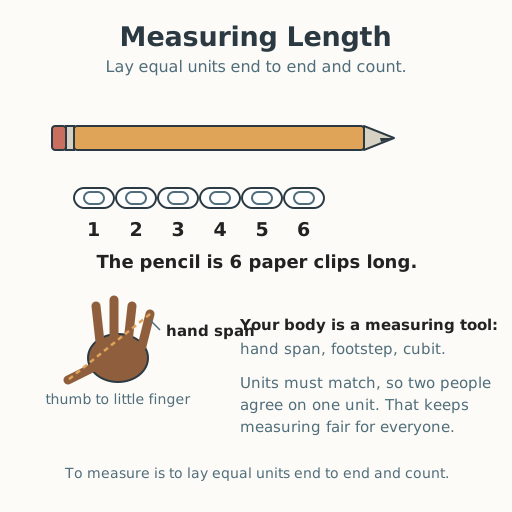
- Worked example — measure with a unit (10 min). Watch and help: lay paper clips (or sticks) end to end along a pencil, touching but not overlapping. Count them: one, two, three … six. The pencil is six paper clips long. Say it: “The pencil is six paper clips long.”
- Measure with your body (10 min). Try your hand span: the distance from your thumb to your little finger when your hand is open. How many hand spans long is your book? Now use footsteps: how many steps across the room? Count aloud as you go.
- Measure and record (10 min). Measure each of your objects with one kind of unit. Write or draw each length. Which object is longer? Which is shorter? Are any the same length?
- Compare with a friend (7 min). You and a friend measure the same object. Did you get the same number? If you used your own hand spans, maybe not — your hands are different sizes! This is why people agree on one shared unit: so measuring is fair for everyone.
- Close (3 min). To measure is to lay equal units end to end and count. To compare is to ask: longer, shorter, or the same? And a shared unit keeps measuring honest.
Differentiation
- Support: Measure one object with one unit and count together; use big, easy units like whole hand spans.
- Support (motor): A partner lays the units while the learner counts and directs; use large, grippable units.
- Extension: Measure the same object with two different units (hand spans and paper clips) and explain why the numbers differ, or order three objects from shortest to longest.
Assessment
- Formative (observation): Can the learner measure a length by laying equal units end to end and counting them, and compare two lengths with “longer,” “shorter,” or “the same”?
Home connection
At home, measure the length of a bed, a table, or a room with your hand spans or footsteps, and tell a grown-up which is longer and which is shorter.
Resources
- National Research Council. (2009). Mathematics Learning in Early Childhood: Paths Toward Excellence and Equity. The National Academies Press. (Measurement with non-standard units and unit iteration as an early mathematical idea.)
- Van de Walle, J. A., Karp, K. S., & Bay-Williams, J. M. (2019). Elementary and Middle School Mathematics (10th ed.). Pearson. (The principle that units must be equal and laid end to end.)